SOP sample for Australia student visa — genuine student statement
Australia asks for a genuine student statement: 4 answers, up to 150 words each. Three samples, each for a different course:
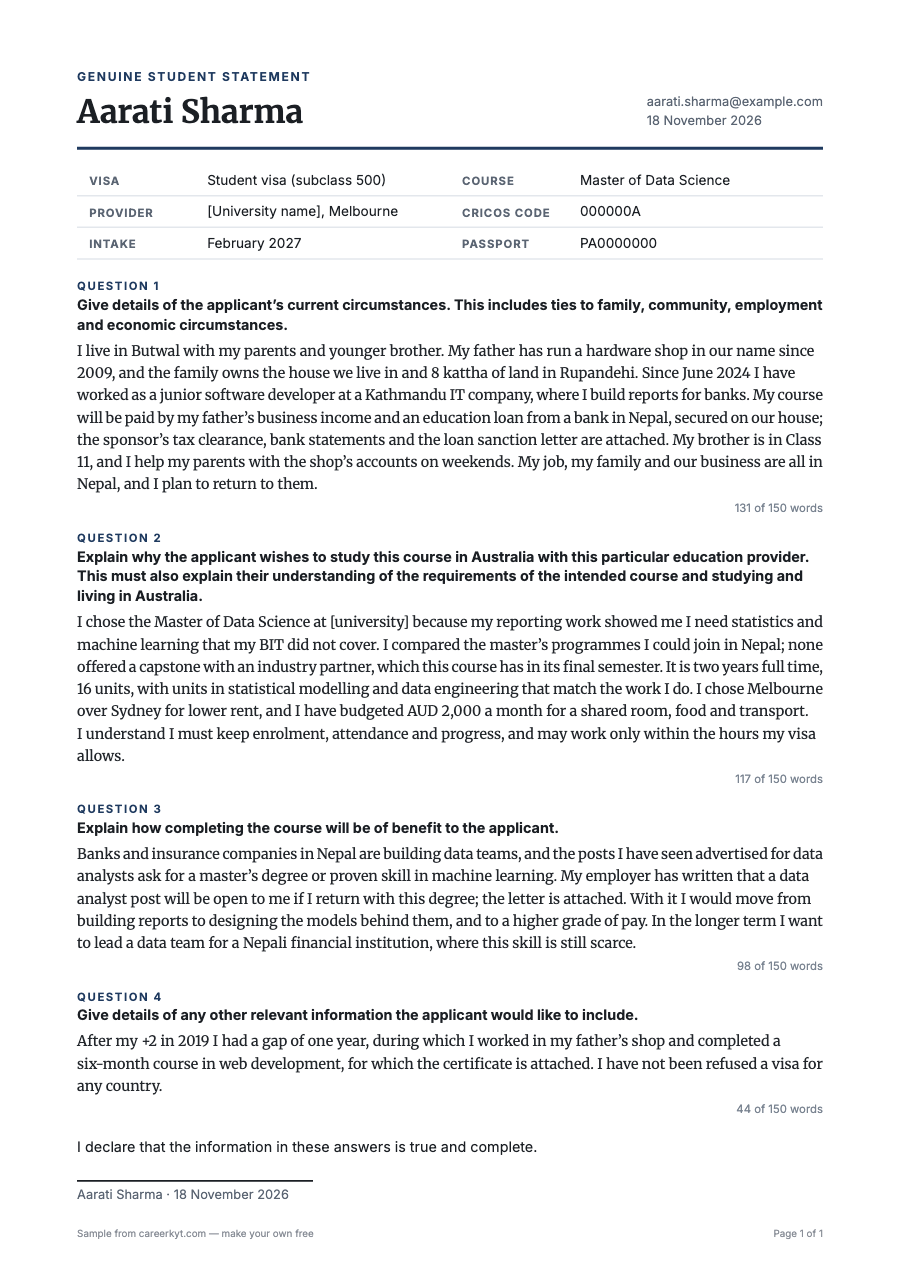
Sample 1: IT · Master of Data ScienceAarati — BIT graduate from Butwal, 18 months as a junior software developer in Kathmandu, applying for a Master of Data Science in Melbourne. · 390 words
Give details of the applicant’s current circumstances. This includes ties to family, community, employment and economic circumstances.
I live in Butwal with my parents and younger brother. My father has run a hardware shop in our name since 2009, and the family owns the house we live in and 8 kattha of land in Rupandehi. Since June 2024 I have worked as a junior software developer at a Kathmandu IT company, where I build reports for banks. My course will be paid by my father’s business income and an education loan from a bank in Nepal, secured on our house; the sponsor’s tax clearance, bank statements and the loan sanction letter are attached. My brother is in Class 11, and I help my parents with the shop’s accounts on weekends. My job, my family and our business are all in Nepal, and I plan to return to them.
Explain why the applicant wishes to study this course in Australia with this particular education provider. This must also explain their understanding of the requirements of the intended course and studying and living in Australia.
I chose the Master of Data Science at [university] because my reporting work showed me I need statistics and machine learning that my BIT did not cover. I compared the master’s programmes I could join in Nepal; none offered a capstone with an industry partner, which this course has in its final semester. It is two years full time, 16 units, with units in statistical modelling and data engineering that match the work I do. I chose Melbourne over Sydney for lower rent, and I have budgeted AUD 2,000 a month for a shared room, food and transport. I understand I must keep enrolment, attendance and progress, and may work only within the hours my visa allows.
Explain how completing the course will be of benefit to the applicant.
Banks and insurance companies in Nepal are building data teams, and the posts I have seen advertised for data analysts ask for a master’s degree or proven skill in machine learning. My employer has written that a data analyst post will be open to me if I return with this degree; the letter is attached. With it I would move from building reports to designing the models behind them, and to a higher grade of pay. In the longer term I want to lead a data team for a Nepali financial institution, where this skill is still scarce.
Give details of any other relevant information the applicant would like to include.
After my +2 in 2019 I had a gap of one year, during which I worked in my father’s shop and completed a six-month course in web development, for which the certificate is attached. I have not been refused a visa for any country.
A made-up student, to show the order and the level of detail. Write your own: the Australia maker asks the same questions and counts as you type.
Sample 2: Nursing · Master of NursingSunita — BSc Nursing graduate from Dharan, registered with the Nepal Nursing Council, 14 months as a staff nurse in Biratnagar, applying for a Master of Nursing in Adelaide. · 335 words
Give details of the applicant’s current circumstances. This includes ties to family, community, employment and economic circumstances.
I live in Dharan with my parents and grandmother. My father teaches at a government secondary school and my mother runs a tailoring shop from our own house. I completed my BSc Nursing in 2024, registered with the Nepal Nursing Council, and since September 2024 I have worked as a staff nurse in the medical ICU of a private hospital in Biratnagar. My course will be paid from my father’s salary, the shop’s income, savings in my parents’ names and an education loan; the salary certificate, tax clearance, bank statements and loan letter are attached. I send part of my salary home each month for my grandmother’s care. My registration, my job and my family are in Nepal.
Explain why the applicant wishes to study this course in Australia with this particular education provider. This must also explain their understanding of the requirements of the intended course and studying and living in Australia.
I chose the Master of Nursing at [university] because ICU work showed me I need advanced assessment and critical-care skills my bachelor’s course covered only briefly. The two master’s programmes I could apply to in Nepal did not offer critical care as a specialisation in my intake year. This course is two years full time and includes supervised clinical practice in hospital settings, which is what I want. I understand that clinical placements need checks and vaccinations before they start, and that attendance at placements is compulsory. I have budgeted AUD 1,800 a month for a shared room near campus, food and transport in Adelaide, and I know my work hours are limited by my visa.
Explain how completing the course will be of benefit to the applicant.
Private hospitals in Nepal are opening more ICU beds, and senior critical-care nurses are few. My hospital has written that it will consider me for an ICU nursing in-charge post when I return with this degree; the letter is attached. The post brings responsibility for a team of nurses and a higher salary grade. In the longer term I want to train new ICU nurses in Koshi Province, where most nurses learn critical care only on the job.
Give details of any other relevant information the applicant would like to include.
I have no study gap. I have not applied for a visa to any other country, and I have not been refused one.
A made-up student, to show the order and the level of detail. Write your own: the Australia maker asks the same questions and counts as you type.
Sample 3: Business · Master of Professional AccountingBikash — BBS graduate from Pokhara, two years as an accounts assistant at a hotel, applying for a Master of Professional Accounting in Sydney. · 343 words
Give details of the applicant’s current circumstances. This includes ties to family, community, employment and economic circumstances.
I live in Pokhara with my parents and my wife, who is a teacher at a private school. My father runs a homestay for trekkers in our own house in Lakeside, registered with the municipality. Since January 2024 I have worked as an accounts assistant at a hotel in Pokhara, where I prepare VAT returns and monthly reports. My course will be paid from the homestay’s income, my parents’ savings and fixed deposits; the business registration, tax clearance, audited accounts and bank statements are attached. My wife will stay in Pokhara in her job. My family, my home and my work are in Nepal, and the homestay is the business I will help run.
Explain why the applicant wishes to study this course in Australia with this particular education provider. This must also explain their understanding of the requirements of the intended course and studying and living in Australia.
I chose the Master of Professional Accounting at [university] because my work now goes beyond what my BBS taught me: IFRS reporting, audit and taxation for a growing hotel. I compared accounting master’s degrees in Pokhara and Kathmandu, but none covered IFRS reporting in the depth this course does, and I checked that the course is accredited by CPA Australia. It is two years full time, 16 units, with financial reporting, audit and taxation units. I chose Sydney because the provider’s campus is in the city centre near shared housing I have priced at AUD 1,600 a month. I understand that I must keep enrolment, attendance and progress, and the limits on work.
Explain how completing the course will be of benefit to the applicant.
Hotels in Pokhara and Kathmandu are growing, and the finance manager posts advertised ask for professional accounting qualifications and experience of international reporting standards. My employer has written that a finance officer post will be open to me after the course; the letter is attached. The degree is also a step towards becoming a chartered accountant, which would let me audit tourism businesses and, later, manage the finances of my family’s homestay as it grows.
Give details of any other relevant information the applicant would like to include.
After my BBS in 2022 I spent one year preparing for and sitting the TOEFL and the Lok Sewa Kharidar examination, which I did not pass. I then joined the hotel. I have not been refused a visa for any country.
A made-up student, to show the order and the level of detail. Write your own: the Australia maker asks the same questions and counts as you type.
SOP sample for UK student visa — personal statement
UK asks for a personal statement: 3 parts, up to 4,000 characters in all. Three samples, each for a different course:
Sample 1: Computing · BSc Computer ScienceSujan — +2 Science graduate from Bharatpur, working part-time at a computer repair shop, applying through UCAS for a BSc (Hons) Computer Science. · 674 words
Why do you want to study this course or subject?
When my uncle's farmers' cooperative in Chitwan lost a season of loan records to a broken laptop, I spent a month rebuilding them in a spreadsheet and then wrote a small Python program to check each member's balance against the paper ledger. It found 37 mistakes. That was the first time code solved a real problem for people I know, and it is why I want to study computer science. I want to understand what sits under the tools I used: how data is stored and kept safe, how an algorithm is made faster, and how software is designed so that someone else can maintain it. I have started reading about databases, and the chapter on how a bank's transfers stay correct even when the power fails explained a problem I had seen when two people edited the cooperative's file at once. I have also worked through half of a free online course on algorithms, where the idea that a better method can turn hours into seconds interested me more than any one language. The records hold members' citizenship numbers and loans, so I also want to learn how personal data is kept secure. After the degree I want to build software for cooperatives and small lenders in Nepal, many of which still keep records on paper or in a spreadsheet only one person understands. A degree that teaches programming together with the theory behind it, with a placement year in a company, is the step I need.
How have your qualifications and studies helped you to prepare for this course or subject?
I completed my +2 in Science at a school in Bharatpur, with Computer Science, Physics and Mathematics among my subjects. Computer Science taught me C and the basics of how a computer works, but the project taught me most: with two classmates I built a library system for our school that tracks 2,000 books, and I wrote the search and the overdue reminders. I learnt to plan before writing code and to test with real users, because the librarian found problems none of us had expected. Mathematics, especially calculus and probability, taught me to work through a problem step by step and check each line, which is how I now find bugs. Physics practicals taught me to record results carefully and explain them in writing. For the school science exhibition in Class 11, my group built a soil-moisture sensor with an Arduino that switched on a pump for a kitchen garden; making the wiring and the code agree took three weeks of testing, and taught me that most of the work is finding why something does not work. I came third in a district mathematics olympiad, which showed me I enjoy problems with no obvious method. Every subject except Nepali was taught and examined in English, and I have taken IELTS to show my English is ready for a degree.
What else have you done to prepare outside of education, and why are these experiences useful?
Since my +2 results in 2026 I have worked part-time at a computer repair shop in Narayangadh, where I install systems, recover data and explain faults to customers who are not technical. Explaining a problem simply has taught me as much as fixing it. I still keep the cooperative's records and my checking program up to date as a volunteer, and I have taught two of its staff to use them. I also followed a free online course in web development and used it to build a simple site for the shop that lists prices and takes repair bookings; it now brings in about ten bookings a week, and the owner asks me to keep it updated. On Saturdays I teach basic computer skills to Class 8 students at a community school, which has made me patient and clearer when I explain. I want to study in the UK because its degrees focus on the subject from the first year, and because many computing courses include a placement year with a company, which the courses I compared in Nepal did not. Living away from home will be new, but this year I have managed my own work hours and savings, and I am ready for it.
A made-up student, to show the order and the level of detail. Write your own: the United Kingdom maker asks the same questions and counts as you type.
Sample 2: Nursing · BSc Adult NursingPratiksha — +2 Science (Biology) graduate from Pokhara, volunteering at a community hospital, applying through UCAS for a BSc (Hons) Adult Nursing. · 647 words
Why do you want to study this course or subject?
When my grandmother had a stroke in 2024, I spent many evenings beside her bed in a hospital in Pokhara. The doctors came for a few minutes; the nurses were there all night. They turned her every two hours, checked her swallowing before each meal and taught my mother how to move her safely at home. I saw that nursing is skilled work that changes how a patient recovers, and I want to learn to do it well. Since then I have read about stroke care and why early movement and swallowing checks matter, and I want to understand the science behind them: anatomy, how medicines act, and how to tell when a patient is getting worse. I have also talked with two nurses at the hospital where I volunteer; both said the hardest part of the job is judging, in the first minutes, which patient needs help most, and that is the skill I most want to learn. Adult nursing suits me because I want to care for patients like my grandmother, with long-term conditions, in hospital and at home. After qualifying I hope to work on a medical ward and later specialise in stroke rehabilitation, where Nepal has few trained nurses. A degree that joins university study with supervised placements in hospitals and the community is the training I need.
How have your qualifications and studies helped you to prepare for this course or subject?
I studied +2 Science in Pokhara, with Biology, Chemistry and Physics. Biology gave me the base this course builds on: how the heart, lungs and nervous system work, and how disease changes them. Chemistry gave me the basics of how substances dissolve and react, which I know underlies how medicines work in the body. Practical work in Biology and Chemistry taught me to follow a method exactly, measure carefully and record what I saw, which I know matters when giving medicines and keeping patient notes. For a class project I surveyed 60 households in my ward about high blood pressure and found that more than half of the adults over 50 had never had it checked. Presenting the results taught me to explain health information in plain words. In Class 12 I helped my school's health club run a handwashing session for 120 pupils at a nearby primary school; planning it with the teachers showed me how much of nursing is teaching. My school taught and examined every subject except Nepali in English, and I have taken IELTS to show my English is ready for study and for talking with patients.
What else have you done to prepare outside of education, and why are these experiences useful?
After my +2 I completed a first-aid course with the Red Cross, and for the last six months I have volunteered three mornings a week at the help desk of a community hospital in Pokhara. I guide patients to the right department, help older people fill in forms and sit with those who are anxious while they wait. I have learnt to stay calm when someone is upset, and that a few kind words at the start make a visit easier. During a dengue outbreak in 2025 I spent two weeks on house visits with our ward's female community health volunteer, noting who had fever and reminding families to empty standing water, which showed me how much care happens outside hospitals. At home I helped care for my grandmother for a year after her stroke, giving her medicines on time and doing the exercises the physiotherapist showed us, which taught me patience and routine. I want to study in the UK because its nursing degrees mix study with placements from the first year, and I want to train in a health system with clear standards for nurses. I have also read the professional code nurses in the UK work to, and its points on dignity and clear communication describe what I saw the best nurses do for my grandmother. I also play badminton for a local club, which keeps me fit for long shifts.
A made-up student, to show the order and the level of detail. Write your own: the United Kingdom maker asks the same questions and counts as you type.
Sample 3: Master's · MSc International BusinessRojina — BBS graduate from Ilam, two years as export coordinator in her family's tea company, applying direct to a university for an MSc International Business Management. · 467 words
Why do you want to study this course or subject?
For two years I have handled export orders for my family's tea company in Ilam, and I have reached the limit of what I can learn on the job. We process orthodox tea from 14 hectares and buy leaf from 60 smallholders. Since 2024 I have dealt with buyers in Germany and India, and I have seen how much depends on things I was never taught: pricing in foreign currency, certification, shipping terms and building a brand abroad. Last year a buyer in Germany refused a shipment because our labels did not meet EU rules, and putting it right cost us three months; I want to learn to see such problems before they happen. I chose the MSc at [university] because its modules in international marketing, global supply chains and cross-cultural management match the problems I meet each week, and its final consulting project with a real company would let me test what I learn. After the course I will return to Ilam to lead our exports, aiming to sell packaged tea under our own name rather than in bulk.
How have your qualifications and studies helped you to prepare for this course or subject?
My Bachelor of Business Studies from Tribhuvan University gave me the basics: accounting, marketing, business statistics and management. My final-year project asked why Nepali orthodox tea sells for less than Darjeeling tea in the same markets, using export figures and interviews with five exporters. It taught me to find data, question it and write a clear argument, which I will need for a dissertation. Business statistics taught me to read price data and test whether a trend is real, which I used to show my father that our sales rose fastest in the months we sent free samples. Marketing interested me most, and the gap between what I studied, mostly the Nepali market, and what I now face in exports is the reason for this course. I studied in English throughout my degree and have taken IELTS for the course.
What else have you done to prepare outside of education, and why are these experiences useful?
Since my BBS in 2024 I have worked full-time in our company as export coordinator, as my experience letter sets out. I prepare quotations, arrange certificates of origin and plant health certificates, and deal with freight agents in Kathmandu and Kolkata. Last year I helped us pass our first organic certification audit. I also finished a three-month online course in digital marketing and used it to start our website. As a member of the youth committee of our district's tea producers' association, I helped run a training day on picking standards for 40 smallholders. This work has shown me how a small company runs, and that we still win orders more by luck than by plan. I want to study in the UK because a one-year master's lets me return to the business soon, with classmates from many countries, which is the setting I now work in.
A made-up student, to show the order and the level of detail. Write your own: the United Kingdom maker asks the same questions and counts as you type.
SOP sample for Canada student visa — letter of explanation
Canada asks for a letter of explanation: 6 parts. Three samples, each for a different course:
Sample 1: Business · PG diploma, Supply Chain ManagementRoshan — BBA graduate from Birgunj, three years as purchase and logistics officer in his family’s import firm, applying for a one-year PG diploma (an Ontario graduate certificate) in supply chain management in Toronto. · 709 words
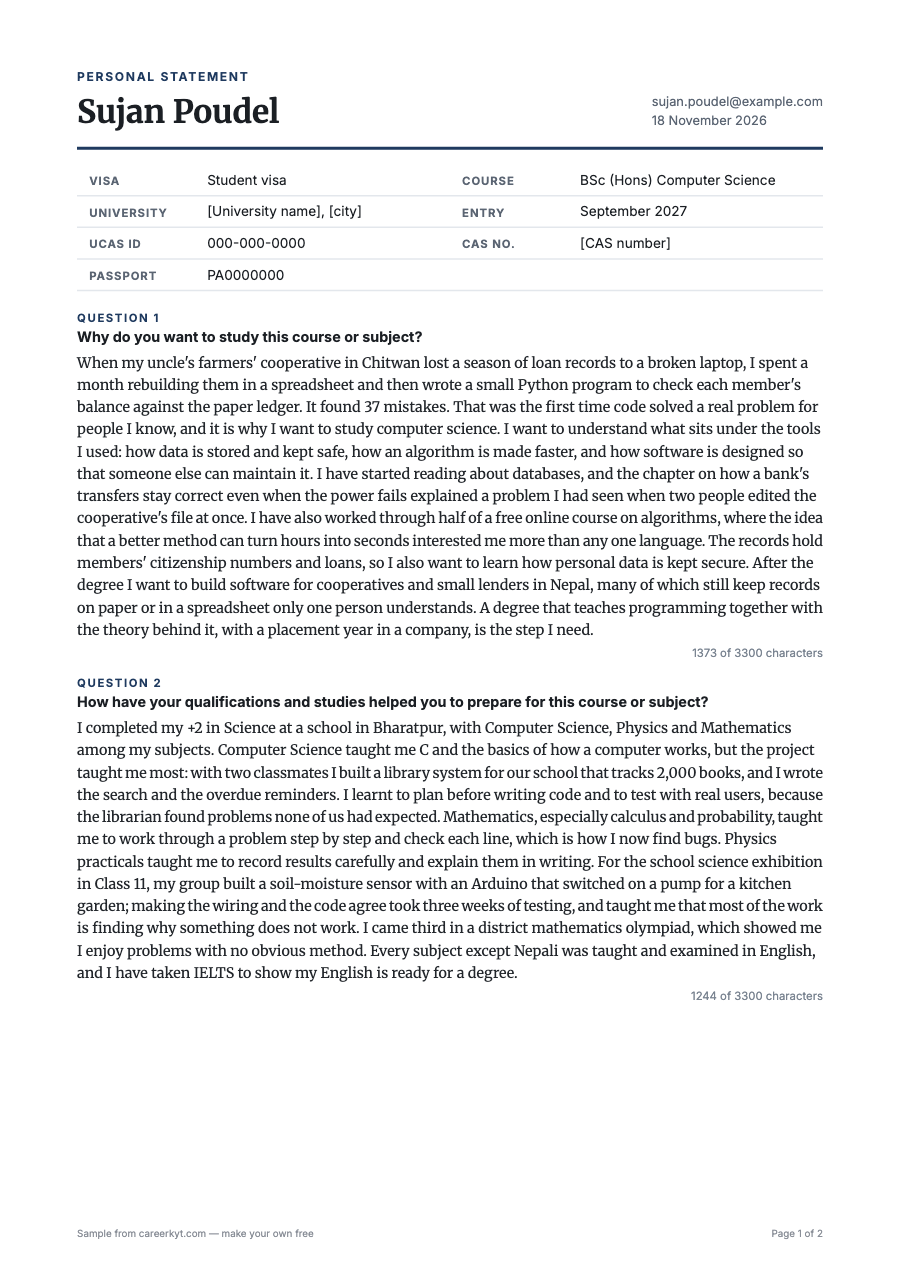
I am applying for a study permit to join the one-year graduate certificate in Supply Chain Management at [college], Toronto, starting in May 2027. My letter of acceptance and provincial attestation letter are attached. I completed my +2 in management in 2019 and my BBA at a Tribhuvan University-affiliated college in Birgunj in 2023, with a CGPA of 3.21. Since August 2023 I have worked full time as purchase and logistics officer in my family’s firm, which imports construction hardware from India and China and supplies about 40 shops in Madhesh Province. There is no gap in my studies or work. My IELTS Academic score is 6.5, with no band below 6.0.
My work has shown me where our firm loses money: containers held for days at the Sirsiya dry port while papers are corrected, stock ordered too early or too late, and freight booked by phone without comparing rates. My BBA taught marketing and general management, with a single course in operations. This certificate covers procurement, inventory planning, logistics, and customs and trade documentation, and its second semester has an applied project with an industry partner. I looked for the same training in Nepal. The MBA programs I could join teach supply chain as one elective, and the short logistics courses I found do not cover inventory planning or customs compliance in depth. I chose Canada because its colleges teach the working side of the subject, with the planning software and documents I will use at home, in one year, so I can be back in the business by mid-2028. I chose this college for its course in customs and trade compliance, the part of our work where a mistake costs most.
After the certificate I will return to Birgunj and take over purchasing and logistics in our firm, which my father now manages alone. My first aim is to move our stock records from paper registers to an inventory system and to plan orders against sales, so that less of our money is held in stock. My father has written, in the attached letter, that I will become the firm’s operations manager when I return. In the longer term I want to offer freight and customs coordination to other importers in Birgunj, as trade through the dry port grows.
My parents, my wife and our one-year-old son live in our own house in Birgunj, and none of them is coming with me. My wife teaches at a school in Birgunj and will stay in her job. My father, who is 58, founded the firm in 1998; its registration, VAT certificate and audited accounts are attached. The family owns our house, the firm’s warehouse and 1 bigha of farmland in Parsa district, as the land ownership certificates show. I am the elder son, and my younger brother is studying engineering in Kathmandu, so the running of the business will pass to me. My family, my home and my work are all in Nepal.
The tuition for the year is CAD 17,800, of which I have paid CAD 9,000; the college’s receipt is attached. IRCC’s living cost figure for one person is CAD 23,448, and I have set aside CAD 2,000 for travel. That leaves CAD 34,248 to show, about NPR 36.3 lakh at NPR 106 to the dollar. My father will pay from the firm’s income and his savings. The firm’s net profit was NPR 41.6 lakh in fiscal year 2082/83, and the income tax returns for him and for me for the last two years are attached. He holds NPR 30 lakh in a fixed deposit and NPR 12.5 lakh in his savings account, built up over three years, as six months of statements show. His letter of support, our relationship certificate and the Ministry of Education’s no-objection letter for sending the fees are attached.
I understand my responsibilities as a student in Canada. I must stay enrolled at my college in each semester and make progress in my courses, and I may work off campus no more than 24 hours a week while classes are on. I will apply to IRCC before changing school, and I will leave Canada before my study permit expires. Every figure in this letter matches the documents attached to my application.
A made-up student, to show the order and the level of detail. Write your own: the Canada maker asks the same questions and counts as you type.
Sample 2: IT · Master of Computer SciencePrabin — BE Computer graduate from Hetauda, three years in software and now a software engineer in Lalitpur, applying for a course-based Master of Computer Science at a public university in Winnipeg. · 683 words
I am applying for a study permit for the two-year, course-based Master of Computer Science at [university], Winnipeg, a public university, starting in September 2027. My letter of acceptance is attached; as a master’s student at a public institution I do not need a provincial attestation letter. I completed my BE in Computer Engineering at a Pokhara University college in Lalitpur in 2023, with a CGPA of 3.46. From September 2023 to March 2024 I was a trainee developer at a software company in Kathmandu, and since April 2024 I have worked as a software engineer at a Lalitpur company that builds mobile banking apps for Nepali banks and cooperatives. My IELTS Academic score is 7.0.
At work I maintain the payment service that handles transfers for our client banks. When traffic rose during Dashain this year the service slowed, and I could fix it only by trial and error, because my BE covered distributed systems in a single course. This master’s has courses in distributed systems, cloud computing and database internals, and a project course in which students build and test a system at scale, which is the work I want to do. I compared the master’s programs I could join in Nepal; they teach these subjects mostly as theory, and I could not find one with a full course in cloud systems and lab work. I chose Canada because its universities teach these subjects with practical labs and industry projects, and this university because two of its faculty research the reliability of distributed systems, the problem I meet at work. Winnipeg’s lower rent also makes the two years affordable for my family.
My employer has approved study leave from August 2027 to August 2029, and has written that I will return as a senior engineer leading the platform team, on a higher salary grade; the letter is attached. Nepal’s banks are moving more of their services to mobile apps and QR payments, and engineers who can keep those systems running at peak load are few. After two or three years in that post I want to lead the engineering of a payment platform used across Nepal.
My parents and younger sister live in our own house in Hetauda. My father retired from the Nepal Electricity Authority in 2022 and receives a pension, and my mother runs a grocery shop from the ground floor of our house. My sister is in the second year of a BSc Nursing course, and I pay part of her fees from my salary. The family owns the house and 6 kattha of land in Makwanpur, as the land ownership certificates show. I am not married, and no one is coming with me. My job is held for me by approved leave, and as their only son I am the one my parents will depend on.
The tuition is CAD 21,500 a year, as my letter of acceptance states. For the first year I need that, IRCC’s living cost figure of CAD 23,448 and about CAD 2,000 for travel: CAD 46,948, about NPR 49.8 lakh at NPR 106 to the dollar. An education loan of NPR 58 lakh has been sanctioned by a commercial bank in Hetauda against our land: NPR 35 lakh is released for the first year and NPR 23 lakh for the second year’s tuition, as the sanction letter sets out. I have saved NPR 7.4 lakh from my salary, and my father holds NPR 9 lakh in a fixed deposit from his retirement fund, as six months of statements show. For the first year that is NPR 51.4 lakh. The Ministry of Education’s no-objection letter is attached.
I understand that my study permit lets me study only while I am enrolled at my university and making progress in each semester, and that I may work off campus up to 24 hours a week during classes. I will not take leave from my program for more than 150 days, and I will apply to IRCC before changing school. When my studies end I will return to my post in Lalitpur, before my permit expires.
A made-up student, to show the order and the level of detail. Write your own: the Canada maker asks the same questions and counts as you type.
Sample 3: Health · Master of Public Health, after a refusalManisha — Public health graduate from Dhangadhi, nearly four years on a maternal-health project in Kailali, reapplying for a Master of Public Health in Saskatoon after a refusal in July 2026. · 662 words
I am applying again for a study permit for the two-year Master of Public Health at [university], Saskatoon, a public university, starting in September 2027. The university has deferred my admission and issued a new letter of acceptance, which is attached. I completed my +2 in science in 2018 and my Bachelor of Public Health at a college in Kathmandu in 2022, in first division. From August to December 2022 I volunteered at a health post in Dhangadhi, for which the certificate is attached. Since January 2023 I have worked as a field officer on a maternal-health project in Kailali run by an NGO with the district health office. My IELTS Academic score is 7.0.
Since January 2023 I have followed pregnant women in six rural municipalities of Kailali: whether they attend four antenatal check-ups, deliver at a health facility and receive postnatal care. I collect and clean the data, but the project’s analysis and the design of new activities are done by consultants from Kathmandu, because none of our field staff is trained in epidemiology or program evaluation. This MPH has courses in epidemiology, biostatistics, and program planning and evaluation, and a practicum in which students evaluate a real health program. I compared the MPH programs in Nepal; they are strong on community health, but among those I could find, none has a full course in program evaluation with a supervised practicum. I chose Canada because its MPH programs are built around practicums, and this university because its practicum places students with rural health programs, the setting closest to ours. Saskatoon’s living costs are also lower than Toronto’s or Vancouver’s.
The coordinator post my employer has offered, described above, would have me plan the project’s activities and evaluate them myself, and lead a team of eight field staff, at about twice my present salary. An MPH is what the post requires, and it would let me do that work at home. Projects like ours in Sudurpashchim Province are often evaluated by people from outside it, and those who can do the work locally are few. In the longer term I want to work in the planning section of the provincial health directorate.
I live in Dhangadhi with my parents and my younger brother. My father has run an agro-vet shop in Dhangadhi since 2010, registered with the sub-metropolitan city, and my mother looks after our house and the family’s remaining 1 bigha of farmland in Kailali. My brother is in Class 12, and I pay his tuition from my salary. After the land sale the family still owns our house and this land, as the land ownership certificates show. I am not married, and no one is coming with me. My job, my family and the project I want to lead are all in Kailali.
The tuition is CAD 19,000 a year, as my letter of acceptance states. For the first year I need that, IRCC’s living cost figure of CAD 23,448 and about CAD 2,000 for travel: CAD 44,448, about NPR 47.1 lakh at NPR 106 to the dollar. My father will pay. He holds the NPR 25 lakh from the land sale explained above, and NPR 11 lakh in savings from the shop, built up over three years, as six months of statements and his income tax returns for the last two years show. An education loan of NPR 14 lakh has been sanctioned by a bank in Dhangadhi; the sanction letter is attached. Together these give NPR 50 lakh. His letter of support, our relationship certificate and the Ministry of Education’s no-objection letter are attached.
I understand that I must stay enrolled at my university and make progress in each semester, that I may work off campus no more than 24 hours a week during classes, and that I must apply to IRCC before changing school. I will leave Canada before my study permit expires and return to my post in Kailali, as my employer’s letter sets out.
A made-up student, to show the order and the level of detail. Write your own: the Canada maker asks the same questions and counts as you type.
SOP sample for New Zealand student visa — statement of purpose
New Zealand asks for a statement of purpose: 7 parts. Three samples, each for a different course:
Sample 1: IT · Master of Information TechnologyPrakash — BSc CSIT graduate from Hetauda, three years as an IT officer at a development bank in Kathmandu, applying for an 18-month Master of Information Technology in Hamilton. · 770 words
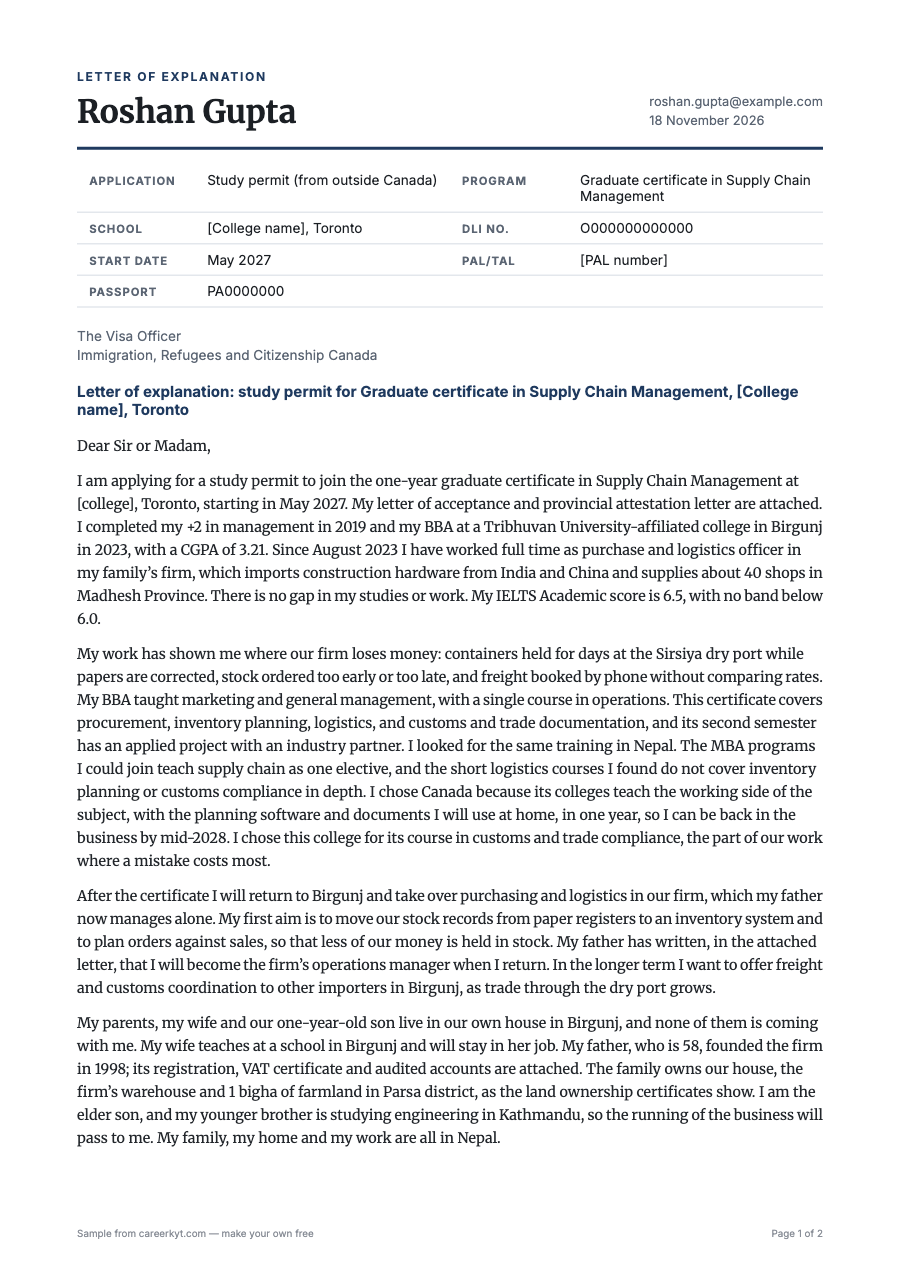
I have an offer of place for the Master of Information Technology at [university] in Hamilton, a Level 9 course of 180 credits over 18 months, starting in February 2027. I chose it for its papers in cyber security, cloud infrastructure and network forensics, and for the final 30-credit industry project with a New Zealand company. In Kathmandu I compared the master’s courses I could join while working: they are taught in the evenings, mostly in theory, and none had a security specialisation with a supervised project. I chose this university over another that offered me a place because its security papers match the controls I manage at work, and because rents in Hamilton are lower than in Auckland. I chose New Zealand because its universities teach in small classes with practical labs, and because an 18-month course lets me return to my work sooner than a two-year degree.
I completed my +2 in Science in Hetauda in 2018 and a BSc in Computer Science and Information Technology from Tribhuvan University in 2023; my final-year project was a small network monitoring tool. Since August 2023 I have worked as an IT officer at the head office of a development bank in Kathmandu, where I manage user access, firewall rules and backups for 42 branches. Last year I helped the bank answer an audit of its IT controls, which showed me how much I still need to learn about security design and cloud systems. I scored 7.0 overall in IELTS Academic in July 2026, with no band below 6.5. The master’s is the next step from the work I already do.
I will share a flat near the campus, where the rooms I have seen advertised cost NZD 220 to 260 a week; with food, transport and a phone I have budgeted about NZD 1,600 a month. I understand that I must attend my classes, make satisfactory progress and keep medical and travel insurance for as long as my visa lasts. I may work up to 25 hours a week in term and full time in scheduled holidays only if my visa conditions allow it, and my study will come first. When the course ends I will leave New Zealand unless I have been granted another visa.
The first year’s tuition, as shown on my offer, will be paid to the university before my visa is issued, and the receipt will be attached. For living costs I will show NZD 20,000 for the first year in a fixed deposit in my father’s name, held at a bank in Nepal for more than three months, and a further sum in my own savings for a ticket home. The money comes from my father’s salary as a teacher at a government secondary school, my mother’s grocery shop, registered with the municipality, and the rent from two shops on the ground floor of our house. My father is my guarantor and has signed the Financial Undertaking for a Student (INZ 1014). For the last six months, my parents have opened a second fixed deposit from the same income, and its statements show it growing each month.
I live in Hetauda with my parents and my grandmother, who is 81 and is cared for by my mother. My younger brother is studying for a bachelor’s degree in Kathmandu, and our parents pay his fees. The family owns our house in Hetauda, with the two shops below it, and 10 kattha of farmland in Makwanpur, all in my father’s name. My bank has written that it will consider me for a post in its IT security team when I return, and I am the one my parents expect to look after the house and land as they grow older. My family, our property and my career are all in Nepal.
After the course I will return to Nepal to work in IT security for a bank. Banks and financial institutions in Nepal must follow Nepal Rastra Bank’s rules on IT and cyber security, and the information security posts I have seen advertised ask for a master’s degree or a security certification with experience. My bank’s letter, attached, says it will consider me for an information security officer post on my return, two grades above my post now. I do not plan to apply for another visa in New Zealand after the course.
I have not been refused a visa by any country. My passport has no earlier visas; my only travel abroad has been two family trips to India, for which Nepali citizens need no visa. I have had no gap in my studies or work.
A made-up student, to show the order and the level of detail. Write your own: the New Zealand maker asks the same questions and counts as you type.
Sample 2: Business · Graduate Diploma, Level 7Rojina — BBS graduate from Nepalgunj who plans the stock and deliveries for her family’s wholesale business, applying for a one-year Level 7 Graduate Diploma in Business (Supply Chain) in Auckland after an Australian refusal. · 767 words
I have an offer of place for the Graduate Diploma in Business (Supply Chain Management) at [institute] in Auckland, a Level 7 course of 120 credits over one year, starting in July 2027. It is at the same level as my bachelor’s degree, but in a subject my BBS did not teach: its papers cover procurement, inventory, logistics and warehouse operations, and the last one is a project with a New Zealand distributor. I compared the MBA courses in Nepalgunj and Kathmandu; they are general management degrees, and none had a supply chain paper with practical work. I chose a one-year diploma rather than a master’s because our business needs these skills soon and I cannot be away from it for two years. I chose this institute because its papers are assessed through case studies and a work project rather than exams alone, as its course outline shows.
I completed my +2 in Management in Nepalgunj in 2019 and a Bachelor of Business Studies from Tribhuvan University in 2023. Since then I have worked full time in my family’s wholesale business in Nepalgunj, which supplies packaged food and household goods to about 120 shops in Banke and Bardiya. I keep the stock records, plan the routes for our two trucks and manage the accounts with our suppliers. I scored 6.5 overall in IELTS Academic in May 2026. Planning deliveries showed me that most of our losses come from stock that expires on the shelf and from trucks that leave half empty, and that I need proper training in supply chain management to fix them.
I will rent a room in a shared house near the campus, where rooms are advertised at NZD 230 to 280 a week, and I have budgeted NZD 1,650 a month for rent, food, transport and a phone. I understand that I must attend classes, make satisfactory progress and keep the insurance my institute requires. I may work up to 25 hours a week in term and full time in scheduled holidays if my visa conditions allow, but I will not need to work to pay my costs. I will leave New Zealand when the course ends.
The tuition for the whole course, as shown on my offer, will be paid to the institute before the visa is issued, since the course lasts one year. For living costs I will show NZD 20,000, and a further sum for a ticket home, in a fixed deposit in my father’s name held for more than three months at a bank in Nepal. The money comes from our wholesale business, a registered firm with a PAN and VAT number that has filed its tax returns for the last three years. Part of the deposit came from selling a plot of land in Banke in 2026, and the sale deed explains that large payment. My father is my guarantor and has signed the Financial Undertaking for a Student (INZ 1014). The firm’s registration, VAT certificate, audited accounts, tax clearance and our relationship certificate are attached.
I live in Nepalgunj with my parents and my younger brother, who is in Class 10. My father started our wholesale business in 2008 and runs it with my mother; I am the one who will take it over, as my brother is still at school. The business rents a warehouse, owns two trucks and supplies shops that have bought from us for more than ten years. Our family owns our house and one bigha of land in Banke, in my father’s name. I am engaged to be married in 2028, and my fiancé works as an engineer in Nepalgunj.
After the course I will return to Nepalgunj and run the supply side of our business: buying, stock and deliveries. I want to bring in a stock system that tracks expiry dates, plan routes so that our trucks leave full, and add Kailali and Dang to our area within three years. My father’s letter, attached, says I will become a partner in the firm when I return. I do not plan to apply for another visa in New Zealand after the course.
In March 2025 my application for an Australian student visa, for a Master of Business Analytics, was refused because the officer was not satisfied that the course fitted my plans for our business; the refusal letter is attached. I accept part of that decision: analytics is not what our business needs. I have since chosen a shorter course in supply chain management, which is the work I do every day. I have had no gap in my studies or work.
A made-up student, to show the order and the level of detail. Write your own: the New Zealand maker asks the same questions and counts as you type.
Sample 3: Agriculture · Master of Agricultural ScienceDipendra — BSc Agriculture graduate from Chitwan, a field technician at a dairy cooperative, applying for a two-year Master of Agricultural Science and declaring a post-study work plan. · 752 words
I have an offer of place for the Master of Agricultural Science at [university], a Level 9 course of 240 credits over two years, starting in February 2027. It has papers in dairy cattle nutrition, pasture management and farm systems, and a research thesis, which I plan to write on feeding dairy cows through the dry season. New Zealand is one of the world’s largest dairy exporters, and its farms are built on grazed pasture, a system the university studies on its own working dairy farms. In Nepal I compared the master’s in animal science at Agriculture and Forestry University, which would suit me in many ways, but I want to learn pasture-based dairying where it is practised. I chose this university over another because two of its staff supervise research on small dairy farms, which is the closest to what I see in Chitwan.
I completed my +2 in Science in Chitwan in 2017 and a BSc in Agriculture from Agriculture and Forestry University, Rampur, in 2022, with my final-year research on feeding dairy cattle. Since March 2023 I have worked as a field technician for a dairy cooperative in Chitwan, visiting about 60 member farms a month to advise on feed, breeding records and milk quality. I also help my father on our own farm of 14 cows. I scored 6.5 overall in IELTS Academic in April 2026. Seeing farms with the same breed of cow produce very different amounts of milk made me want to study nutrition and pasture properly.
I will live in a university flat in my first year, at about NZD 260 a week, and then share a house; I have budgeted NZD 1,650 a month in all. I understand that I must attend, make steady progress on my thesis with my supervisor, and keep insurance for the whole of my visa. I may work up to 25 hours a week in term, and full time in scheduled holidays, if my conditions allow; I hope to find seasonal work on dairy farms, which would also teach me. I will leave when my visa ends unless I am granted another visa.
The first year’s tuition, as shown on my offer, will be paid before my visa is issued. For the first year’s living costs I will show NZD 20,000, and the price of a ticket home, in a fixed deposit at a bank in Nepal held for more than three months. The money comes from our farm, which sells about 140 litres of milk a day to the cooperative, and from my elder brother’s hardware shop in Bharatpur; the cooperative’s payment records and the shop’s tax clearance show both incomes. My father is my guarantor and has signed the Financial Undertaking for a Student (INZ 1014). For the second year, my father and brother are saving from the same income into a second deposit, and the bank statements show those monthly payments. Our relationship certificate and the land ownership certificates are attached.
I live in Bharatpur with my parents and my grandparents. My elder brother lives nearby with his wife and runs his hardware shop. Our family owns one and a half bigha of land in Chitwan, with our house and cow shed on it, in my father’s name. My father is 58, and as my brother has his shop, I am the one who will take over the farm and its 14 cows. The cooperative I work for has written that it wants me back as a dairy adviser when I return.
After the course I would like to work for one or two seasons on a New Zealand dairy farm, on a post-study work visa if I am eligible, to learn how farms there manage pasture, herd records and costs day to day. I am stating that plan now so that it is clear. After that I will return to Chitwan to run our farm and to work for the cooperative; its chair has written that it plans a senior dairy adviser post and would consider me for it. I want to show our member farms how to get more milk from better feed rather than from more cows.
After my BSc results in 2022 I had a gap of five months before I joined the cooperative. I worked on our farm and completed a three-month training course in artificial insemination of cattle, for which the certificate is attached. I have not been refused a visa for any country, and I have not travelled abroad.
A made-up student, to show the order and the level of detail. Write your own: the New Zealand maker asks the same questions and counts as you type.
SOP sample for USA student visa — statement of purpose
USA asks for a statement of purpose: 6 parts. Three samples, each for a different course:
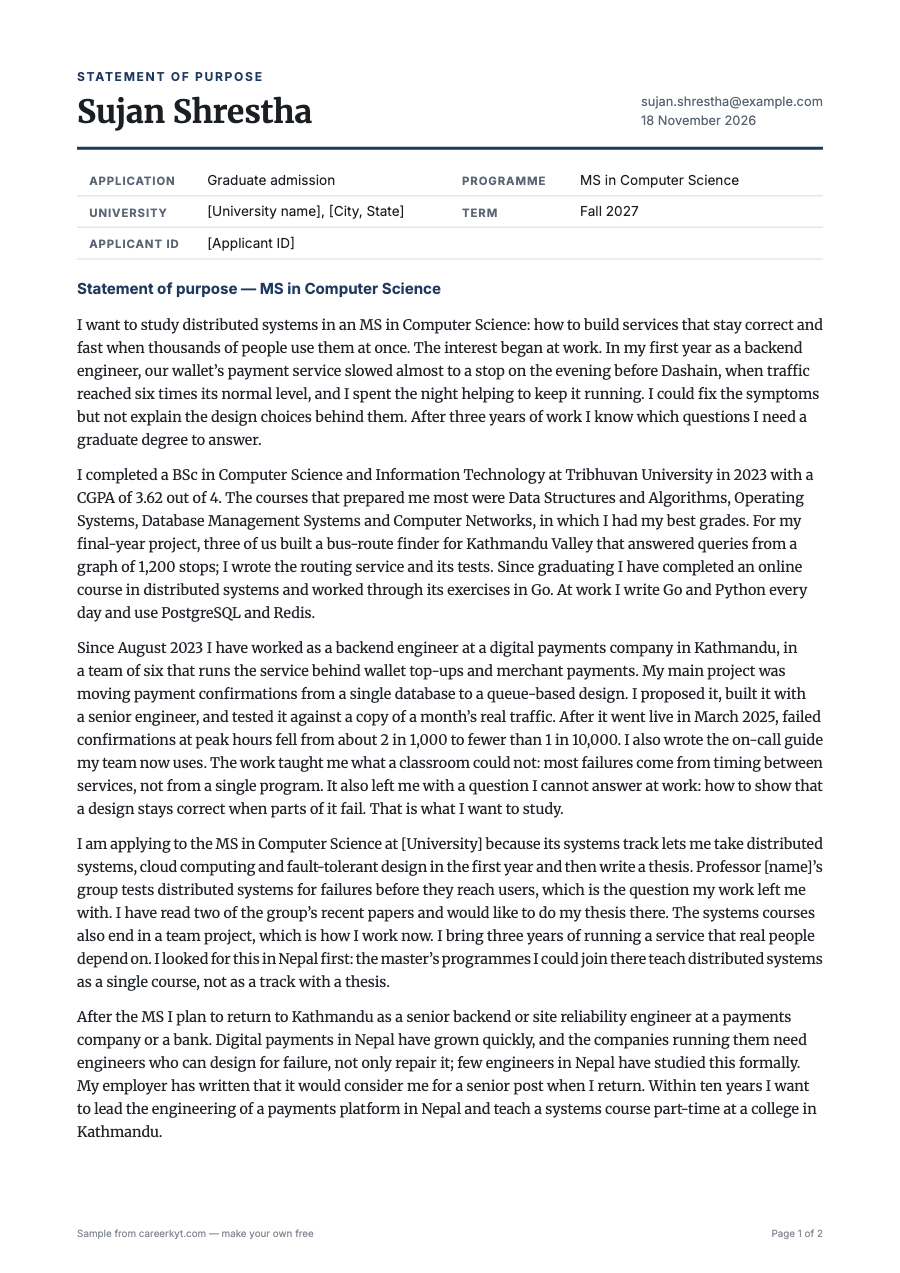
Sample 1: IT · MS in Computer ScienceSujan — BSc CSIT graduate from Bhaktapur, three years as a backend engineer at a payments company in Kathmandu, applying for an MS in Computer Science for Fall 2027. · 635 words
I want to study distributed systems in an MS in Computer Science: how to build services that stay correct and fast when thousands of people use them at once. The interest began at work. In my first year as a backend engineer, our wallet’s payment service slowed almost to a stop on the evening before Dashain, when traffic reached six times its normal level, and I spent the night helping to keep it running. I could fix the symptoms but not explain the design choices behind them. After three years of work I know which questions I need a graduate degree to answer.
I completed a BSc in Computer Science and Information Technology at Tribhuvan University in 2023 with a CGPA of 3.62 out of 4. The courses that prepared me most were Data Structures and Algorithms, Operating Systems, Database Management Systems and Computer Networks, in which I had my best grades. For my final-year project, three of us built a bus-route finder for Kathmandu Valley that answered queries from a graph of 1,200 stops; I wrote the routing service and its tests. Since graduating I have completed an online course in distributed systems and worked through its exercises in Go. At work I write Go and Python every day and use PostgreSQL and Redis.
Since August 2023 I have worked as a backend engineer at a digital payments company in Kathmandu, in a team of six that runs the service behind wallet top-ups and merchant payments. My main project was moving payment confirmations from a single database to a queue-based design. I proposed it, built it with a senior engineer, and tested it against a copy of a month’s real traffic. After it went live in March 2025, failed confirmations at peak hours fell from about 2 in 1,000 to fewer than 1 in 10,000. I also wrote the on-call guide my team now uses. The work taught me what a classroom could not: most failures come from timing between services, not from a single program. It also left me with a question I cannot answer at work: how to show that a design stays correct when parts of it fail. That is what I want to study.
I am applying to the MS in Computer Science at [University] because its systems track lets me take distributed systems, cloud computing and fault-tolerant design in the first year and then write a thesis. Professor [name]’s group tests distributed systems for failures before they reach users, which is the question my work left me with. I have read two of the group’s recent papers and would like to do my thesis there. The systems courses also end in a team project, which is how I work now. I bring three years of running a service that real people depend on. I looked for this in Nepal first: the master’s programmes I could join there teach distributed systems as a single course, not as a track with a thesis.
After the MS I plan to return to Kathmandu as a senior backend or site reliability engineer at a payments company or a bank. Digital payments in Nepal have grown quickly, and the companies running them need engineers who can design for failure, not only repair it; few engineers in Nepal have studied this formally. My employer has written that it would consider me for a senior post when I return. Within ten years I want to lead the engineering of a payments platform in Nepal and teach a systems course part-time at a college in Kathmandu.
Between my +2 in 2018 and the start of my bachelor’s in 2019 I had a gap of eight months, in which I taught mathematics to Class 8 students at a school in Bhaktapur. The school’s letter is with my documents.
A made-up student, to show the order and the level of detail. Write your own: the United States maker asks the same questions and counts as you type.
Sample 2: Business · MBAAnisha — BBA graduate from Ilam, four years at a commercial bank in Kathmandu, now an SME credit analyst, applying for a two-year MBA for Fall 2027. · 638 words
I want to do a two-year MBA with a concentration in finance, to move from analysing loans to running a lending business. For four years at a commercial bank in Kathmandu I have assessed loans to small and medium businesses: hotels, dairies and tea factories. Again and again I have seen a sound business refused, or a weak one approved, because the bank judged its collateral rather than its cash flow. I can see the problem, but I lack the training in strategy, corporate finance and leading people to change how a lending team works. After four years of work I know what I need from an MBA.
I completed a Bachelor of Business Administration at Pokhara University in 2021 with a CGPA of 3.48 out of 4, concentrating in finance. Financial Management, Business Statistics and Managerial Accounting were my strongest courses. In my final year I wrote a project report on how interest-rate changes affected loan demand among hotels in Pokhara, using two years of data from three banks. At the bank I passed its internal credit certification in 2023 and completed a 15-day training in credit risk at a banking training institute in Kathmandu. My weakest area is financial modelling beyond spreadsheets, and I have started an online course in Python for finance to prepare.
I joined the bank in September 2022 as a trainee assistant and have worked in its SME credit department since 2023. I now prepare about 60 credit appraisals a year, for loans of NPR 10 million to 100 million, and present them to the credit committee. In 2025 I proposed a simple cash-flow score for hotel and tourism loans, built it with my team leader and tested it on 140 past loans. It flagged most of the loans that later fell overdue, and the department now uses it beside its collateral checks. I have also trained four new assistants in writing appraisals. As a trainee I worked at the counter and in loan recovery, which showed me how borrowers experience a bank. What I lack is the wider view: how to set the strategy for a whole loan book, price risk across it and lead a team through change.
I am applying to the MBA at [University] for three reasons. Its finance concentration includes courses in credit analysis, financial modelling and entrepreneurial finance, the three things my work needs. Its first-year project with a small business would let me work with the kind of firm I lend to, in a different market. And most of its class arrive with several years of work behind them, which is how I learn best: from people who have done the job. I bring four years of judging businesses by their numbers in a market where the numbers are often incomplete. The MBA programmes in Kathmandu are taught in the evenings around work; I want two full years of case work, a summer internship and classmates from many countries.
After the MBA I plan to return to banking in Nepal as a credit manager for SME lending, the post held by my bank’s senior credit staff. My bank has written that it will consider me for a managerial post when I return with the degree. In five to ten years I want to head SME lending at a Nepali bank and make cash-flow lending normal for small hotels, dairies and tea producers, the businesses I already know. My parents’ tea garden in Ilam is one of them, and I want to help it sell to buyers abroad.
Between my BBA in 2021 and joining the bank in 2022 I worked for nine months in my family’s tea business in Ilam, keeping its accounts and handling its sales to two factories. My first-year GPA, 3.1, was lower than my later years, when it rose above 3.6.
A made-up student, to show the order and the level of detail. Write your own: the United States maker asks the same questions and counts as you type.
Sample 3: Engineering · Funded PhDNirmala — MSc in Water Resources Engineering from Tribhuvan University, two years as a research engineer on sediment at hydropower plants, applying for a funded PhD in Civil and Environmental Engineering for Fall 2027. · 633 words
I want to research how sediment from the Himalaya wears down hydropower plants, and how to predict it, in a PhD in Civil and Environmental Engineering. In the monsoon, Nepal’s rivers carry so much sand that turbines at run-of-river plants can lose efficiency within a single season, and plants shut down to protect them. For two years I have measured this sediment at power plants, but the models we use were built for rivers that carry far less of it. I need a PhD to build better ones: the training in sediment transport, statistics and field methods, and the years to test a model properly.
I hold a BE in Civil Engineering from Kathmandu University, completed in 2020, and an MSc in Water Resources Engineering from Tribhuvan University, completed in 2024 with a CGPA of 3.81 out of 4. My MSc thesis estimated suspended sediment in a river in Gandaki Province from turbidity readings and compared three rating-curve methods against two years of measured samples; the best of them cut the error by about a third. The courses that matter most for this PhD were Sediment Transport, Hydrology, Open-Channel Hydraulics and Statistical Methods in Water Resources. I analyse data in Python and R, model rivers in HEC-RAS, and have led monsoon field sampling with a team of four.
Since January 2025 I have worked as a research engineer at a hydropower research centre in Kathmandu, on a project with three run-of-river plants in central Nepal. I run the sediment monitoring at two of them: I set up the turbidity sensors, train plant staff to take samples and process about 1,500 samples a year in our laboratory. With my supervisor, Dr [name], I wrote a paper comparing measured sediment with turbine wear at one plant over two monsoons, which we presented at a national hydropower conference in 2025. I did the analysis and wrote the first draft. The plant used our findings to change when it flushes its settling basin. The work showed me how much the plants depend on data that no one has modelled well. It also showed me my limit: I can analyse one season at one plant, but I have not yet learned to build a model that holds across rivers and years.
I am applying to the PhD in Civil and Environmental Engineering at [University] to work in Professor [name]’s group, whose research on sediment transport in steep mountain rivers is closer to my questions than any other I have found. The group’s recent work joins field sensors with machine-learning models, the next step from my MSc thesis. I wrote to Professor [name] in September 2026 about my research and we have since spoken by video; the group expects to take a new student on a research assistantship for Fall 2027. I would also take courses in fluvial geomorphology and data science that are not taught in my field in Nepal. I bring two monsoons of field data from Himalayan rivers and experience of sampling in hard conditions.
After the PhD I plan to return to Nepal to teach and research at an engineering campus, and to advise hydropower developers on sediment. Nepal is building more run-of-river plants on rivers that carry heavy sediment, and it has few researchers trained to model it. My research centre has written that it would welcome me back as a senior researcher. Within ten years I want to lead a research group in Nepal that keeps sediment records for the main rivers and trains engineers to use them, so that plants are designed from measured data.
Between my BE in 2020 and the start of my MSc in 2022 I worked for eighteen months as a site engineer on a rural road project in Kaski district. The experience letter is with my documents.
A made-up student, to show the order and the level of detail. Write your own: the United States maker asks the same questions and counts as you type.
SOP sample for Korea student visa — study plan
Korea asks for a study plan: 6 parts. Three samples, each for a different course:
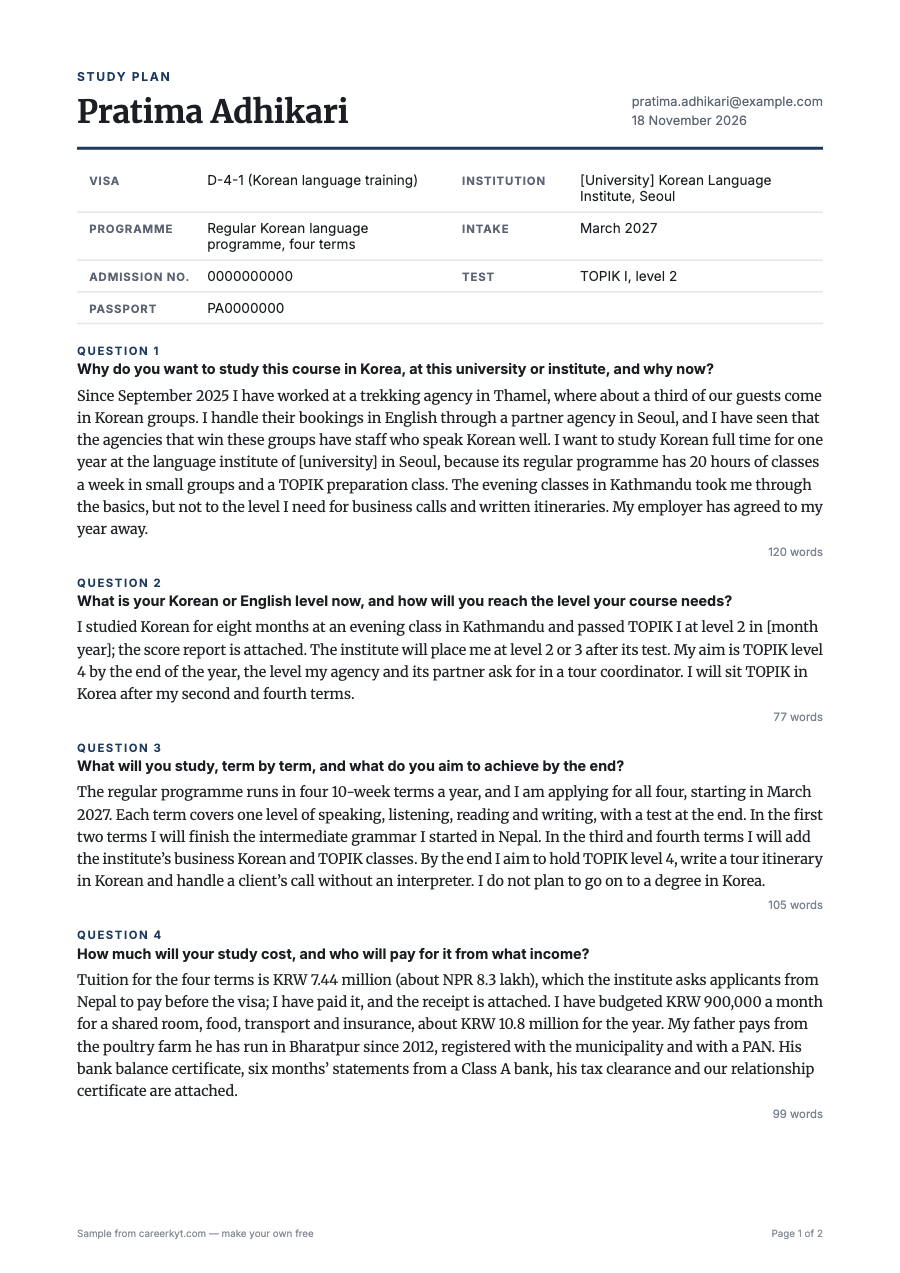
Sample 1: D-4 · Korean language programmePratima — BBS graduate from Bharatpur, 14 months at a Thamel trekking agency that hosts Korean groups, applying for a year of Korean at a university language institute in Seoul. · 525 words
Why do you want to study this course in Korea, at this university or institute, and why now?
Since September 2025 I have worked at a trekking agency in Thamel, where about a third of our guests come in Korean groups. I handle their bookings in English through a partner agency in Seoul, and I have seen that the agencies that win these groups have staff who speak Korean well. I want to study Korean full time for one year at the language institute of [university] in Seoul, because its regular programme has 20 hours of classes a week in small groups and a TOPIK preparation class. The evening classes in Kathmandu took me through the basics, but not to the level I need for business calls and written itineraries. My employer has agreed to my year away.
What is your Korean or English level now, and how will you reach the level your course needs?
I studied Korean for eight months at an evening class in Kathmandu and passed TOPIK I at level 2 in [month year]; the score report is attached. The institute will place me at level 2 or 3 after its test. My aim is TOPIK level 4 by the end of the year, the level my agency and its partner ask for in a tour coordinator. I will sit TOPIK in Korea after my second and fourth terms.
What will you study, term by term, and what do you aim to achieve by the end?
The regular programme runs in four 10-week terms a year, and I am applying for all four, starting in March 2027. Each term covers one level of speaking, listening, reading and writing, with a test at the end. In the first two terms I will finish the intermediate grammar I started in Nepal. In the third and fourth terms I will add the institute’s business Korean and TOPIK classes. By the end I aim to hold TOPIK level 4, write a tour itinerary in Korean and handle a client’s call without an interpreter. I do not plan to go on to a degree in Korea.
How much will your study cost, and who will pay for it from what income?
Tuition for the four terms is KRW 7.44 million (about NPR 8.3 lakh), which the institute asks applicants from Nepal to pay before the visa; I have paid it, and the receipt is attached. I have budgeted KRW 900,000 a month for a shared room, food, transport and insurance, about KRW 10.8 million for the year. My father pays from the poultry farm he has run in Bharatpur since 2012, registered with the municipality and with a PAN. His bank balance certificate, six months’ statements from a Class A bank, his tax clearance and our relationship certificate are attached.
What will you do after the course, and what brings you back to Nepal?
I will return to my job at the agency, where the director has written that I will move from bookings to Korean-market coordinator, planning Korean groups’ itineraries and handling the partner account, at a higher salary; the letter is attached. An agency with a Korean-speaking coordinator can deal with Korean agencies directly instead of through an interpreter. My parents, my sister in Class 10 and our farm are in Bharatpur. Later I want to run a desk for Korean groups at the agency.
Is there anything else the embassy should know, such as a gap, a change of subject or an earlier visa refusal? Leave it blank if not.
After my BBS results in January 2025 I had eight months before my job, in which I helped on the farm and started my Korean classes; the class certificate is attached. I have not been refused a visa for any country.
A made-up student, to show the order and the level of detail. Write your own: the South Korea maker asks the same questions and counts as you type.
Sample 2: D-2 · MS in Civil EngineeringRojan — BE Civil graduate from Pulchowk Campus, two years as a site engineer on a hydropower project, admitted to an English-taught MS in Civil Engineering with a half-tuition scholarship. · 490 words
Why do you want to study this course in Korea, at this university or institute, and why now?
I finished my BE in Civil Engineering at Pulchowk Campus in 2023, and since then I have worked as a site engineer on a 40 MW run-of-river hydropower project in Sindhupalchok. Every monsoon, sediment wears down the turbines and fills the settling basins, and the design work to deal with it is mostly done by foreign consultants. The MS in Civil Engineering at [university] is taught in English and has a hydraulics laboratory where Professor [name] studies sediment transport; he has accepted me into his lab. Korean companies are building hydropower plants in Nepal, so the methods used there are used here too. Two years on site have shown me exactly what I need to learn.
What is your Korean or English level now, and how will you reach the level your course needs?
The course is taught in English. I scored 6.5 overall in IELTS Academic in [month year], above the department’s minimum; the report is attached. Daily life, lab safety notices and some of the lab’s talk will be in Korean, so from my first semester I will take the university’s Korean classes for international students twice a week, and I aim to pass TOPIK I at level 2 by the end of my first year.
What will you study, term by term, and what do you aim to achieve by the end?
The MS is four semesters, from March 2027 to February 2029, with 24 credits of coursework and a thesis. In the first year I will take open-channel hydraulics, sediment transport, numerical modelling and research methods, and assist in the lab’s flume experiments. In the third semester I will start a thesis on settling basins, using flow and sediment records from projects in Nepal that my employer has agreed to share. In the fourth I will complete and defend it. My goal is to design and check desilting structures myself, which no course in Nepal teaches in this depth.
How much will your study cost, and who will pay for it from what income?
Tuition is KRW 5.2 million a semester. The university’s scholarship pays half, as items 7 and 8 of my admission certificate and the scholarship certificate show, so I pay KRW 2.6 million a semester, KRW 10.4 million for the course. Living costs are about KRW 1 million a month for the dormitory, food and transport. I pay from NPR 9 lakh I saved from two years’ salary, in my own account, and my parents add rent from four shops in our house in Lalitpur. The balance certificates, six months’ statements, rental agreements and tax clearance are attached.
What will you do after the course, and what brings you back to Nepal?
I will return to Nepal as a hydraulic design engineer. My employer has written that a design post in its Kathmandu office will be open to me after the degree, at a higher grade; the letter is attached. Nepal has many hydropower projects under construction, and sediment design is where I have seen the fewest Nepali engineers. I am registered with the Nepal Engineering Council, and I am the elder son of parents who live in our own house in Lalitpur.
Is there anything else the embassy should know, such as a gap, a change of subject or an earlier visa refusal? Leave it blank if not.
I have no study gap: I joined my job two months after graduating. I have not applied for a visa to any other country.
A made-up student, to show the order and the level of detail. Write your own: the South Korea maker asks the same questions and counts as you type.
Sample 3: GKS · Master’s, embassy trackSushmita — BSc Agriculture graduate from AFU Rampur, two years as an agriculture technician in a Palpa municipality, applying through the embassy track of the Global Korea Scholarship for a master’s in horticulture. · 506 words
Why do you want to study this course in Korea, at this university or institute, and why now?
I studied BSc Agriculture at the Agriculture and Forestry University in Rampur, and since 2024 I have worked as an agriculture technician in the agriculture section of a municipality in Palpa. Farmers here are moving to plastic tunnels for tomatoes and cucumbers, but they lose much of the crop to heat and disease because the tunnels have no climate control. Korea grows a large share of its vegetables in greenhouses, and its universities teach that work with research farms beside them. The courses at [university] in protected horticulture and smart-farm systems match the problem I see every week, so it is my first choice of the three the scholarship lets me name.
What is your Korean or English level now, and how will you reach the level your course needs?
GKS begins with a year of Korean language study for scholars below TOPIK level 5, which includes me. I have studied Korean on Saturdays in Butwal since January 2026 and passed TOPIK I at level 2 in [month year]. In the language year I will study full time, aiming for TOPIK level 4, so that I can read Korean research papers and talk with growers on the research farm. My degree courses will be in English, and my IELTS score is 6.5.
What will you study, term by term, and what do you aim to achieve by the end?
After the language year from September 2027, the master’s at [university] is four semesters from September 2028. In the first year I will take protected cultivation, greenhouse climate control, plant nutrition and research methods, and work in the department’s research greenhouse. In the second year I will write a thesis on cooling low-cost plastic tunnels for tomatoes in a mid-hills climate, with a trial on the university farm and data I collect in Palpa. My goal is a tunnel design that a Nepali farmer can build and run at a known cost.
How much will your study cost, and who will pay for it from what income?
If I am selected, the scholarship pays my tuition, the language year, a monthly allowance, medical insurance and airfare, as the award letter will state. Before the first allowance arrives I will need about KRW 1.5 million (about NPR 1.7 lakh) for a deposit, bedding and a phone. My father will pay this from his electrical repair shop in Tansen and our family savings, shown in a bank balance certificate and six months’ statements from a Class A bank. Our relationship certificate is attached. I will not need to work during the course.
What will you do after the course, and what brings you back to Nepal?
I will return to my post in the municipality, which has given me study leave; the leave letter is attached. With the degree I can design a greenhouse programme for the municipality and train the 40 farmers’ groups we already work with. Later I want to join the province’s agriculture research or extension service, where a master’s degree would let me apply for more senior posts. My parents and grandmother live in our house in Tansen, and the farmers’ groups I started are there.
Is there anything else the embassy should know, such as a gap, a change of subject or an earlier visa refusal? Leave it blank if not.
After my BSc in 2023 I waited seven months for my results and the municipality’s vacancy, and in that time I completed a three-month training in greenhouse vegetable growing; the certificate is attached. I have not been refused a visa for any country.
A made-up student, to show the order and the level of detail. Write your own: the South Korea maker asks the same questions and counts as you type.
SOP sample for Japan student visa — reason for study
Japan asks for a reason for study: 7 parts. Three samples, each for a different course:
Sample 1: +2 graduate · Care worker collegeSabina — +2 Management graduate from Waling, Syangja, with JLPT N5, applying for a two-year course from April 2027 at a language school in Fukuoka, then a care worker college. · 481 words
Who are you, and what have you done since school? Give your education, any work, and what you are doing now, and explain any gap.
I am 19 and live in Waling, Syangja, with my parents and younger brother. I completed Class 12 in Management under the National Examinations Board in 2025 with a GPA of 3.12. From January to October 2026 I studied Japanese at an institute in Pokhara, and for three months of that time I also volunteered at an elderly care home there, helping the staff with meals and exercises. My father runs a poultry farm and my mother looks after our home.
Why do you want to learn Japanese, and why in Japan rather than in Nepal? Say how your interest began and how you have studied so far.
My interest began at the care home, where I saw how few trained carers there are for old people in Nepal. I learned that Japan trains care workers through colleges and a national exam, and that the training is in Japanese. I studied 320 hours of Japanese at the institute and passed JLPT N5 in July 2026. Classes in Nepal stop at the basics, and outside them I rarely hear Japanese. In Japan I would use it every day, and I need it at a high level to study care work in it.
Why did you choose this school, and this course length and intake?
I chose a two-year course from April 2027 because it ends in March 2029, when care worker colleges start their year. The school has a track for students going on to vocational colleges, with classes for JLPT N3 and N2 and help with college applications. Its dormitory is ten minutes from the school. I chose Fukuoka because rent is lower than in Tokyo, and I have budgeted for living there.
How will you study while you are in Japan? Give the levels you aim for, and by when.
I aim to pass JLPT N4 in July 2027, N3 in December 2027 and N2 in December 2028, before I apply to college. I will attend every class and study for three hours each day after school, using the books the school sets and practising speaking with my teachers. If I work part time, it will be only with permission, within the hours allowed, and never at the cost of my classes.
What will you do after the language school? Name the next course and the work it leads to.
After the language school I plan to join a two-year care worker course at a vocational college in Fukuoka from April 2029, and then sit the national exam for certified care workers. I want to work in a care home in Japan for some years to learn the work properly. Later I want to return to Syangja and start a home-care service, because many old people there live alone while their children work abroad.
Who will pay for your studies and living costs, from what income, and how was the money saved?
My father will pay for my studies. He has run a poultry farm in Waling since 2012, registered with the municipality, and his income for the fiscal year 2082/83 was NPR 21 lakh, as his tax clearance shows. He has saved NPR 32 lakh from the farm’s sales, and his bank statements show the deposits over the past year. The first year’s fees are JPY 820,000, and I have budgeted JPY 75,000 a month for living costs.
Have you been refused a COE or a Japanese visa, or withdrawn an application? Is there anything else the school should know? Leave it blank if nothing applies.
I have not applied for a Certificate of Eligibility or a Japanese visa before.
A made-up student, to show the order and the level of detail. Write your own: the Japan maker asks the same questions and counts as you type.
Sample 2: BSc CSIT · Master’s in information scienceRojan — BSc CSIT graduate from Bhaktapur, eight months as a junior web developer, with JLPT N4, applying for a 1 year 9 months course from July 2027 in Osaka, then a master’s in information science. · 485 words
Who are you, and what have you done since school? Give your education, any work, and what you are doing now, and explain any gap.
I live in Bhaktapur with my parents and younger sister. I completed a BSc in Computer Science and Information Technology at a Tribhuvan University college in Kathmandu, graduating in December 2025. From January to August 2026 I worked as a junior web developer at a software company in Lalitpur, building booking pages for hotels. I left the job in September 2026 to study Japanese full time for this application.
Why do you want to learn Japanese, and why in Japan rather than in Nepal? Say how your interest began and how you have studied so far.
At my company I worked on a project for a Japanese travel agency, and I saw that the engineers who could read the client’s documents in Japanese were the ones who led the work. I began evening classes in 2025, studied 400 hours at an institute in Kathmandu and passed JLPT N4 in December 2025. The master’s courses I want to apply to are taught in Japanese, so I need the language at university level. Evening classes in Nepal do not reach that level; daily life and study in Japan will.
Why did you choose this school, and this course length and intake?
I chose a 1 year 9 months course from July 2027 because it ends in March 2029, before graduate schools start in April. The school has a university track with JLPT N2 and N1 classes, academic writing, and advice on contacting professors. It is in Osaka, where several universities I am considering have information science departments, and where a shared room near the school costs about JPY 40,000 a month.
How will you study while you are in Japan? Give the levels you aim for, and by when.
I aim to pass JLPT N3 in December 2027 and N2 in July 2028, and to try N1 in December 2028. In my second year I will write a research plan with my teachers’ help and contact professors in software engineering. I will attend every class and study four hours a day outside them. Any part-time work will be only with permission, within the hours allowed.
What will you do after the language school? Name the next course and the work it leads to.
I plan to apply for a two-year master’s course in information science starting in April 2029, or to begin as a research student if a professor accepts me first. After the degree I would like to work as a software engineer at a Japanese company for some years, if I meet the requirements for a work status. My long-term aim is to lead projects for Japanese clients at an IT company in Nepal.
Who will pay for your studies and living costs, from what income, and how was the money saved?
My father will pay. He has worked as an overseer at a construction company in Bhaktapur since 2010 and earns NPR 85,000 a month, as his salary certificate shows. We also rent out three shop rooms in our house for NPR 45,000 a month. His savings of NPR 30 lakh, built from salary and rent, are in his account, and the past year’s statements show the deposits. First-year fees are JPY 780,000; I have budgeted JPY 85,000 a month.
Have you been refused a COE or a Japanese visa, or withdrawn an application? Is there anything else the school should know? Leave it blank if nothing applies.
I have not applied for a Certificate of Eligibility or a Japanese visa before. My name is spelled “Rojan” in my passport and “Rojun” on my +2 certificate; the same-person certificate from my ward office is attached.
A made-up student, to show the order and the level of detail. Write your own: the Japan maker asks the same questions and counts as you type.
Sample 3: Working cook · Culinary collegeManoj — Cook at a hotel in Pokhara who finished +2 in 2020 and has worked since, with NAT-TEST 5Q, applying for a 1 year 6 months course from October 2027 in Osaka, then a culinary college. · 462 words
Who are you, and what have you done since school? Give your education, any work, and what you are doing now, and explain any gap.
I am 25 and live in Pokhara with my parents. I completed Class 12 in Management in 2020, during the COVID-19 lockdown, and spent the next year helping on my family’s dairy farm. In 2021 I took a three-month commis cook training and passed the Level 1 skill test of the National Skill Testing Board. Since March 2022 I have worked in the kitchen of a hotel in Lakeside, Pokhara, first as a commis cook and, since 2024, as a cook.
Why do you want to learn Japanese, and why in Japan rather than in Nepal? Say how your interest began and how you have studied so far.
Many guests at our hotel are Japanese trekkers, and in 2023 the hotel began serving them a Japanese breakfast. A chef from Japan trained our kitchen for two weeks, and I saw how exact Japanese cooking is, from cutting to rice. I started evening classes in 2025, completed 260 hours at an institute in Pokhara and passed NAT-TEST 5Q in 2026. Recipes can be learned in Nepal, but the skills and the kitchen language are taught properly only in Japan, in Japanese.
Why did you choose this school, and this course length and intake?
I chose a 1 year 6 months course from October 2027 because it ends in March 2029, when culinary colleges start their year. The school is in Osaka, a city known for its food, and its vocational-college track has JLPT classes and visits to colleges. I have checked that a room in its dormitory costs JPY 38,000 a month, which I have included in my budget.
How will you study while you are in Japan? Give the levels you aim for, and by when.
I aim to pass JLPT N4 in December 2027, N3 in July 2028 and N2 in December 2028. I will attend every class, keep a notebook of kitchen words, and study three hours a day after school. If I take part-time work, it will be only with permission and within the hours allowed. My savings and my father’s support cover my costs, so I will not need to work long hours.
What will you do after the language school? Name the next course and the work it leads to.
After the language school I plan to study for one year at a culinary college in Osaka that prepares students for Japan’s cook’s licence. Then I will return to Pokhara and open a small Japanese restaurant in Lakeside with my savings and my family’s help, because Japanese visitors there have few places that serve food they know. My hotel’s manager has also written that he would consider me for head cook.
Who will pay for your studies and living costs, from what income, and how was the money saved?
My father will pay most of the costs. He has run our dairy farm in Lekhnath, Pokhara, since 2008, with 12 cows, selling milk to a dairy company; his income for 2082/83 was NPR 14 lakh, shown in the ward’s income certificate and the company’s payment records. He has NPR 24 lakh saved over five years, and I have NPR 5 lakh from my salary. First-year fees are JPY 800,000; I have budgeted JPY 75,000 a month.
Have you been refused a COE or a Japanese visa, or withdrawn an application? Is there anything else the school should know? Leave it blank if nothing applies.
I have not applied for a Certificate of Eligibility or a Japanese visa before.
A made-up student, to show the order and the level of detail. Write your own: the Japan maker asks the same questions and counts as you type.
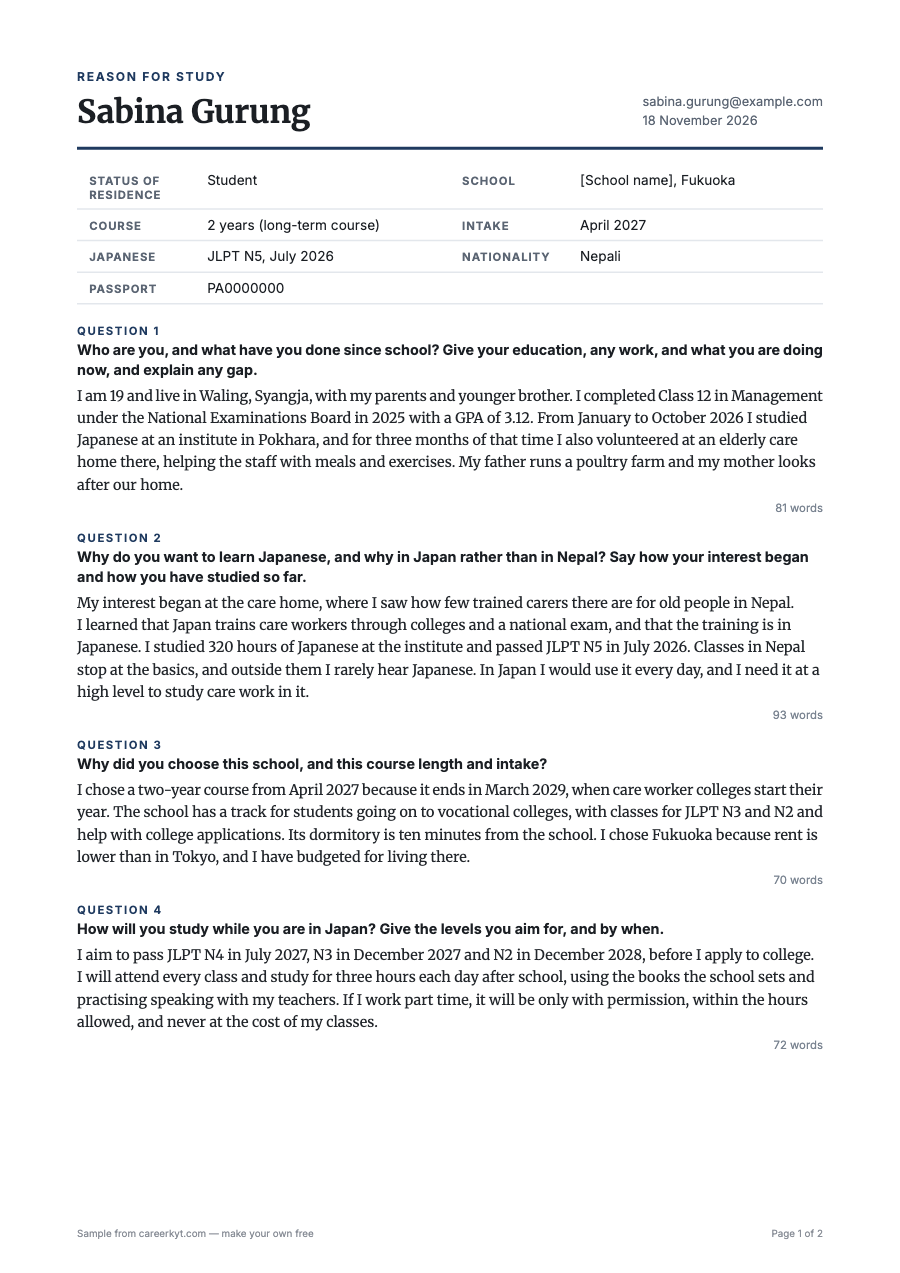
SOP sample for Germany student visa — letter of motivation
Germany asks for a letter of motivation: 6 parts. Three samples, each for a different course:
Sample 1: IT · MSc Computer ScienceSujan — BE Computer Engineering graduate from Pokhara, two years as a software engineer in Lalitpur, admitted to an English-taught MSc in Computer Science. · 644 words
I studied for a Bachelor of Engineering in Computer Engineering at a Pokhara University college from 2019 to 2023 and graduated with a CGPA of 3.45 out of 4. I chose computing because I built small websites for shops in Pokhara while at school and wanted to understand how larger systems work. The course covered programming, data structures, databases, computer networks and operating systems, and in the final year I built a booking system for trekking agencies with two classmates as our project. Since August 2023 I have worked as a software engineer at an IT company in Lalitpur, where I build and maintain backend services for a client in the Netherlands. My transcripts, degree certificate and experience letter are attached.
I have been admitted to the MSc in Computer Science at [university] for the winter semester 2027/28. It is a four-semester programme of 120 ECTS credits, taught in English, and I will specialise in distributed systems. The modules I have chosen, Distributed Systems, Cloud Computing and IT Security, follow from my work: our services now run on several servers, and the faults I spend most time on are ones my bachelor’s course never covered. I looked at the master’s courses I could join in Kathmandu, but none offered a specialisation in distributed systems with a thesis written inside a research group. At [university] the distributed systems group takes master’s students for project work and theses, and fault-tolerant systems, its main research area, is what I want to write my thesis on.
I chose Germany over the United Kingdom and Australia, the other two countries I looked at, for three reasons. Its master’s programmes in computer science last two years and end in a research thesis, rather than one year of taught courses. Public universities charge no tuition for this programme; I will pay a semester contribution of about EUR 300, which includes a local transport ticket. And German industry, from car makers to machine builders, depends on the reliable distributed software I want to build. I understand that study there means a great deal of self-study and written exams at the end of each semester. I have passed the Goethe-Zertifikat A2 in Kathmandu and will continue German at the university’s language centre, so that I can manage daily life and, later, work in German.
After the degree I want to work as a backend or cloud engineer. German law lets graduates stay for up to 18 months to look for skilled work, and I would like to spend two or three years with a German software company, where systems of a much larger scale are built. I then plan to return to Pokhara, where my family lives, and set up a small team that builds and runs software for clients abroad, as my present employer does in Lalitpur. Nepal’s IT exports are growing, and engineers who have run large systems are still few. My employer has written that it would welcome me back in a senior role; the letter is attached.
I have opened a blocked account and paid in EUR 11,904, which releases EUR 992 a month for the first year; the confirmation is attached. The money comes from my own savings since 2023 and from my father, who has run a pharmacy in Pokhara since 2005; his business registration, tax clearance and bank statements are attached with our relationship certificate. I have budgeted about EUR 380 a month for a room in a shared flat, EUR 140 for health insurance and EUR 300 for food and other costs. I may work part time within the limits for students, but my budget does not depend on it.
I have no gap in my studies or work. I have not applied for a visa to Germany or any other Schengen country before, and I have not been refused a visa for any country.
A made-up student, to show the order and the level of detail. Write your own: the Germany maker asks the same questions and counts as you type.
Sample 2: Agriculture · MSc, degree from IndiaPratiksha — From Chitwan, BSc Agriculture from an Indian university on a Government of India scholarship, two years as an agriculture technician with a municipality, admitted to an English-taught MSc in Agricultural Sciences. · 608 words
I completed a BSc (Hons) in Agriculture at a state agricultural university in India from 2019 to 2023, on a Government of India scholarship for Nepali students, with an OGPA of 8.1 out of 10. I grew up on my family’s farm in Chitwan, where we grow rice and mustard and keep poultry, and I chose agriculture to understand why our yields were falling. The course covered soil science, agronomy, plant breeding, plant protection and agricultural economics, and in the final year I spent six months on a village placement working with farmers. Since January 2024 I have worked as an agriculture technician in a municipality in Chitwan, where I run soil tests and train farmers’ groups. Because my degree is from India, my APS certificate is attached.
I have been admitted to the MSc in Agricultural Sciences at [university] for the winter semester 2027/28. It is a two-year programme of 120 ECTS credits, taught in English, with a focus on farming in tropical and subtropical regions. I will take the modules on soil fertility and land management and on crop production systems, because my work has shown me that a soil test is only useful if the advice that follows fits a small farm. The programme ends with a thesis that may use field data from the student’s own country, and I plan to write mine on soil acidity in the Chitwan valley. I could not find a master’s in Nepal in this field taught in English with a field thesis of that kind.
German universities have a long record of research on tropical agriculture, and this programme brings together students from Asia, Africa and Latin America, which matters in my field because the problems are shared. I also compared programmes in the Netherlands and Australia, but their fees were far above what my family can pay. [University] charges non-EU students a tuition fee of EUR 1,500 a semester plus the semester contribution, and I have included both in my budget. I understand that master’s students in Germany plan much of their own study and must pass written and oral exams. I have passed the Goethe-Zertifikat A1 and am studying for A2, so that I can talk with farmers and staff on field visits.
I plan to return to Nepal after the degree. I want to work as a soil fertility specialist, first with a development project in Chitwan and later in agricultural research. Nepal imports its chemical fertiliser, and in my area much of it is used without a soil test, so farmers lose both yield and money. My municipality has written that it will consider me for a senior post in its agriculture section when I return; the letter is attached. In the longer term I want to set up soil testing that farmers’ groups can run themselves.
My parents will pay for my studies from our farm’s income and their fixed deposits. The farm has 1 bigha 5 kattha of land in our family’s name and a poultry unit registered with the municipality. I have paid EUR 11,904 into a blocked account for the first year and set aside EUR 1,500 for the first semester’s tuition; the confirmations are attached with the land ownership certificate, the farm’s tax records, bank statements and our relationship certificate. I have budgeted about EUR 850 a month for rent, health insurance and food, and I do not plan to rely on part-time work.
After my degree in 2023 I spent six months at home, helping on the farm and preparing for the municipality’s recruitment exam, which I passed. I have not been refused a visa for any country.
A made-up student, to show the order and the level of detail. Write your own: the Germany maker asks the same questions and counts as you type.
Sample 3: Studienkolleg · then Electrical EngineeringRoshan — +2 Science graduate from Biratnagar with German at B1, admitted to a Studienkolleg technical course, leading to a bachelor’s in electrical engineering taught in German. · 556 words
I passed Grade 12 in the Science stream under the National Examinations Board in 2025, at a school in Biratnagar, with a GPA of 3.41. I chose science because I wanted to study engineering, and physics and mathematics were my strongest subjects. The course covered physics, chemistry, mathematics, computer science and English, and in physics I liked electricity and magnetism most. Since my +2 I have studied German full time in Kathmandu and passed the Goethe-Zertifikat B1 in June 2026. I have no work experience. My Grade 10 and Grade 12 certificates and mark sheets, my character certificate and my B1 certificate are attached.
I have been admitted to the technical course (T-Kurs) of the Studienkolleg at [university] for the summer semester 2027, after passing its entrance test. The course lasts two semesters, is taught in German, and covers mathematics, physics, chemistry, computer science and German. It ends with the assessment examination (Feststellungsprüfung), which I need because a Nepali +2 certificate does not by itself give entry to a German bachelor’s degree. After it I want to study for a Bachelor of Engineering in Electrical Engineering, a seven-semester degree that includes a practical semester in a company. I chose electrical engineering because of power: in Biratnagar I have seen factories stop whenever the supply fails.
I chose Germany because its universities of applied sciences teach engineering through laboratory work and a semester in industry, and public universities charge no tuition; I will pay a semester contribution of about EUR 300. My family could not afford the fees in Australia or the United Kingdom. Learning German was part of the decision: I have studied it for a year and want to study and work in it. I know that the Studienkolleg expects full attendance, that the final examination can be repeated only once, and that my bachelor’s place depends on my result.
After my bachelor’s degree I want to work as an electrical engineer in Nepal’s hydropower or power distribution sector. New plants and transmission lines are being built in Koshi Province, and the companies building them need engineers who understand power systems and protection. I would like to gain experience in my practical semester and, if possible, for a year or two in Germany, and then return to Biratnagar, where my mother lives and where my father plans to come home from Qatar. In the longer term I want to help keep the power supply steady for the factories around Biratnagar.
My father has worked as a site supervisor for a construction company in Qatar since 2016 and sends money home every month; his employment contract, salary letter and remittance records are attached. My mother runs a grocery shop in our own house in Biratnagar. From their savings I have paid EUR 11,904 into a blocked account for my first year; the confirmation is attached with our relationship certificate and the land ownership certificate for the house. I have budgeted about EUR 350 a month for a room in a student hall, EUR 140 for health insurance and EUR 300 for food and other costs.
I finished my +2 in 2025 and have spent the time since learning German full time, from A1 to B1, and preparing for the Studienkolleg entrance test; the certificates are attached. I have not been refused a visa for any country.
A made-up student, to show the order and the level of detail. Write your own: the Germany maker asks the same questions and counts as you type.
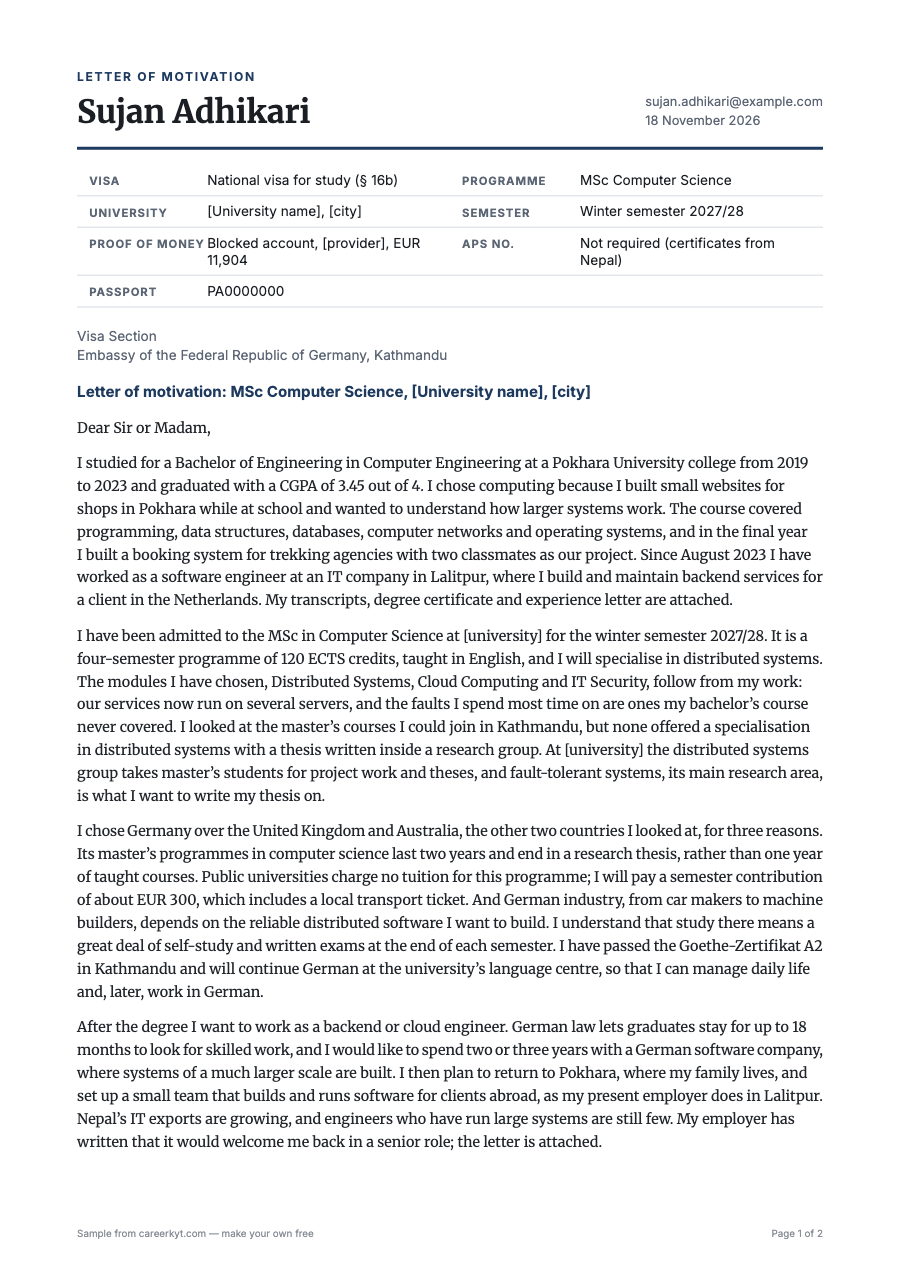
Cover letter samples for a visitor visa
For a parent or relative visiting, the letter is a cover letter, not an SOP. One sample for each country, as a PDF and a Word file:
- SchengenFamily visit · Parents to their son in GermanyPDFWord
- United KingdomParents · visiting their daughter in ReadingPDFWord
- JapanVisiting family · Parents to a daughter in YokohamaPDFWord
- CanadaParents · son’s convocation in TorontoPDFWord
- AustraliaParents · Son’s graduation in SydneyPDFWord
- New ZealandParents · visiting a daughter who works in HamiltonPDFWord
How to use a sample without copying it
- Read the sample for your country and the course nearest yours, for the order and the level of detail: names of modules, the fee in rupees, who pays and from what income.
- Write every sentence about yourself. The facts must agree with your papers: marks, gap years, the sponsor's income and the bank balance.
- Explain a gap or a change of subject plainly, with what you did in that time — the SOP guide shows how.
- Keep to the country's limit. The makers count as you type.
Common questions
Where can I find SOP samples for free?
On this page: 24 statements of purpose for Australia, the UK, Canada, New Zealand, the USA, Korea, Japan and Germany, three for each country, each for a different course, written to that country's own questions and limits. The first sample for each country is a PDF and a Word file too.
Can I copy an SOP sample?
No. Use a sample to see the order and the level of detail, then write every sentence about your own course, money and plans. Visa officers read the same samples everyone finds, and the UK's UCAS checks every personal statement for similarity to others.
Is there an SOP sample for an Australia student visa as a PDF?
Yes. Australia now asks for a Genuine Student statement — four answers of up to 150 words each, typed into the visa form — and the first Australia sample on this page is a PDF and a Word file. The other two are for nursing and accounting.
How long should an SOP be?
As long as the country asks: Australia, four answers of up to 150 words each; the UK, three parts in up to 4,000 characters; Canada, New Zealand, the USA and Germany expect a letter or essay of six or seven parts, and the samples here run 550–770 words. Japan and Korea ask for a reason for study or a study plan in parts.
What is the format of an SOP?
Five things in order: who you are and what you studied, why this course, why this institution and country, how you will pay, and what you will do after. Each country names its own parts; the format, paragraph by paragraph, is in our guide to the statement of purpose.