
Most SOP advice for Japan describes a university essay. A Nepali student going to a language school writes something shorter and more exact: the reason for study, which the school sends to immigration with your Certificate of Eligibility application. Write each part here with a word counter, see it as a page, and copy it onto your school’s form.
What Japan actually asks for
The language school applies for your Certificate of Eligibility (COE) at the Immigration Services Agency; you then take the COE to the embassy for the visa. Immigration’s lists for a language-school COE ask for the application form, your passport and proof of Japanese and, depending on the school’s rating, your last graduation certificate and your sponsor’s papers. None of them lists a reason for study, and immigration warns that it may ask for papers not on the list.
The reason for study is the school’s requirement, on the school’s form, and most schools ask for one. JASSO’s own language centre lists a “Reason and purpose of study in Japan” for applicants from Nepal, says no one else may write it for you, and asks anyone who finished their last school more than five years ago to explain those years in detail. Some schools take English (the Shinjuku Japanese Language Institute in Tokyo accepts Japanese, Chinese or English); others want your own language with a Japanese translation. Ask your school which it wants, and whether it wants the form in your own hand.
Sources: Immigration Services Agency, status of residence “Student” and JASSO Tokyo Japanese Language Education Center, admission, read 18 November 2026. Check them again before you apply.
The six parts, and what each one wants
- You and your studies so far: your last school or college, the year and result, any work or training, with no months missing.
- Why Japanese, why Japan: how your interest began, the hours you have studied and the test you passed, and why in Japan rather than in Nepal.
- This school, this course: what the school offers you, and why this length and intake. A course that ends in March meets colleges and universities that start in April.
- Your study plan: the levels you aim for and the test months, how you will study, and part-time work only within the hours allowed.
- After the language school: the next course and the work it leads to, said honestly. It must agree with the plan on your application form.
- Who pays, and how: your sponsor, their income, how the savings were built, and the fees and living costs in yen.
- If you have been refused a COE or visa, withdrew an application, or have papers that differ, a seventh part explains it. Leave it out if nothing applies.
SOP sample for Japan student visa — PDF and Word
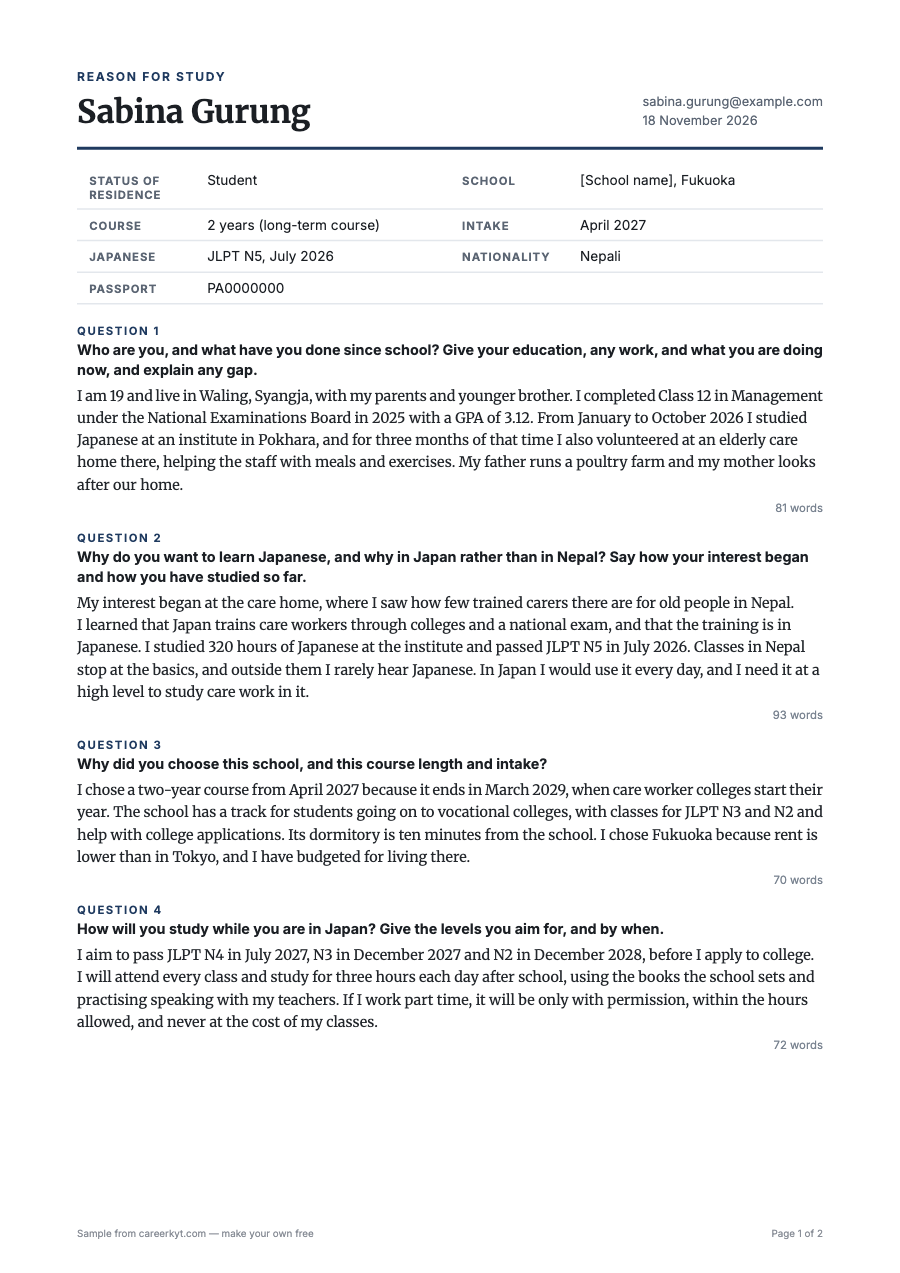
A complete reason for study for a made-up student, Sabina, a +2 graduate from Syangja with JLPT N5, going to a two-year course in Fukuoka and then a care worker college: 481 words in all. Download the PDF or the Word file.
The maker above has two more: Rojan, a BSc CSIT graduate from Bhaktapur aiming for a master’s in information science, and Manoj, a cook in Pokhara who finished +2 in 2020 and explains the years since. Open “See examples” under any part and switch between them. Read them for the shape, then write yours about you. Schools interview applicants, and a statement you cannot talk about in your own words does more harm than good.
What changed in 2026
- Hours alone no longer prove your Japanese. Until now, 150 hours of study could show the A1 level a language school needs. From the October 2026 intake, immigration requires a test certificate or the school’s interview. The tests include JLPT N5, JFT-Basic A1 and, for the time being, NAT-TEST 5Q. Schools are asked to interview applicants where they can.
- Schools now check part-time work every three months: where you work, what you do, and your daily hours. The limit is 28 hours a week, with permission. Immigration says part-time work cannot pay all your fees and living costs.
- From the April 2027 intake, a new immigration form has the school confirm that it has checked your sponsor’s papers and why they pay.
- A TB clearance certificate has been required from Nepali applicants since 23 June 2025. It comes from a clinic Japan designates and is valid for 180 days from the chest X-ray.
- Source: Immigration Services Agency, April 2026 notice on Japanese language school entrants (in Japanese), read 18 November 2026. These changes apply to every nationality, not to Nepal alone.
The papers from Nepal that back each part
Nepal is not on immigration’s list of countries whose applicants may send fewer papers, so a Nepali applicant usually sends the full set. That means a sponsor’s statement on the school’s form, written by the sponsor, explaining how they came to pay. It also means proof of your relationship, a bank balance certificate (original), the past year’s bank records showing how the money was saved, and the sponsor’s job and income for the last year. Immigration warns that a large sum paid in just before applying, or a forged certificate, counts against you.
From Nepal that usually means a relationship certificate from the ward, the sponsor’s income certificate and tax clearance, a salary certificate if the sponsor is salaried, your graduation certificate and a character certificate, an experience letter if you have worked, and the student NOC to send the fees. Every figure in your reason for study should match these papers. An income, a date or a job title that differs is what an officer notices first.
If you are applying to a university, or for MEXT
A university or graduate school sets its own statement: often a 志望理由書 (reason for applying) with a length in Japanese characters, and two college forms we read asked for 700–800 and about 1,200 characters. For graduate study, contact with a professor and a research plan matter most. A MEXT scholarship through the embassy uses MEXT’s own forms, including a field of study and research plan. Follow the university’s form and its limit; the general structure is in the SOP guide.
What weakens a reason for study
- Someone else’s words. Consultancy templates read the same in hundreds of files, and the school may interview you about what you wrote.
- Money as the reason. A plan that depends on part-time work to pay fees, or on sending money home, goes against what immigration says.
- A plan that does not fit. Saying you will work in Japan straight after a language school, or naming a university without a path to the Japanese level it needs. Immigration says going on to a university or vocational college needs B2-level Japanese, about JLPT N2.
- Gaps left unexplained. A year at home after +2 is normal; months missing from your history are not.
- Figures that do not match. An income, a bank balance or a date that differs from your sponsor’s papers.
Common questions
Is an SOP required for a Japan student visa?
Immigration’s lists of documents for a language-school COE do not include one, but most schools ask for a reason for study on their own form and send it with your application. For a university, the statement is part of admission. In practice, yes: write one.
What is 留学理由書 (ryūgaku riyūsho)?
The reason for study: your own account of why you are learning Japanese, why in Japan, why this school, your study plan, what you will do after, and how it is paid for. Language schools ask for it on their application form, usually with a declaration that you wrote it yourself.
How many words should an SOP for Japan be?
Immigration sets no length. Your school’s form sets the space, and some schools give a length in Japanese characters. About 350–550 words in English, one A4 page, covers the six parts well. If the school gives a character count, ask how it applies to an English statement.
Can I write my SOP for Japan in English?
Often yes. The Shinjuku Japanese Language Institute in Tokyo accepts Japanese, Chinese or English, while YIC Kyoto wants your own language with a Japanese translation, and JASSO asks for a translation that names the translator. Ask your school which language it wants before you write.
Is 150 hours of Japanese enough for a Japan student visa?
Not on its own, from the October 2026 intake. Immigration now requires a test certificate, such as JLPT N5, JFT-Basic A1 or NAT-TEST 5Q, or an interview by the school. The hours still go on the certificate from your institute in Nepal.
How much bank balance is needed for a Japan student visa from Nepal?
Immigration does not fix an amount. It asks for a bank balance certificate, the past year’s records showing how the money was saved, and the sponsor’s income. Schools set their own figure: Yoshida Institute, for example, asks for at least USD 20,000. Ask your school, and never borrow a large sum to show just before applying.
Can I say I want to work in Japan after my studies?
Be honest, and make the plan fit. Finishing a language school does not by itself qualify you to work; most work statuses need a degree, a vocational college diploma or passed skills tests, and immigration decides each case. Whatever you write must match the plan on your application form.
Is there a reason for studying in Japan sample letter?
Yes: this page has a complete sample as a PDF and a Word file, for a made-up +2 graduate going to a care worker college, and the maker shows two more, for an IT graduate and a working cook. Use them for the shape only. Your school may interview you, so the words must be yours.
Can a consultancy write my SOP for Japan?
It can help you check the facts, but the statement should be yours. JASSO says no one else may write it for you, and schools ask you to sign that you wrote it. A template you cannot explain in an interview is a risk to your application.
More free tools
All free tools, by category. Writing something in Nepali? The CV maker, the निवेदन tool and the document tools are free too.
Last updated