
Most cover letter samples for Australia are written for applicants from India or Singapore, and few say what Home Affairs actually lists. This maker follows that list. Write the six parts (your trip, its purpose, the money, your ties, your travel history, the visa conditions), add a seventh only if you need it, watch the length as you type, and download the letter as PDF or Word.
Does Australia ask for a cover letter?
Not by name. The Tourist stream page asks you to “provide as much proof as you can to show you are visiting Australia as a temporary visitor only”, and lists what that proof could be: money for the stay, an invitation from a relative or friend, “your plans while in Australia”, and reasons to return home. A cover letter is not on the list. It is the common way to set out your plans and to point the officer to each paper.
The test behind the list is clause 600.211 of the Migration Regulations: you must genuinely intend “to stay temporarily in Australia for the purpose for which the visa is granted”. The officer looks at whether you kept to the conditions of any earlier Australian visa, whether you intend to keep to this one’s, and “any other relevant matter”. Clause 600.212 adds that you must have, or have access to, enough money for the stay. Home Affairs sets no bank balance figure.
Which stream. The Tourist stream is for a holiday or a visit to family or friends, and needs no sponsor. The Sponsored Family stream needs a sponsor who is your relative and a settled Australian citizen or permanent resident. Each costs AUD 250 per applicant (about NPR 25,000), and each member of a family applies separately. The Australian Embassy in Kathmandu does not handle visas; it says the High Commission in New Delhi manages most applications from Nepal. You apply online in ImmiAccount either way.
Home Affairs’ processing time guide, updated 2 November 2026, shows half of Tourist stream applications decided within 21 days and 90% within 31; for the Sponsored Family stream, 40 and 89 days. Sources read on 18 November 2026; check the fee and the times again before you apply.
The six parts of the letter, and what each answers
- You and your trip: who you are, the visa and stream, your dates, and who travels with you. Home Affairs generally grants a stay of three months, so ask for what your plan needs.
- Why you are visiting: the reason, who invited you, where you will stay, and your weeks in Australia. These are the “plans while in Australia” that Home Affairs lists.
- Who pays for the trip: what it costs, who pays, the income behind it and where the money is. Home Affairs names itemised bank statements for three months, pay slips, audited accounts, tax records and term deposits.
- Why you will return to Nepal: your job and approved leave, your business, the family who stay, your house or land. Home Affairs lists each of these as a reason to return home.
- Your travel history: where you have been and that you came back on time. Clause 600.211 looks first at whether you kept to the conditions of any earlier Australian visa.
- Your visa conditions and return: no work, no study longer than three months, leaving before your stay ends, and health insurance. It answers the clause’s second test, and it closes the letter.
- Anything else is optional: a longer visa as the parent of an Australian citizen or permanent resident, a child travelling with you, a health matter, a sponsor’s form, or what has changed since a refusal.
Sample cover letter for Australia visitor visa — PDF and Word
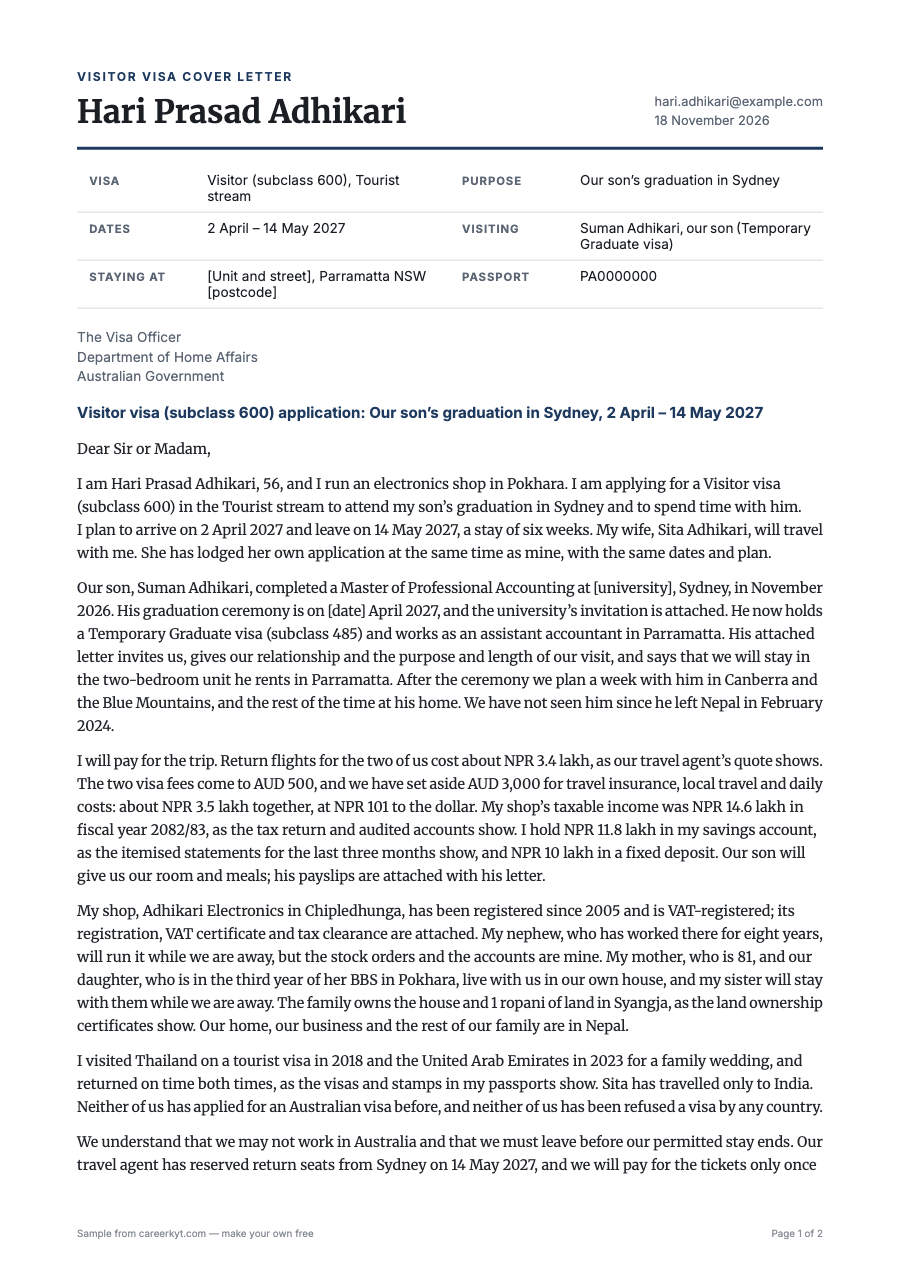
A complete letter for a made-up applicant, Hari from Pokhara, who is going with his wife to their son’s graduation in Sydney. The son finished his master’s there and now holds a graduate visa. Download the PDF or the Word file.
The maker has two more. Anisha is a bank officer from Lalitpur on a 16-day holiday with her husband, on approved leave. Prakash is a poultry farmer from Chitwan on his first trip abroad, sponsored by his brother, an Australian citizen, for the brother’s wedding. Open “See examples” under any part and switch between them. Read them for the shape, with each claim tied to a document, then write yours about you.
Parents visiting a son or daughter: the invitation letter
Home Affairs names this letter in its list. It says a letter from your relative or friend in Australia “could state: their relationship to you; the purpose of your visit and length of stay; if you will be staying with them”, and that if they will pay for your stay, you should “provide proof of their funds”. Ask your son or daughter to add their own visa or citizenship, their address, and their signature with the date.
With it, attach a copy of their passport and visa grant or VEVO record, their enrolment or employment letter, and for a graduation, the university’s invitation to the ceremony. If they pay for anything, add their payslips and a bank statement. Link yourself to them with a relationship certificate (नाता प्रमाणित) from your ward office, in English.
Your son or daughter is on a student, graduate or work visa: apply in the Tourist stream with their invitation letter. The Sponsored Family stream is not open to you, because the sponsor must be a settled Australian citizen or permanent resident, who has usually lived in Australia for the last two years.
Your son or daughter is an Australian citizen or permanent resident: you may ask for a visa valid for more than 12 months. Say so in your application and attach proof of their status. Home Affairs decides case by case; you still cannot stay more than 12 months in any 18, and you must have health insurance. For longer stays at a time, Home Affairs points to the Sponsored Parent (Temporary) visa. They can also sponsor you in the Sponsored Family stream, which may bring a security bond, usually AUD 5,000 to 15,000 per person, refunded when you leave on time.
Each parent applies separately. You can attach the same letter to both applications, or write one each with the same dates and plan. The officer may read both, so the facts must agree.
The papers from Nepal behind each part
Money. Itemised statements for your own account for the last three months, a balance certificate, and a fixed deposit certificate if you have one. If you are employed, add a salary certificate or pay slips (see salary certificate for a visa). If you run a business, add its registration, audited accounts and tax clearance. Explain a large deposit in the last few months with the paper behind it: a land sale deed, a loan, a matured deposit. If a family member in Nepal pays for you, add their affidavit of support.
Ties. If you work, a letter from your employer giving your post, your salary, the approved leave dates and a line that you will return to the job: Home Affairs asks for “a letter from your employer stating you plan to return to your job”. An employer’s NOC or leave letter does this. Add your land ownership certificates (lalpurja), and a relationship certificate for the family who stay.
Identity and history. Your passport bio page, any old passports with visas and stamps, and your national identity card if you have one, or your citizenship certificate.
Translations and scans. Anything not in English needs an English translation as well as the original. A translator in Nepal need not be accredited, but each translation must give their full name, address and telephone number, and their qualifications and experience in the language. You need no certified copies unless Home Affairs asks. Scan every page in colour, and save a document of several pages as one file.
After you apply. Home Affairs tells you if you must give biometrics; its list shows collection centres in Kathmandu and, with reduced hours, Pokhara, run by VFS Global for a fee. Applicants aged 75 or over need a medical examination, and a stay of six months or more can need one too. Do not buy tickets yet: Home Affairs says not to arrange travel until it tells you in writing that the visa is granted.
Why visitor visas are refused, and what weakens a letter
- A plan that does not fit the person. A long stay with no clear reason, or dates that do not match the leave your employer approved.
- Money without a source. A large deposit just before you apply with no paper behind it, or a host who pays but shows no proof of funds.
- Ties stated, not shown. A job with no employer’s letter, a business with no registration, a house with no lalpurja.
- Numbers that disagree. Dates, amounts or names that differ between the letter, the form, your spouse’s application and your papers.
- Silence about a refusal. The form asks about refusals by any country. Say what has changed, and show it with a document.
- Plans to work. A visitor visa does not allow work. The Australian Embassy in Nepal warns about agents who say you can work on one, or switch to a student visa once there. A visitor visa may also carry condition 8503, under which you cannot be granted most other visas while you are in Australia.
- After a refusal. The refusal letter gives the reasons and says whether the decision can be reviewed. If it cannot, apply again only with the papers that were missing, and keep everything else the same.
Common questions
Is a cover letter mandatory for an Australia tourist visa?
No. Home Affairs does not list one. It asks for proof that you are a genuine visitor, including “your plans while in Australia”, and a cover letter is the usual way to set those plans out and point the officer to each paper.
Who should the cover letter be addressed to?
To the Department of Home Affairs: “The Visa Officer, Department of Home Affairs, Australian Government”. You attach it in ImmiAccount. The Australian Embassy in Kathmandu does not handle visas; the High Commission in New Delhi manages most applications from Nepal.
How much bank balance is needed for an Australia tourist visa from Nepal?
Home Affairs sets no figure. You must have, or have access to, enough money for your stay and to leave Australia. Give the trip’s cost in the letter, show a balance that covers it with itemised statements for the last three months, and show the income behind it.
What is the Australia tourist visa fee from Nepal?
AUD 250 per applicant in the Tourist stream, applied for outside Australia, as of November 2026 (it rose from AUD 200 on 1 July 2026): about NPR 25,000 at mid-November rates. The Sponsored Family stream is also AUD 250. Biometrics, medical checks and translations cost extra. Check Home Affairs’ Visa Pricing Estimator before you pay.
How long does an Australia visitor visa take from Nepal?
Home Affairs’ worldwide figures, updated 2 November 2026: half of Tourist stream applications were decided within 21 days and 90% within 31; for the Sponsored Family stream, 40 and 89 days. They are a guide, not a promise, so apply well before you plan to travel.
Can parents of a student in Australia apply in the Sponsored Family stream?
No. The sponsor must be a settled Australian citizen or permanent resident. Parents of a son or daughter on a student, graduate or work visa apply in the Tourist stream, with an invitation letter from their child.
What should an invitation letter for parents’ visitor visa to Australia say?
Home Affairs says it could state the relationship, the purpose of the visit and the length of stay, and whether the parents will stay with the host. If the host pays, attach proof of their funds. Add the host’s visa or citizenship, address, signature and the date.
How long can parents stay on an Australian visitor visa?
Generally three months, and up to 12 months in some cases. Parents of an Australian citizen or permanent resident may get a visa valid for more than 12 months, but can stay no more than 12 months in any 18. Longer stays at a time need the Sponsored Parent (Temporary) visa.
Can I work or change to a student visa on a visitor visa?
You cannot work on a visitor visa, and you can study for no more than three months. If your visa carries condition 8503, you cannot be granted most other visas while in Australia. The Australian Embassy in Nepal warns that agents who promise otherwise are running a scam.
How long should the cover letter be?
Home Affairs sets no length. One to two pages is usual, and the ranges in the maker add up to about 350–800 words. Short and exact, with every figure found in a document, is better than long.
More free tools
All free tools, by category. Writing something in Nepali? The CV maker, the निवेदन tool and the document tools are free too.
Last updated