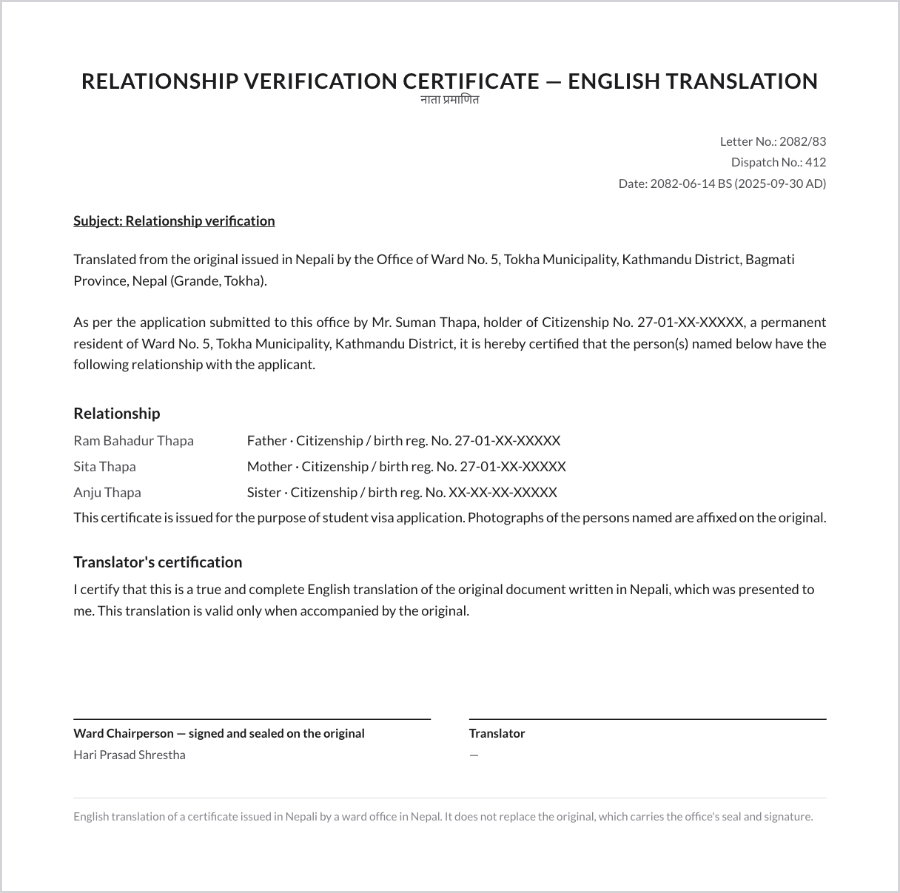
A relationship certificate — नाता प्रमाणित — is the ward office's written confirmation of how named people are related: parents and children, husband and wife, brothers and sisters. The ward issues it in Nepali. Embassies, foreign universities and immigration offices want it in English. This page shows the English format they expect, makes the translation for you from the certificate you already have, and explains how to apply for one if you do not have it yet.
What a relationship certificate is used for
Visas. Student, dependant and family visas ask for proof of relationship — a student showing who their sponsoring parents are, a spouse joining a partner abroad, a parent visiting a child. The relationship certificate is the Nepali document that answers it.
Sponsorship and bank documents. When a parent sponsors a student's studies, the embassy matches the sponsor's name on the bank and income papers against the relationship certificate. Our sponsor affidavit is often filed with it.
Inside Nepal — property transfer after a death (नामसारी), insurance and pension claims, and some bank and court processes — the Nepali original is what is used.
How to get a relationship certificate from your ward
The certificate is issued by the ward office of your permanent address. You apply with a short निवेदन to the ward chairperson — our निवेदन tool writes the नाता प्रमाणित application — naming each person and their relationship to you.
Attach what proves each relationship: citizenship certificates of the adults, birth registration for children, marriage registration for a spouse, and recent passport photos where the ward asks for them. Some wards also want the current year's land or house tax receipt.
Ask for English if you need it. Some ward offices will issue the certificate in English, or in both languages, on request. If yours does, you may not need a translation at all — ask before you apply.
Requirements and fees differ from one municipality to the next, and a few now accept applications online. Check with your own ward office.
Relationship certificate in English — the format
An English translation reproduces the original line for line, adding nothing. Embassies compare it against the Nepali certificate, so everything on the original must be there:
The issuing office — ward number, municipality or rural municipality, district and province — and the letter number, dispatch number and date, with the BS date and, ideally, the AD date beside it.
The certifying sentence: that, on the application of the named person, the persons listed have the stated relationship with them.
Each person — full name, relationship to the applicant, and the citizenship or birth registration number shown on the original — in the original's order.
The purpose, if the original states one, a note that photographs are affixed if they are, and who signed it, marked "signed and sealed on the original".
The translator's certification at the foot: that this is a true and complete translation of the original. Most embassies want that certified by a translator or a notary public (नोटरी पब्लिक), and always presented with the original.
The mistakes that get a translation sent back
Names spelled differently from the passport. The single commonest problem. Use the exact English spelling on each person's passport, not a new transliteration of the Nepali.
BS dates converted wrongly, or converted without saying so. Give the BS date as on the certificate, and the AD date beside it, labelled.
Leaving a person out because they are not relevant to this visa. A translation that differs from the original in what it lists is not a translation.
Making it look like the original. A translation carries no seal and is not on the ward's letterhead. It says it is a translation, and it travels with the original — which is what makes it acceptable.
Common questions
What is a relationship certificate in Nepal?
It is नाता प्रमाणित, a certificate from your ward office confirming how named people are related to you — parents, children, spouse, siblings. It is issued in Nepali by the ward of your permanent address, on your application.
How do I get a relationship certificate in English?
Ask your ward office first — some issue it in English or both languages on request. Otherwise, translate the Nepali certificate into English with every detail copied exactly, and have the translation certified by a translator or a notary public. Submit it together with the original.
Can this tool issue a relationship certificate?
No. Only the ward office can issue one. This tool translates a certificate you already have into English, and our निवेदन tool writes the application to request one from your ward.
What documents are needed for a relationship certificate?
Usually an application to the ward, citizenship certificates of the adults, birth registration of children, marriage registration for a spouse, and photographs. Some wards ask for a tax receipt as well. Requirements vary, so check with your ward office.
Does the English translation need to be notarised?
Most embassies expect the translation to be certified by a translator or notarised by a notary public, and presented with the original. Check the checklist of the embassy you are applying to.
Other tools
House rent agreement
Fill in the details and download a complete agreement, ready to sign.
Vehicle sale agreement
Selling a bike or a car — record it properly, in one page, ready to sign.
Land sale agreement (बैना)
The advance-payment agreement made before राजिनामा — written down properly.
Loan agreement · तमसुक
Lending money to someone? Write it down before it goes wrong.
Employment contract
Put the job, the pay and the notice period in writing — for both sides.
Partnership agreement
Starting a business together — settle the hard questions while they are easy.
Certificate
Participation, prize, appreciation and training certificates in eight designs — plus experience, character and salary letters. Print a whole list at once.
Affidavit of financial support · आर्थिक जमानतनामा
Who is paying for your study abroad, how much, and where the money comes from.
Application to a ward office · निवेदन
नाता प्रमाणित, बसाइँसराइ, दर्ता, सिफारिस — the opening line every office expects.
Complaint to the police (जाहेरी)
The structure a police office expects — so your complaint is not handed back.
Consent letter for a minor's travel
For a passport, a visa, an airline or a school trip — in the form they ask for.
Signature
Draw it or photograph it, get a clean transparent PNG — and put it on your documents.
Last updated