
Most Japan cover-letter samples online are written for India or the Philippines, where some visa centres ask for one. Kathmandu’s lists do not, but Japan wants a plain account of what you will do, and a short letter is where your papers and your inviter’s papers meet. Write the seven parts here, watch the length as you type, and download the letter as PDF or Word.
Does Japan ask for a cover letter from Nepal?
Applications from Nepal go to the Japan Visa Application Centre in Kathmandu, run by VFS Global, and the Embassy of Japan in Nepal decides them. Its two lists for a temporary visitor, tourism and visiting relatives and friends, name the visa form, your passport, a 45 × 35 mm photo, a flight reservation, proof of funds and a plan of the stay. Neither lists a cover letter. Both say every document on them is mandatory, so the letter is an extra page, never a replacement for one of them.
It is still worth writing. Japan’s short-term stay checklist says the purpose must describe what you will do, and that a vague description such as tourism or visiting relatives is not acceptable. The letter is where you say it in full, and where your own papers meet the ones your inviter sends from Japan. Some visa centres in India do ask for a covering letter, which is why so many samples online are written for Indian applicants.
VFS’s lists give about six working days for a decision, and the tourism list asks that you travel at least ten days after your appointment. The lists were read on 18 November 2026 and change without notice; check the current one on VFS’s page before you apply.
The seven parts of a Japan visa cover letter
- You and the trip: your name, age, work and town; the visa, a single-entry temporary visitor visa; your dates and the number of days, as on your flight reservation; and who travels with you.
- What you will do in Japan: the real reason (a person, an event, the places) and your plan by date and city, the same as your itinerary or the Schedule of Stay. This is the part Japan’s checklist means when it rejects a vague purpose.
- Who invites you: the inviter, how you are related, their status of residence, their work or school, and the papers they have sent. A tourist with no inviter says so in a line.
- Who pays, and from what: a rough cost of the trip, who pays it, and the income and balance behind it. If your inviter pays, they sign Japan’s Letter of Guarantee.
- Why you will return: your job and approved leave, your business or pension, the family who stay, your house and land.
- Your travel history: earlier trips on a visa, earlier visits to Japan, and any refusal. If this is your first trip abroad, say so.
- Your return, and your word: the date you fly home, that you will not work or study, and that every figure matches your papers.
Cover letter for Japan visa sample — PDF and Word
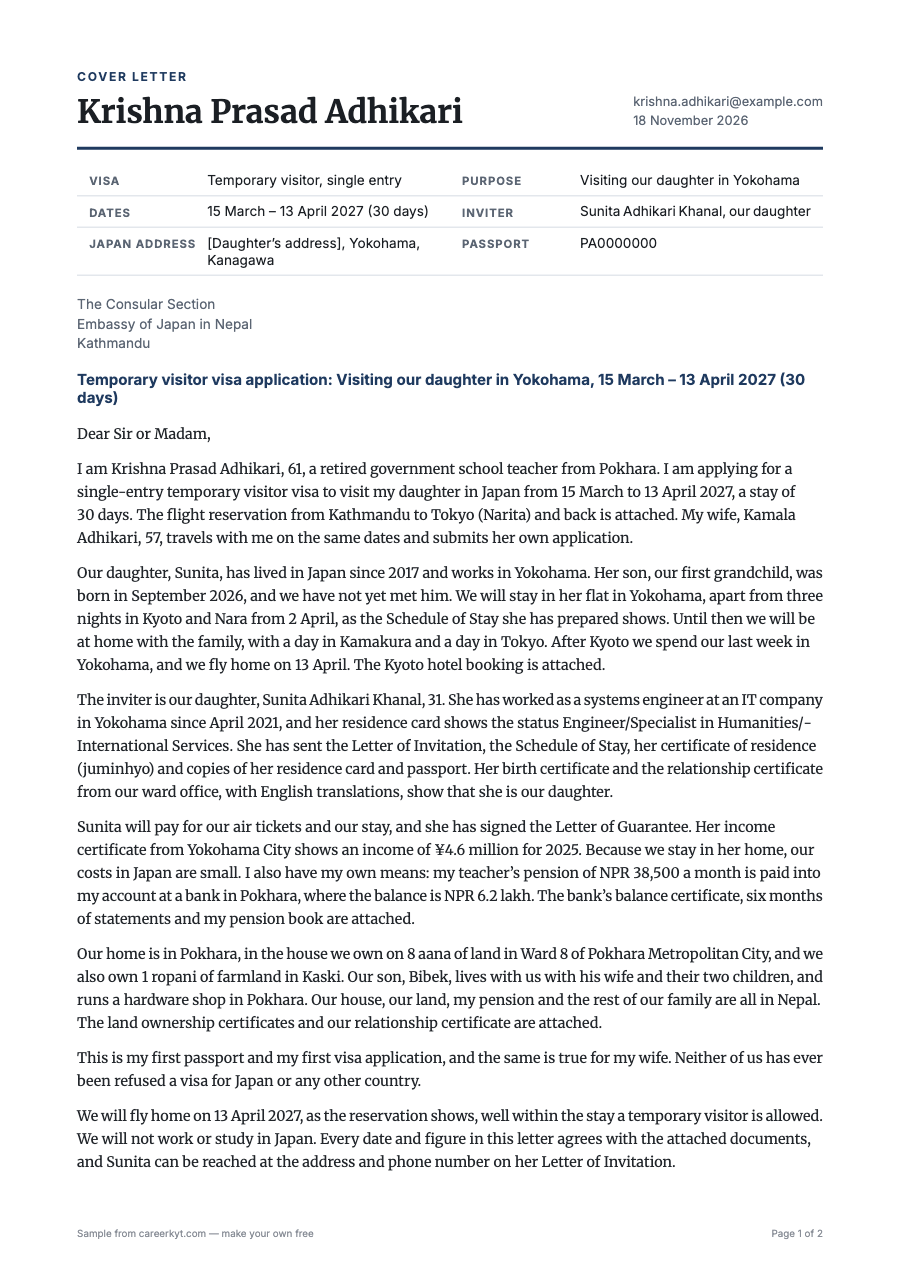
A complete letter for a made-up applicant, Krishna from Pokhara, a retired teacher going with his wife for 30 days to their daughter, a systems engineer in Yokohama, to meet their first grandson. His daughter pays and signs the Letter of Guarantee. Download the PDF or the Word file.
The maker has two more. Anish is an audit manager in Kathmandu taking nine days of leave to see the cherry blossom with his wife, paying for it himself. Puja runs a beauty parlour in Dharan and is going to her brother’s graduation in Fukuoka; he is a student, so she pays her own way. Open “See examples” under any part and switch between them. Read them for the shape, with each claim tied to a paper, then write yours about you.
Your papers, and the papers your inviter sends from Japan
From you, in Nepal. The visa form, signed; your passport and a copy of its photo page; one 45 × 35 mm photo; the flight reservation; and proof of funds. For funds, the tourism list names two originals: a certificate of income or tax payment issued by a public agency, and a certificate of deposit balance. In Nepal that usually means a tax clearance certificate or the ward office’s income-source certificate, with the bank’s balance certificate; ask VFS which it accepts when you book. Add six months of statements, and if you are employed, a salary certificate. Documents in Nepali must be translated into English.
From your inviter, in Japan. For a family visit your relative fills in Japan’s own forms: the Letter of Invitation (招へい理由書), the Schedule of Stay (滞在予定表) and, if they pay, the Letter of Guarantee (身元保証書). They add a certificate of residence (住民票, juminhyo) from their city office listing everyone in the household and a copy of both sides of their residence card, and, if they pay, an income or tax certificate from the city office. If the inviter or their spouse is Japanese, a certified copy of the family register (koseki) is needed too. If two or more of you apply together, they also fill in the List of Visa Applicants. The forms are on the foreign ministry’s visa pages; your inviter downloads, fills and signs them in Japan.
The rules on paper. The embassy asks for originals, not faxes or emailed copies, and papers issued in Japan are valid for three months from their date of issue. VFS wants a set of photocopies with the originals, in the order of its checklist, with no staples or pins. Japan’s checklists say a tax withholding slip (源泉徴収票) does not count as the inviter’s income proof, so ask for the city office’s certificate.
To prove the relationship, use a birth or marriage registration certificate and a relationship certificate (नाता प्रमाणित) from your ward office, translated. Japan counts as relatives a spouse, blood relatives and in-laws up to the third degree. Anyone further counts as a friend, and the friendship is shown with photos and messages rather than certificates.
The invitation letter for a Japan visa, and how yours differs
The invitation letter is not a letter your relative writes freely. Japan has a form for it, the Letter of Invitation, which the inviter fills in and signs: who is invited, the relationship, the purpose and the dates. The Letter of Guarantee is a separate form, signed only when the inviter pays, in which they undertake to cover the stay and the journey home.
Your cover letter is the other half of the same account. Write it after the inviter’s forms arrive, and copy their dates, addresses and spelling of names exactly. The officer reads both, and a difference between them is the first thing to stand out.
If your son or daughter studies in Japan, their income may be too small for them to act as guarantor. You can pay for the trip yourselves and say so in the letter; they still invite you and send the Schedule of Stay, and your own income and balance certificates carry the funds. Kathmandu’s list ties the guarantor’s papers to the person “who pays for the travel expenses”, so ask VFS which papers apply to you.
The leave letter (NOC) from your employer
Kathmandu’s tourism list, as read on 18 November 2026, does not name an employer’s letter. It is still the strongest single paper for the part on why you will return, so most employed applicants include one. Put it on the organisation’s letterhead, dated shortly before you apply, with your post, how long you have worked there, your salary, the leave approved and the date you are due back. The NOC maker has the wording; add an experience letter if your years of service matter.
If you run a business, the business registration, PAN and tax clearance do the same job. If you are retired, your pension book and the bank entries for it do.
Why Japan visas are refused, and what a refusal means
Japan does not tell you why a visa was refused. Its visa FAQ also says that an application for the same purpose will not be accepted within six months of a refusal. The embassy in Kathmandu says it sometimes accepts one sooner, where circumstances have changed significantly and the travel is needed for humanitarian reasons. So the first application is the one to get right. If you have been refused before, for Japan or anywhere, say when in the travel history part and what has changed.
These are the usual weak points:
- A vague purpose. “Tourism” or “visiting relatives” with no plan. Japan’s checklist says this is not acceptable.
- Two accounts that differ. Dates, addresses or names that are not the same in your letter, the visa form, the ticket and the inviter’s Schedule of Stay.
- Old or copied papers from Japan. A certificate of residence or a tax certificate more than three months old, or an emailed scan instead of the original.
- Money without a source. A large deposit just before you apply, with nothing to show where it came from.
- A template letter. Text copied from a sample, or written for another country’s embassy.
Common questions
Is a cover letter required for a Japan visa from Nepal?
No. Kathmandu’s checklists for tourism and for visiting relatives do not list one, as read on 18 November 2026. It is an optional extra page. Write one if your trip needs explaining: who you visit, what you will do, who pays and why you will return.
Who should a Japan visa cover letter be addressed to?
To the Consular Section, Embassy of Japan in Nepal, Kathmandu. You hand it in at the VFS Global Japan Visa Application Centre with your other papers, but the embassy decides the visa.
What is the difference between my cover letter and the invitation letter?
The invitation letter is Japan’s own form, the Letter of Invitation, filled in and signed by your relative or friend in Japan. Your cover letter is yours. They describe the same trip, so the dates, addresses and names in both must match.
Can my son or daughter in Japan sponsor my Japan visa?
Yes. They sign the Letter of Guarantee and send their income or tax certificate from their city office, with their certificate of residence and residence card copy. If their income is small, for example as a student, you can pay yourselves and show your own income and balance.
How much bank balance is needed for a Japan tourist visa from Nepal?
Japan sets no figure. Kathmandu’s tourism list asks for a bank balance certificate and a certificate of income or tax payment, both originals. Show enough to pay for the trip you describe, with the source of any large recent deposit. Figures quoted by agents are not official.
What is a schedule of stay for a Japan visa?
Japan’s form for your plan in Japan, day by day: where you will be, what you will do and where you will stay. For a family visit your inviter fills it in; a tourist gives a day-by-day itinerary with hotel bookings. Your cover letter should follow it exactly.
Do I need a NOC from my employer for a Japan visa?
Kathmandu’s tourism list does not name one, but it is the best proof that you will return. Ask for a letter on letterhead with your post, salary, the leave approved and the date you are due back.
How long does a Japan visa take in Nepal, and what does it cost?
VFS’s lists give about six working days. Japan’s fee for a single-entry visa was reported to rise to ¥15,000 from 1 July 2026, paid in rupees at VFS, which adds its own service charge. Check both at VFS when you book.
What happens if my Japan visa is refused?
Japan does not give the reason, and it will not accept a new application for the same purpose within six months, except in rare humanitarian cases. Before applying again, fix whatever was weak and say in your letter what has changed.
How long can I stay in Japan on a visitor visa?
A temporary visitor can stay up to 90 days, for tourism, visiting family or friends, or short business, and cannot work for pay. The days you are given may be fewer, so ask only for what your plan needs.
More free tools
All free tools, by category. Writing something in Nepali? The CV maker, the निवेदन tool and the document tools are free too.
Last updated