In short
A quotation (कोटेसन) is a written price offer from a seller to a customer. It lists each item with its quantity, rate and amount, then any discount, 13% VAT if the business is VAT-registered, the total in figures and in words, how long the price is valid, and the payment and delivery terms. It carries the business's name, address, PAN and a quotation number, and is signed by the owner or an authorised person.
A quotation (कोटेसन) is a written price: what you will supply, how much of it, at what rate, and what it comes to. An estimate is the same paper for work whose final cost may change, and a bill is the one you hand over when the goods are delivered. This makes all three on your own letterhead. Type each item on a line and the amounts, the total and the total in words are calculated.
On this page
What a quotation must contain
Your business. Name, address and phone, and your PAN number. Add your logo and it prints as a letterhead.
A number and a date. A quotation the customer cannot refer to by number is one they cannot accept by phone.
Who it is for. The customer's name and address. Offices and schools file quotations by the name written here.
The items. Description, quantity and rate for each, with the amount. Be specific: "Cement, OPC, 50 kg bag" and not "cement".
Discount, VAT and the total. And the total in words, which stops a figure being altered afterwards.
How long the price holds. Fifteen or thirty days is usual. Prices of materials move, and a quotation with no validity is open for ever.
Terms. Payment, delivery time and place, and warranty, one per line.
How to type the items
One item per line, as description | quantity | rate. For example: Cement, OPC, 50 kg bag | 20 | 950 prints as item 1 with an amount of Rs 19,000.
The quantity can carry its unit: Labour, mason | 6 days | 1,500. Nepali digits work too.
Leave the quantity out and it is taken as one: Transport to site | 2,500.
A line with no rate is printed as you wrote it, with no amount. Use it for a heading among the items, such as "Electrical work".
A discount can be an amount (500) or a percentage (5%).
Quotation, estimate or bill
Quotation (कोटेसन) — a fixed price for a fixed list. Schools, offices and NGOs usually ask three suppliers for one before they buy.
Estimate (लागत अनुमान) — your best figure for work where quantities may change, such as construction or repairs. Say in the terms what would change it.
Bill (बिल) — what was actually supplied. It shows any advance already received and the balance due, and has a line for the person receiving the goods to sign.
Hiring for the work you have quoted? The same letterhead works for an appointment letter and a salary slip.
VAT, and what this is not
On a quotation or an estimate you can add 13% VAT so the customer sees the price including it. Show it only if your business is registered for VAT.
A bill made here is not a tax invoice. A VAT-registered business must issue invoices in the form the Inland Revenue Department requires, and larger businesses from approved billing software. Use this for quotations, estimates and ordinary bills, and issue your tax invoice the way your registration requires. The bill prints a line saying so.
Need the total in words on a cheque or another document? The number to words converter does that on its own.
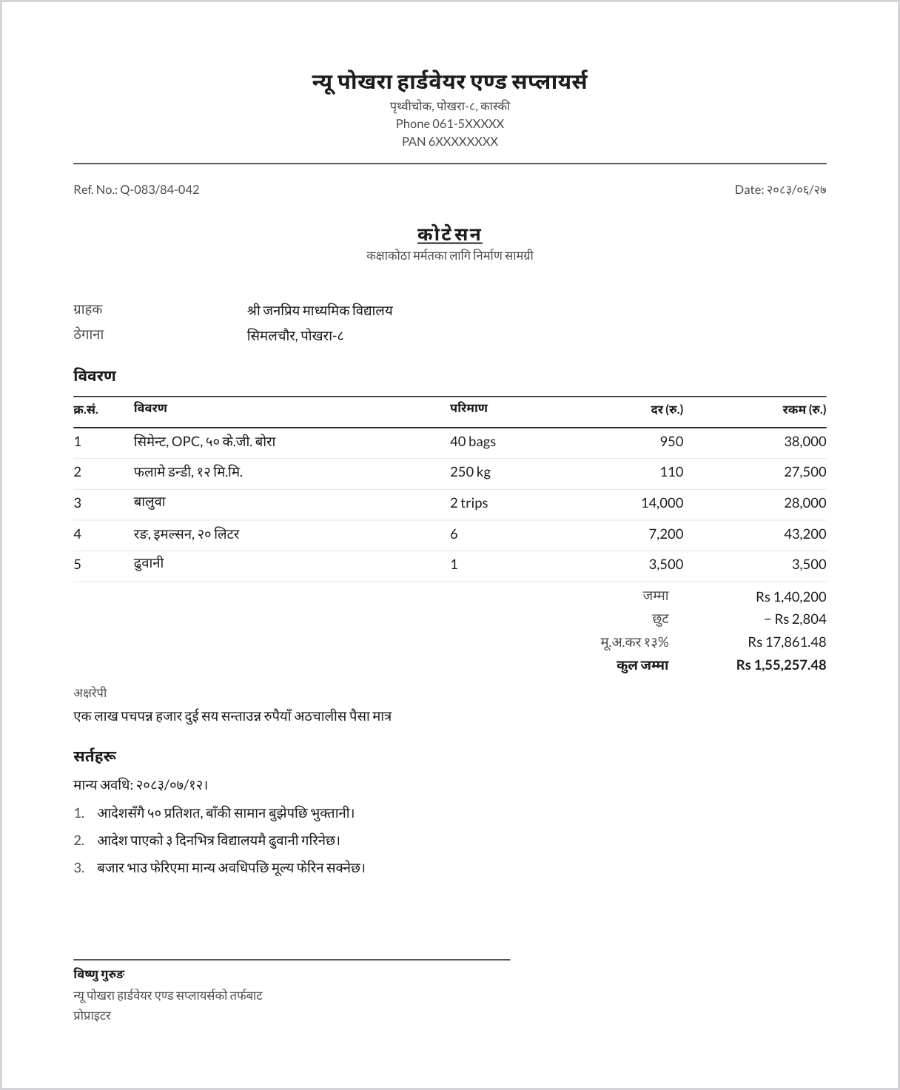
Quotation sample — a worked example
न्यू पोखरा हार्डवेयर एण्ड सप्लायर्स, पृथ्वीचोक, पोखरा-८ · कोटेसन नं. Q-083/84-042 · मिति २०८३/०६/२७
ग्राहक: श्री जनप्रिय माध्यमिक विद्यालय, सिमलचौर, पोखरा-८
1. सिमेन्ट, OPC, ५० के.जी. बोरा — 40 bags × Rs 950 = Rs 38,000
2. फलामे डन्डी, १२ मि.मि. — 250 kg × Rs 110 = Rs 27,500
3. बालुवा — 2 trips × Rs 14,000 = Rs 28,000
4. रङ, इमल्सन, २० लिटर — 6 × Rs 7,200 = Rs 43,200
5. ढुवानी — Rs 3,500
जम्मा (subtotal): Rs 1,40,200
छुट (discount) 2%: − Rs 2,804
मू.अ.कर (VAT) 13%: Rs 17,861.48
कुल जम्मा (total): Rs 1,55,257.48
अक्षरेपी: एक लाख पचपन्न हजार दुई सय सन्ताउन्न रुपैयाँ अठचालीस पैसा मात्र
मान्य अवधि: २०८३/०७/१२ सम्म। सर्तहरू: आदेशसँगै ५० प्रतिशत, बाँकी सामान बुझेपछि भुक्तानी; आदेश पाएको ३ दिनभित्र ढुवानी।
VAT is worked out on the figure after the discount: Rs 1,40,200 less Rs 2,804 is Rs 1,37,396, and 13% of that is Rs 17,861.48.
How to make a quotation online
- Choose quotation, estimate or bill, then enter your business: name, address, phone and PAN. Add your logo for a letterhead.
- Enter the number, the date and the customer.
- Type the items, one per line, as description | quantity | rate. Each amount, the subtotal and the total are worked out.
- Add a discount, VAT on a quotation or estimate, and your terms. The total is written in words for you. Download it as a PDF, or as a Word file you can still edit. It is free, there is no sign-up, and nothing you type is uploaded.
Common questions
How do I make a quotation in Nepali?
Enter your business details and the customer's, type each item as description | quantity | rate, and choose Nepali as the document language. The headings print in Nepali and the total is written in Nepali words (अक्षरेपी).
What is the difference between a quotation and an estimate?
A quotation is a fixed price for a stated list of goods or work. An estimate is an approximate cost that may change when the real quantities are known. This tool makes both; choose which at the top of the form.
Can I add VAT to the quotation?
Yes, 13% VAT can be added to a quotation or an estimate. Do it only if your business is VAT-registered.
Is the bill a VAT bill or tax invoice?
No. It is an ordinary bill. A VAT-registered business has to issue tax invoices in the form the Inland Revenue Department prescribes, and this tool does not replace that.
How long should a quotation be valid?
Fifteen to thirty days is usual. Write it in the Valid until field so the price cannot be claimed months later.
Can I download the quotation in Word or PDF?
Yes, as a print-ready PDF or an editable Word file. A filled-in sample in both formats is on this page.
Is my information sent anywhere?
No. Everything stays in your browser. Nothing is uploaded, and there is no account unless you make one to sync your work across devices.
Last updated


