In short
A relieving letter is the letter an employer gives on an employee's last working day confirming that their resignation was accepted and that they were relieved of their duties: their designation, date of joining, last working day and, often, the status of the full and final settlement. The next employer asks for it in background verification. Make one here or download the sample.
A relieving letter is the proof that you left a job properly: you resigned, served your notice, handed over your work, and the company let you go. The next employer's background check asks for it, and a gap where it should be reads as "left without notice" even when that is not what happened. This page gives the standard format as a Word file and a PDF, explains what each line is for, and lets the company make one on its own letterhead.
On this page
What a relieving letter is for
It is issued by the employer, usually by HR, on or soon after the last working day. It certifies three things: the employee resigned and the company accepted it; they were relieved of their duties on a stated date; they handed over their work and the company's property.
Background verification. In India the new employer — or the agency it hires — usually asks for the relieving letter from the previous job, alongside payslips and an experience letter. Without it, the check often stays open, and some offers are made conditional on it.
Proof you are free to join. It shows the new employer that no notice period is outstanding, which protects them from a dispute with the old one.
Provident fund and the final settlement. It fixes the date of exit, which is the date the full and final settlement and the provident fund transfer are counted from.
Relieving letter format — what it must contain
The company's letterhead, a reference number and the date of issue.
The employee's full name and, where the company uses one, the employee ID — add it in the additional paragraph.
Designation and department, as they were on the last day.
Date of joining and last working day — "employed with us from 4 July 2022 to 31 October 2026". These two dates are what background verification checks against your CV.
The resignation and its acceptance: "their resignation dated 1 August 2026 was accepted, and they were relieved of their duties with effect from the close of working hours on 31 October 2026."
Handover of charge and company property, and the full and final settlement — completed, or being processed.
A signature from HR or a manager, with their name and designation printed under it, and the company seal.
Relieving letter vs experience letter — are they the same?
No, though many companies combine them. The relieving letter says you left properly: resignation accepted, duties handed over, the exit date. The experience letter says what you did there: designation, dates, responsibilities and conduct — see our experience letter page.
A relieving-cum-experience letter does both in one page: the relieving paragraph, then the main responsibilities and a line on conduct. In the maker below, choose Relieving and fill in the main responsibilities — they print as bullets under the relieving wording.
If a company gives only one, ask for the other in writing. Background verification usually wants the relieving letter; a visa or a skills assessment abroad wants the experience letter with duties.
For the employee: before your last day
Resign in writing, and keep the acceptance. An email to your manager and HR with the date is enough; the relieving letter will refer to that date.
Serve the notice period, or settle it. If you leave early, agree in writing that the notice is waived or bought out, so the letter can say so rather than leave a question.
Hand over and get it signed off. The laptop, ID card, documents and access — the handover checklist is usually what HR waits for before releasing the letter.
Check the letter on the day. Name spelled as on your ID, the right designation, the right dates. A wrong date is easy to fix in the first week and hard a year later.
If it is held back. Ask HR in writing for the letter and the reason, and keep the email. There is no single law that sets out the relieving letter for every private employer, so if writing does not settle it, take advice from a labour office or a lawyer before anything else.
Relieving letter sample — the standard wording, in full
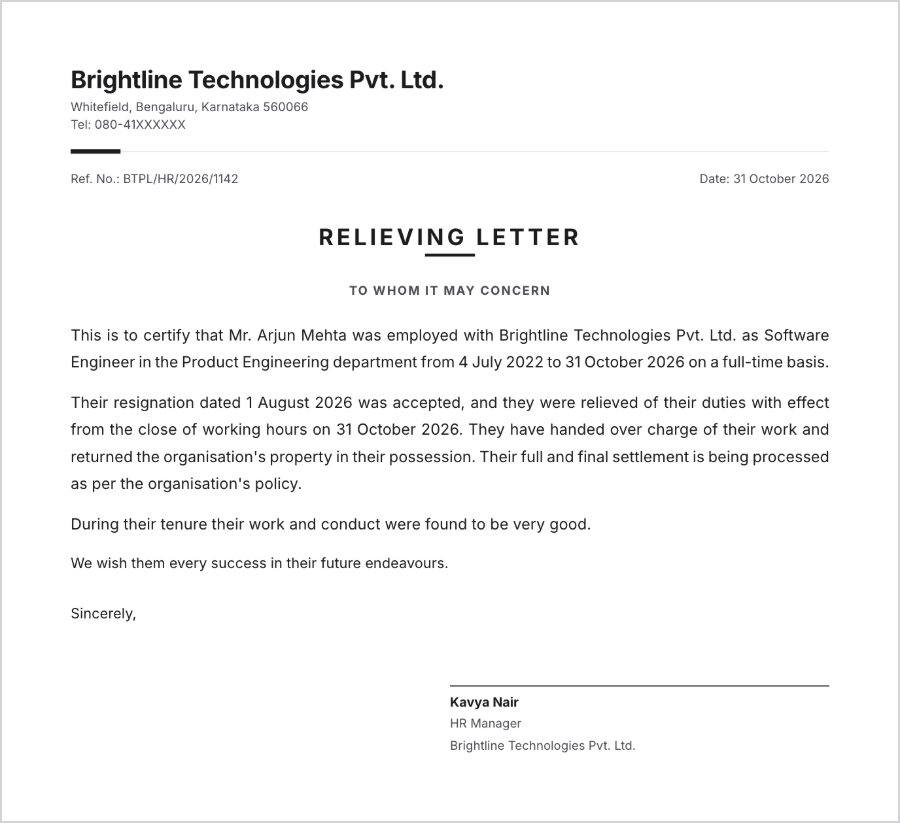
[Company letterhead — name, address, phone]
Ref. No.: ______    Date: ______

RELIEVING LETTER

TO WHOM IT MAY CONCERN

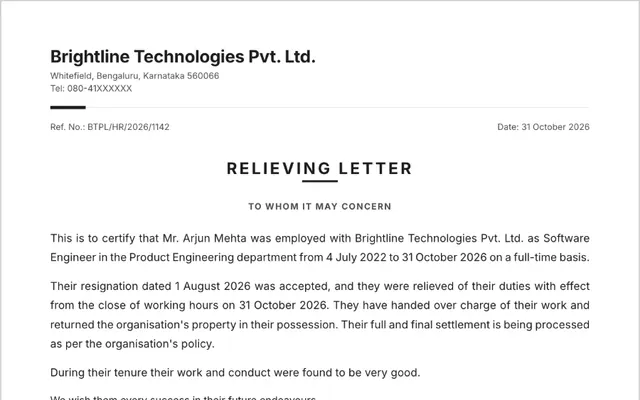
This is to certify that Mr./Ms. [full name] was employed with [company] as [designation] in the [department] department from [date of joining] to [last working day] on a full-time basis.

Their resignation dated [date] was accepted, and they were relieved of their duties with effect from the close of working hours on [last working day]. They have handed over charge of their work and returned the organisation's property in their possession. Their full and final settlement is being processed as per the organisation's policy.

During their tenure their work and conduct were found to be very good. We wish them every success in their future endeavours.

_______________________
[Signer's name]
[HR Manager]
[Company seal]
The tool fills this in from a form, keeps your letterhead and signature for every certificate you issue, and prints a whole list of names at once.
Make a relieving letter online
- Choose Relieving, then enter the employee: full name, and the honorific they use.
- Enter the designation and department, the date they joined and their last working day, the date of their resignation letter, and whether the full and final settlement is done. Add their main duties for a relieving-cum-experience letter.
- Add your letterhead: the organisation's name, address, phone and registration or PAN number, with your logo if you have one.
- Give it a reference number and a date of issue. Download it as a PDF, or as a Word file you can still edit. It is free, there is no sign-up, and nothing you type is uploaded.
Common questions
What is a relieving letter?
A letter from an employer confirming that an employee's resignation was accepted and that they were relieved of their duties on a stated date, having handed over their work. It is given on or soon after the last working day.
Is a relieving letter the same as an experience letter?
No. The relieving letter confirms that you left properly — resignation accepted, the exit date, handover done. The experience letter describes the job — designation, dates, duties and conduct. Many companies combine them in a relieving-cum-experience letter.
When is a relieving letter given?
On the last working day, or once the handover is complete. Some companies send it with the full and final settlement, which can take a few weeks; if yours does, ask HR for the expected date in writing.
Who signs a relieving letter?
Someone with authority over employment — usually the HR manager, or a director in a small company — with their name and designation printed under the signature, and the company seal.
What if my employer does not give me a relieving letter?
Ask HR in writing for the letter and the reason it is held back, and keep the email. Meanwhile, offer your new employer other proof: the resignation acceptance, your last payslips and the full and final settlement. If writing does not settle it, take advice from a labour office or a lawyer.
Can I download a relieving letter format in Word?
Yes. The sample above downloads as a Word file or a PDF. To make one with the company's and the employee's details, choose Relieving in the certificate maker and download it on your letterhead — free, with no sign-up.
In this topic
Certificates
The wording and layout for each certificate an office or employer issues.
Certificate maker — the whole subject in one place
By type
- Experience letter
- Salary certificate
- Character certificate
- Internship certificate
- Training certificate
- No objection certificate (NOC)
- Relieving letter
- Bonafide certificate
- Participation certificate
- Certificate of appreciation
- Prize certificate
Asking for one
Last updated