In short
A house construction contract (घर निर्माण सम्झौता, or ठेक्का सम्झौता) is the agreement between the owner and the contractor building the house. It says what the price covers — labour only, or labour and materials — the rate per square foot or the total, when each payment is due as the work reaches each stage, the completion date and the penalty for delay, and who repairs defects after handover.
Building a house is the largest payment most families here ever make, usually to a ठेकेदार on a rate per square foot agreed by word. The arguments come later and they are always the same five: what that rate included, who was buying the cement, when the money was due, why it is three months late, and who fixes the crack.
On this page
The five things that cause disputes
What the rate covers. A rate per square foot means nothing until it says whether it includes materials, finishing, electrical and plumbing work, and the boundary wall.
Who supplies the materials. In a labour contract the owner buys them; in a full contract the contractor does. Write down which, and list any the owner supplies.
Payment by stage. Pay for work done, never ahead of it — an advance, then a share at the foundation, each slab, the walls and plaster, and handover. The template's stages are editable.
The completion date and the penalty for delay, with the reasons the date may move: the owner's own delay, a disaster, a government restriction.
Defects after handover. A defects period — commonly a year — in which the contractor repairs cracks and leaks at their own cost, and a share of the price held back until it ends.
Labour contract or full contract?
ज्याला ठेक्का (labour only). The contractor brings the workers; the owner buys the materials. The owner controls quality and price of materials, and carries the work of buying and storing them.
सामग्रीसहित ठेक्का (labour and materials). The contractor supplies everything for one price. Simpler for the owner, and the place where quality is most often cut — so the grade and brand of cement, rods and bricks belong in the contract.
Many contracts are a mix. The form asks which, and lists what the owner supplies.
Before the work starts
Your municipality must approve the building's drawing and issue a permit (नक्सा पास) before construction begins; what it asks for varies by municipality, so ask the ward or the municipality's engineering section. Put the permit number in the contract, and a clause that the contractor builds to that drawing.
For anything beyond a small single storey, an engineer who checks each stage before it is paid for is worth what they cost. The template's payment clause says a stage is paid once the owner or the owner's engineer has checked it.
The workers on site
The workers are the contractor's, and the National Civil (Code) Act's chapter on wages applies to them: wages as agreed or at the local rate (section 641), adequate safety measures (section 642), an eight-hour day unless the worker agrees to more and is paid for it (section 643), and work once taken on not left unfinished without good reason (section 645).
The template puts the workers' wages, hours, safety and any accident on the site with the contractor, and lets the owner finish an abandoned job through someone else at the contractor's cost.
घर निर्माण सम्झौताको नमुना — पूरा कागज
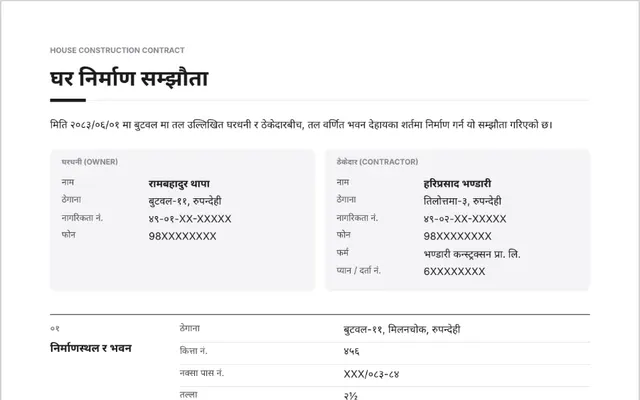
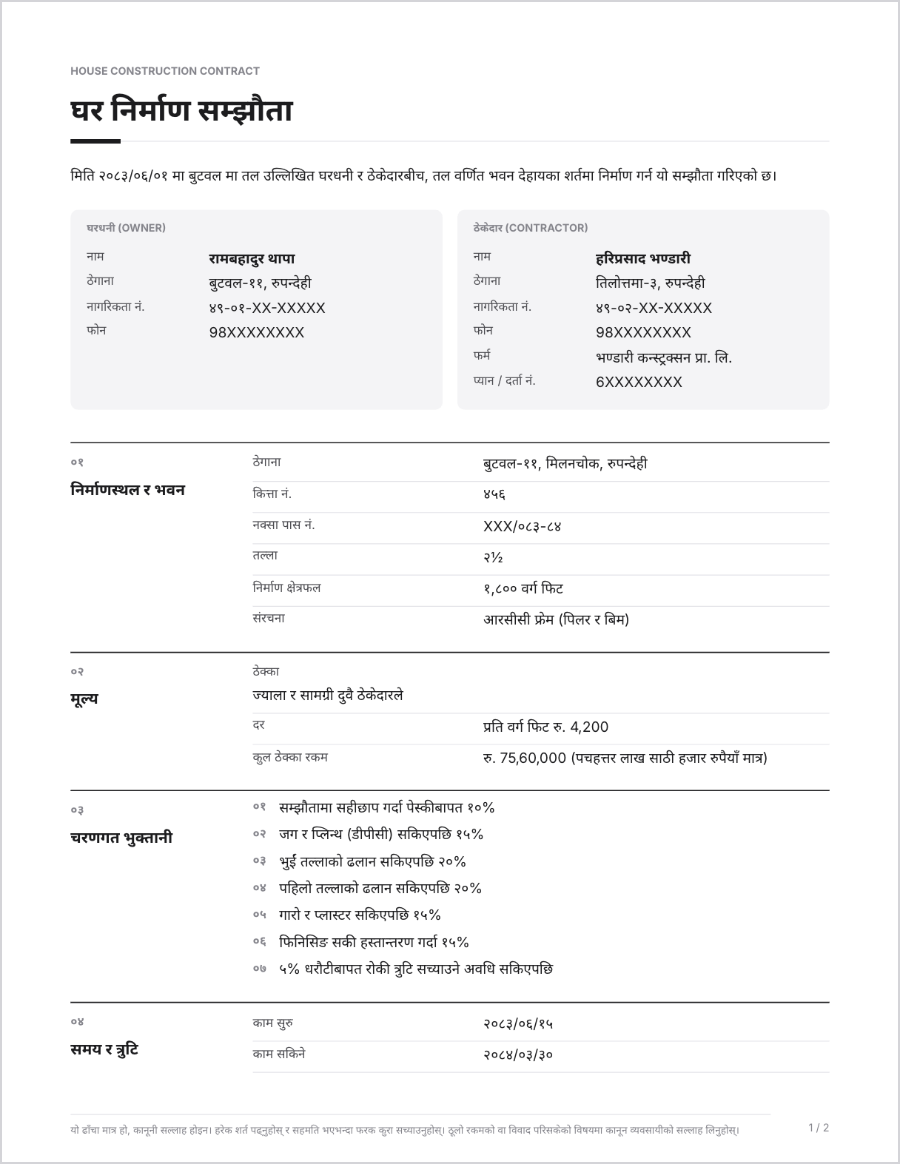
घर निर्माण सम्झौता
मिति: [२०८३ असोज १]
घरधनी: [पूरा नाम], [ठेगाना], ना.प्र.नं. [नम्बर]
ठेकेदार: [पूरा नाम], [ठेगाना], ना.प्र.नं. [नम्बर], फर्म [नाम], प्यान [नम्बर]
भवन: [ठेगाना], कित्ता नं. [नम्बर], नक्सा पास नं. [नम्बर] — [२½] तल्ले, [१,८००] वर्ग फिट, आरसीसी फ्रेम।
ठेक्का: [ज्याला र सामग्री दुवै ठेकेदारले], प्रति वर्ग फिट रु. [४,२००] — कुल रु. [७५,६०,०००।–] (अक्षरेपी पचहत्तर लाख साठी हजार रुपैयाँ मात्र)।
भुक्तानी: सहीछाप गर्दा १०%, डीपीसी सकिएपछि १५%, भुईं तल्लाको ढलानपछि २०%, पहिलो तल्लाको ढलानपछि २०%, गारो र प्लास्टरपछि १५%, हस्तान्तरणमा १५%, र ५% त्रुटि सच्याउने अवधि सकिएपछि।
समय: काम [२०८३ असोज १५] मा सुरु भई [२०८४ असार ३०] भित्र सकिनेछ। ढिलाइमा प्रतिदिन रु. [२,०००] कट्टा। हस्तान्तरणपछि [१२] महिनाभित्र देखिएका त्रुटि ठेकेदारले आफ्नै खर्चमा सच्याउनेछ।
ठेकेदारले स्वीकृत नक्साबमोजिम निर्माण गर्नेछ। कामदारको ज्याला, सुरक्षा र निर्माणस्थलको दुर्घटनाको जिम्मेवारी ठेकेदारको हुनेछ।
घरधनी: [हस्ताक्षर]
ठेकेदार: [हस्ताक्षर]
साक्षी १: [नाम] · [ना.प्र.नं.]
साक्षी २: [नाम] · [ना.प्र.नं.]
घर निर्माण सम्झौता बनाउने — make a house construction contract online
- Enter the owner and the contractor, with the contractor's firm and PAN if there is one.
- Describe the site and the building: address, kitta number, building permit number, storeys, area and structure.
- Say whether the price covers labour only or labour and materials, the rate per square foot or the lump sum, and the total.
- Set the payment for each stage, the amount held back, the defects period, the start and completion dates and the delay penalty.
- Add the witnesses and choose Nepali or English. Download it as a PDF, or as a Word file you can still edit. It is free, there is no sign-up, and nothing you type is uploaded.
Common questions
What should a house construction agreement include?
Both parties; the site with its kitta and building permit numbers; what the price covers and who supplies the materials; the rate or total; payment by stage; the start and completion dates and the delay penalty; the defects period and the amount held back until it ends; and who is responsible for the workers. Then the witnesses' signatures.
What is retention, or धरौटी, in a construction contract?
A share of the price — five percent is common — held back from the last payment until the defects period ends. It is what makes a contractor come back to fix a leak a year later.
Should I pay the contractor in advance?
A small advance to start is usual. After that, pay each stage once it is done and checked, never ahead of it. The template's stages add up to a hundred percent and are editable.
What is a thekka samjhauta?
ठेक्का सम्झौता is a contract for a job done for an agreed price — here, building a house. A घर निर्माण सम्झौता is the same agreement named for what it builds.
Is my information sent anywhere?
No. Everything stays in your browser. Nothing is uploaded, and there is no account unless you make one to sync your work across devices.
In this topic
Agreements and legal papers
Agreement formats for a house, land, a vehicle, a loan or a business, and the papers that go with them.
Agreement papers in Nepal — the whole subject in one place
Agreements
- House rent agreement (घर बहाल)
- घर बहाल सम्झौता कसरी लेख्ने
- Land sale agreement (बैना)
- बैना कसरी लेख्ने
- Land lease (जग्गा भाडा)
- Vehicle sale agreement
- Loan agreement (तमसुक)
- House construction contract
- Partnership agreement
- Employment contract (करार)
Legal papers
Last updated