
Most SOP advice for Korea is written for students from other countries, or describes a long essay. The embassy in Kathmandu asks for two plainer things: a cover letter that says why you are going and how it is paid for, and a study plan that says what you will study and what you will do after. Write the six parts here, see the length of each as you type, and download them as one file.
What the Korean Embassy in Nepal asks for
The embassy’s list for student visas (D-2 and D-4, stays over 90 days) asks you, from Nepal, for a visa cover letter that describes in detail the purpose, motivation and costs of your study in Korea (“한국유학 목적, 동기, 비용”), and a study plan (학업계획서). The English version of its visa page calls them “Visa cover letter” and “SOP”. There is no official form, no set headings and no word limit.
The same list asks for transcripts and a graduation certificate verified by the embassy, a TOPIK report for a Korean-taught course or IELTS or TOEFL for an English-taught one, a TB report from one of four named hospitals, and six months’ bank statements from Class A banks only. Documents count for six months from issue, language scores for two years, and Nepali documents need a notarised English translation. The embassy may also call you for an interview.
Sources: student visa documents notice (in Korean, revised 5 August 2026) and the Visa Issuance page (in English), Embassy of the Republic of Korea in Nepal, read 18 November 2026. Check them again before you apply.
The six parts of a study plan for Korea
Because there is no form, the parts below are ours. They follow what the embassy names, the reasons it gives for refusing visas, Seoul National University’s guideline (“the reasons you applied … and your plans after completing the course”) and the three headings of the Global Korea Scholarship’s study plan.
- Why Korea, why this course — how it follows from what you studied and do now, and why this institute rather than one in Nepal. This is the cover letter’s “purpose and motivation”.
- Your language plan — your TOPIK level or IELTS score now, the level you need, and how you will get there.
- What you will study — the programme term by term, and your goal by the end.
- Who pays, and how much — tuition, living costs a month, who pays and from what income. This is the cover letter’s “costs”.
- Your plan after the course — the job you aim for and what brings you back to Nepal.
- Anything to explain — a gap, a change of subject, an earlier refusal. Leave it blank if there is nothing.
- If your consultancy or institute wants the cover letter as a separate page, it is parts 1, 4 and 5; the study plan is parts 2, 3 and 5. Keep the facts and figures the same in both.
Study plan sample for the Korean embassy
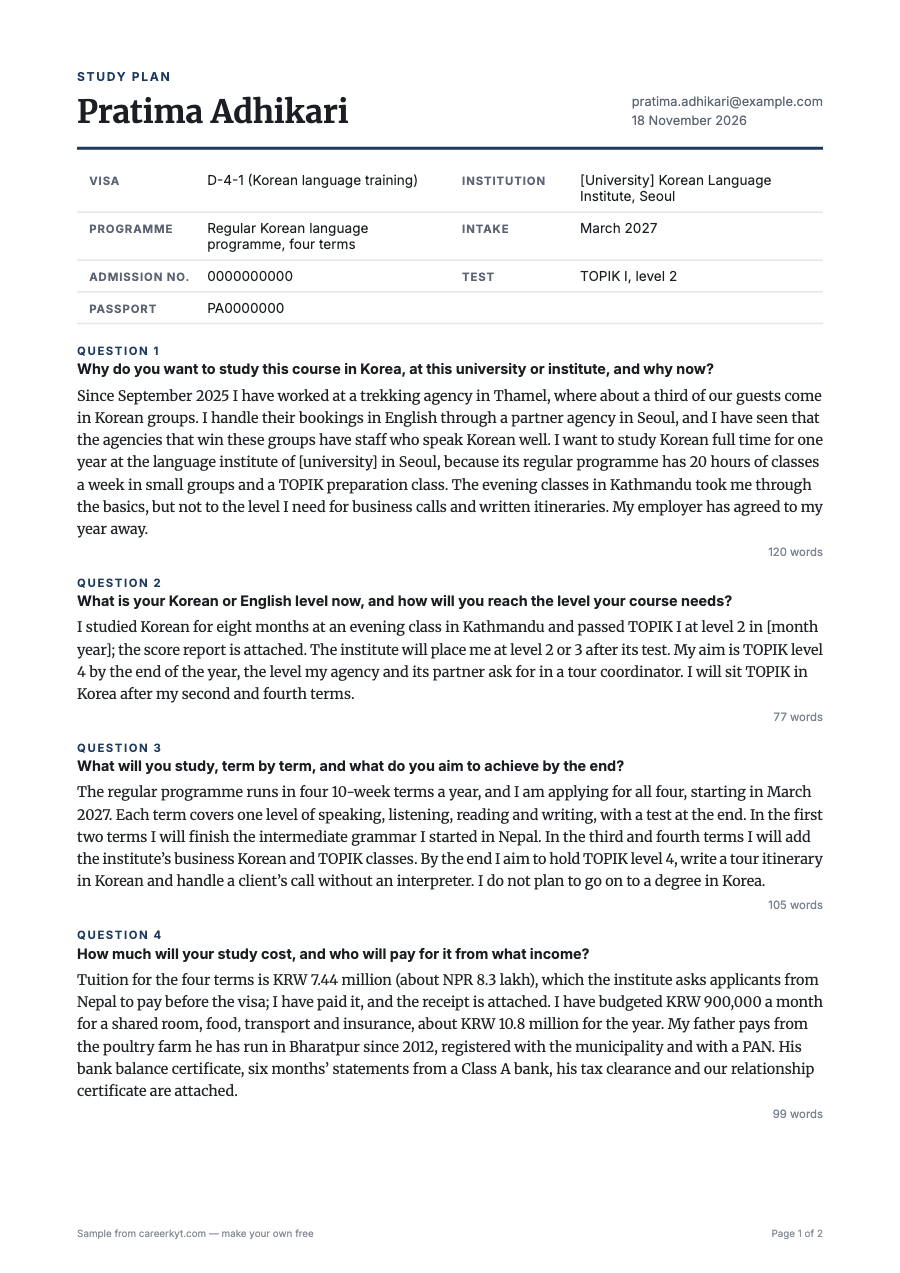
A complete study plan for Pratima, a made-up D-4 Korean language student. Download the PDF or the Word file. Read it for the shape; write yours about you.
The maker above has three examples, each a made-up Nepali student. Pratima, a trekking-agency worker from Bharatpur, is applying for a year of Korean on a D-4 visa. Rojan, a site engineer from Lalitpur, is applying for an English-taught master’s on a D-2 visa with a half-tuition scholarship. Sushmita, an agriculture technician from Palpa, is applying for the Global Korea Scholarship. Open “See examples” under any part to switch between them.
Read them for the shape: each part makes a few points, and each point is something a paper in the file proves — a TOPIK report, a receipt, a bank balance certificate, an employer’s letter. Then write yours about you. A sample copied from a website or a consultancy file reads like hundreds of others, and the embassy can refuse a visa when the purpose of entry is not explained.
D-4 language course or D-2 degree: what changes
- D-4 Korean language course. The institute’s own study plan is usually one A4 page: Seoul National University asks for “the reasons you applied … and your plans after completing the course in detail”, in Korean, English, Chinese or Japanese. Institutes set their own bank balance — Seoul National University KRW 10 million, Sogang USD 10,000, both issued within 30 days — and some ask applicants from Nepal to pay a year’s tuition before the visa.
- D-2 degree, Korean track. The embassy asks for a TOPIK report. Say which level you have and which level the department expects in each year.
- D-2 degree, English track. The embassy asks for IELTS or TOEFL. Say how you will manage daily life in Korean; a plan for basic Korean helps.
- Who pays the tuition. Items 7 and 8 of the Standard Admission Certificate say who pays, and the embassy asks the university to fill them in detail. Your “costs” part must agree with them and with any scholarship certificate.
- The NOC from Nepal. In May 2025 the Ministry of Education paused NOCs for Korean-language study on D-2 and D-4 visas, and in June 2025 the Supreme Court ordered the pause not to be carried out. We have found no later notice that settles it. Check the student NOC on noc.moest.gov.np before you pay any fees.
- The university’s standing. Korea’s education and justice ministries review universities’ international students each year and can restrict their visas; 20 institutions were named in February 2026, news reports say. Ask the university whether it can sponsor your visa before you pay.
GKS: the scholarship’s own personal statement and study plan
The Global Korea Scholarship has its own forms, with headings. Form 3, the study plan, asks for a Language Study Plan (how you will improve your Korean or English before and after you arrive), a Goal of study and Study Plan, and a Future Plan after Study (in Korea or another country). Form 2, the personal statement, asks about your motivation, education, significant experiences, any awards or skills, and other activities; the graduate form also asks about people or events that influenced you.
Both must be in Korean or English. In the 2026 graduate forms each may run to 17,000 characters; in the 2027 undergraduate forms each is up to three pages. The six parts here cover the same ground, so a GKS applicant can draft here and then move the text onto the forms. In Nepal the embassy track has few places: two for undergraduates in 2027, according to the embassy’s GKS notice.
The papers from Nepal that back each answer
Every figure and claim in the plan should match a paper in your file, so write the plan from the papers, not the other way round. Where a paper is made in Nepal, this site has a maker for it:
- Funds. A bank balance certificate and six months’ statements from a Class A bank. If the account is a parent’s, add a relationship certificate.
- Sponsor. The sponsor’s affidavit of support, their income sources and tax clearance.
- Your work. An experience letter and salary certificate if you work.
- Your studies. A character certificate, and transcripts verified by the embassy.
- Your language. A TOPIK or IELTS report, and a training certificate for any Korean class.
- Verification appointments. The embassy says its appointments for verifying academic documents are fully booked for 2026, and that it will announce slots for the autumn 2027 intake early next year. Plan for that wait.
What gets a Korea student visa refused
The embassy does not give reasons for a refusal, but it lists the usual grounds. These are the ones a study plan can cause or prevent:
- The purpose is not explained. “I love Korean culture” is not a purpose; a course, a job and a reason are.
- Nothing shows you will return. The embassy can refuse when your family and economic circumstances do not show you will come back within your stay. Name the job, the family and the property.
- Documents that cannot be checked. A figure in the plan that no paper shows, or a paper the embassy cannot verify.
- Contradictions. A cost, a date or a job title that differs between the plan, the admission certificate and the bank papers.
- An interview that does not match. If you are called in, you will be asked what the plan says. Write only what you can explain in your own words.
- Anything false. The embassy says false statements or documents can restrict a visa for up to three years, and a fake document can bar entry to Korea for up to five.
Common questions
Is an SOP required for a Korea student visa from Nepal?
Yes, in two parts. The Korean Embassy in Nepal asks for a visa cover letter describing the purpose, motivation and costs of your study, and a study plan (학업계획서). Its English page calls them “Visa cover letter” and “SOP”. Your university or language institute may ask for its own study plan when you apply for admission as well.
What is the format of a study plan for a Korean university?
For the visa there is no official form. Language institutes usually ask for one A4 page in free format: Seoul National University wants the reasons you applied and your plans after the course. The Global Korea Scholarship is the exception: its study plan has three set headings, a language study plan, your goal and study plan, and your future plan.
How long should a study plan for Korea be?
About one A4 page, or 450 to 600 words, unless your institute says otherwise. Seoul National University and Sungshin ask for one A4 page. The 2026 GKS graduate forms allow up to 17,000 characters per essay, and the 2027 undergraduate forms up to three pages each.
Should the study plan be in Korean or English?
English is the usual choice for the visa: the embassy’s English page lists the SOP, and it asks for Nepali documents to be translated into English. Many institutes also accept Korean, and some accept Chinese or Japanese. Write in Korean only if you can explain every line in Korean at an interview.
What is the difference between the visa cover letter and the study plan?
The cover letter says why you are going to Korea, why now and how it is paid for. The study plan says what you will study, how your Korean or English will reach the level needed, and what you will do after. They share facts, so the figures must match.
How much bank balance is needed for a D-4 visa from Nepal?
There is no single embassy figure. Each institute sets its own, for example KRW 10 million at Seoul National University, USD 10,000 at Sogang and KRW 8 million at Yonsei’s Mirae campus, usually on a certificate issued within 30 days. The embassy also asks for six months’ statements from a Class A bank.
Can I get an NOC from Nepal for Korean language study?
This is not settled. In May 2025 the Ministry of Education paused NOCs for Korean-language study on D-2 and D-4 visas, and in June 2025 the Supreme Court ordered the pause not to be carried out. Check the current position on noc.moest.gov.np before you pay any fees.
What should a GKS study plan include?
The form gives three headings: a language study plan (how you will improve your Korean or English before and after arriving), your goal of study and a detailed study plan, and your future plan after the programme, in Korea or another country. Write it in Korean or English.
Why are Korean student visas refused?
The embassy does not give reasons, but it lists the usual grounds. These include a purpose of entry that is not explained, family and economic circumstances that do not show you will return, documents whose authenticity cannot be confirmed, false statements, and a failed interview.
More free tools
All free tools, by category. Writing something in Nepali? The CV maker, the निवेदन tool and the document tools are free too.
Last updated