In short
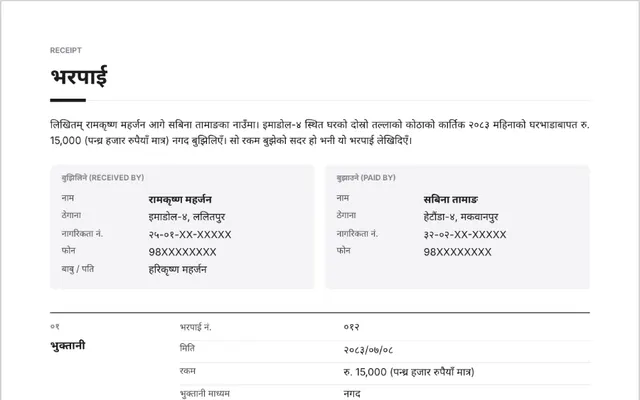
A भरपाई is a receipt written and signed by the person who received money or goods, for the person who paid. It names both of them, says how much in figures and words, what it was for, and the date and place. Under Nepal's Civil Code a receipt counts as a deed of the transaction; a landlord paid rent in cash must give one, and a lender who is repaid must return the loan deed or give a receipt.
Money changes hands in Nepal on trust far more often than on paper — rent paid in cash, a loan repaid to a relative, an advance on a plot of land. The भरपाई is the one piece of paper that settles it later: who paid whom, how much, for what, and when.
On this page
भरपाई लेख्ने तरिका — what goes in it
The Civil Code lists what a deed of a transaction sets out (section 477). For a receipt, that means:
Who received it, and who paid it. Full names and addresses; a Nepali deed also names the father, or the husband of a married woman.
How much, in figures and in words (अक्षरेपी), and whether it was cash, a cheque or a transfer.
What it was for. The month of rent; the loan and the date of its deed; the land or vehicle an advance was paid on.
The date and the place, and the signature of the person who received the money. Witnesses for large cash payments.
When the law asks for a receipt
A receipt is a deed. The Civil Code says no transaction is carried on without a deed, and counts a cheque, a bill, a voucher and a receipt as one (section 476).
Rent paid in cash. A house owner who receives rent in cash gives the tenant a receipt (section 391).
A loan repaid. When a loan is repaid in full, the lender gives back the loan deed, torn or marked as paid; if it cannot be found, the lender gives a receipt instead — the तमसुक नभेटिएको भरपाई. A part payment is noted on the back of the deed, with a receipt for it (section 482).
An advance. Nothing requires a receipt for a बैना, but it is the only proof of it until the sale is registered — which is why one should always be written, and witnessed.
लिखितम्, आगे, रोज, शुभम् — the old words
A traditional भरपाई opens with लिखितम् (written by) and the receiver's name, then आगे and the payer's name with का नाउँमा (to). It closes with the date written out: इति सम्वत् २०८३ साल कार्तिक ८ गते रोज १ शुभम्.
रोज is the day of the week, counted from Sunday as 1, and शुभम् closes the deed. The tool writes that line for you from the date, in the Nepali version.
A receipt is not a bill
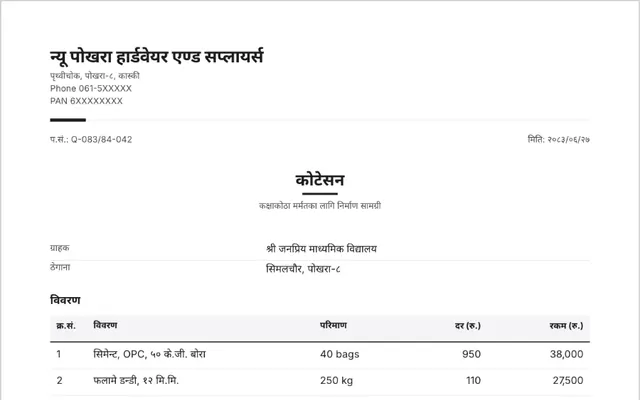
A भरपाई between two people is not a tax invoice, and must not be made to look like one; a VAT bill comes from a business registered for VAT. For a business's quotation or bill to a customer, use the quotation and bill maker.
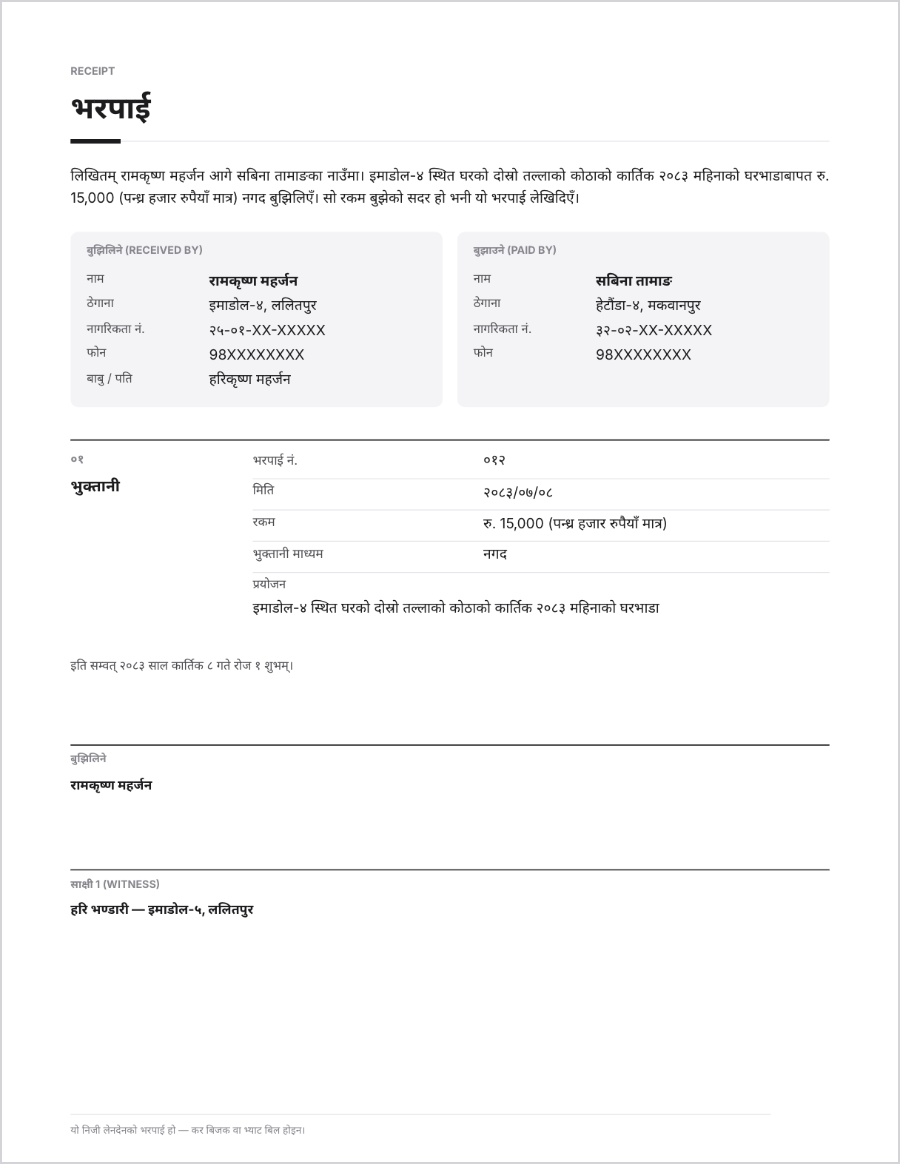
भरपाईको नमुना — पूरा कागज
भरपाई
लिखितम् [बुझिलिनेको पूरा नाम], [ठेगाना], ना.प्र.नं. [नम्बर] आगे [बुझाउनेको पूरा नाम], [ठेगाना] का नाउँमा।
[ठेगाना] स्थित [घर/कोठा] को [कात्तिक २०८३] महिनाको घरभाडाबापत रु. [१५,०००।–] (अक्षरेपी पन्ध्र हजार रुपैयाँ मात्र) नगद बुझिलिएँ। सो रकम बुझेको सदर हो भनी यो भरपाई लेखिदिएँ।
बुझिलिने: [हस्ताक्षर] · [नाम]
साक्षी: [नाम] · [ना.प्र.नं.] · [हस्ताक्षर]
इति सम्वत् [२०८३] साल [कार्तिक] [८] गते रोज [१] शुभम्।
भरपाई बनाउने — make a receipt online
- Choose what it is for: rent, a loan repaid, an advance, goods or work, or something else.
- Enter who received the money and who paid it.
- Enter the amount and how it was paid, then the details for its kind: the month of rent, the loan deed and whether it was returned, or what the advance was for and the balance.
- Add witnesses if you want them and choose Nepali or English. Download it as a PDF, or as a Word file you can still edit. It is free, there is no sign-up, and nothing you type is uploaded.
Common questions
What is भरपाई in English?
A receipt — an acknowledgement, signed by the person who received money or goods, that they received it. बुझिलिने is the receiver; बुझाउने is the one who paid.
Who signs a भरपाई?
The person who received the money. The payer keeps it. For a large cash amount, or an advance on land, one or two witnesses who saw the money paid are worth adding.
What if the loan deed (तमसुक) is lost when the loan is repaid?
The lender gives a receipt saying the amount was received on that date, which stands in for the returned deed (Civil Code, section 482). Choose "A loan repaid" and "Cannot be found" in the form and the receipt says so.
Can I write a भरपाई in English?
Yes. The tool writes it in Nepali or English from the same form; the Nepali version keeps the traditional opening and closing words.
Is my information sent anywhere?
No. Everything stays in your browser. Nothing is uploaded, and there is no account unless you make one to sync your work across devices.
In this topic
Agreements and legal papers
Agreement formats for a house, land, a vehicle, a loan or a business, and the papers that go with them.
Agreement papers in Nepal — the whole subject in one place
Agreements
- House rent agreement (घर बहाल)
- घर बहाल सम्झौता कसरी लेख्ने
- Land sale agreement (बैना)
- बैना कसरी लेख्ने
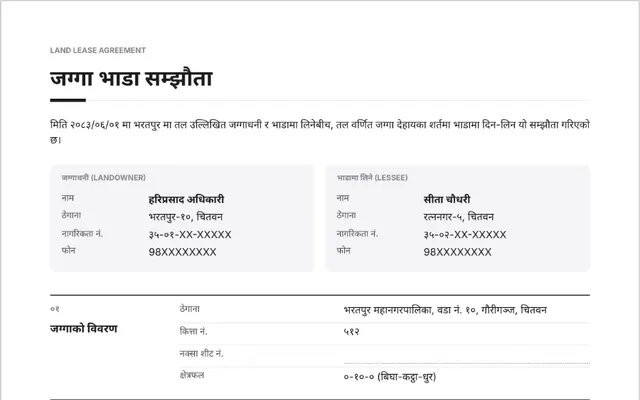
- Land lease (जग्गा भाडा)
- Vehicle sale agreement
- Loan agreement (तमसुक)
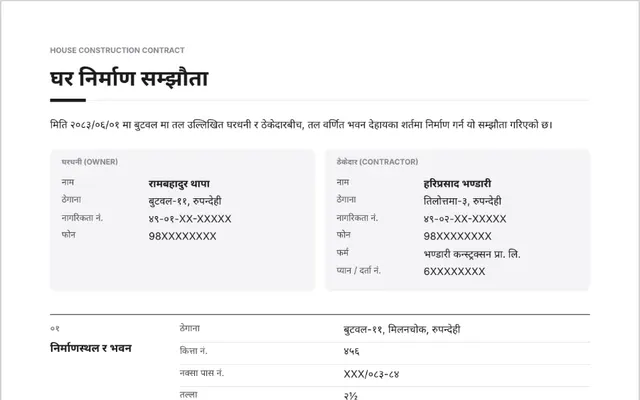
- House construction contract
- Partnership agreement
- Employment contract (करार)
Legal papers
Last updated