
Many UK visa cover letter samples tell you to attach hotel bookings, flight tickets and travel insurance. The Home Office lists all three among documents it finds of little use. What it does recommend is an account of your life at home and your plans in the UK, with a paper behind every fact. Write the six parts here, watch the length as you type, and download the letter as PDF or Word.
Does the UK ask for a cover letter for a visitor visa?
No. A cover letter is not on the Home Office’s list of documents, and no form asks for one. Its guide to supporting documents comes closest: “It is recommended that you provide information about your circumstances in your home country and details of the activity that you will be doing in the UK.” A short letter is the plainest way to do that, and sending one is common practice.
The letter has one job: to show that you are a genuine visitor. Under the Visitor rules (paragraph V 4.2) that means you will leave at the end of the visit, will not live in the UK through frequent or successive visits, are coming for a permitted purpose, will not work, and have enough money for the trip without working or claiming public funds. The caseworker guidance puts the burden of proof on you, judged on the balance of probabilities: more likely than not.
Write facts, not promises. The same guidance tells officers: “You must not ask for or accept a written guarantee or undertaking from the applicant concerning the length of their stay.” A line swearing that you will return adds nothing. Your job, your family and your money, each backed by a paper, do the work. Sources read on 18 November 2026; check them again before you apply.
The six parts of a UK visitor visa cover letter
There is no set length. One to two pages, about 400–800 words, is the usual size, and the ranges in the maker add up to that. Write it as one letter to the Entry Clearance Officer, in this order:
- You and your visit: who you are, who is applying with you, the visa, your dates and where you will stay, exactly as on your online form.
- Why you are visiting: your main reason in one sentence, then a plan in outline. The guidance says visitors “are not required to provide an itinerary”, but officers expect “some plans for their stay”.
- Who pays, and from what: the cost of the trip, who pays each part, their income and what they must keep paying at home, and where the money came from.
- Your life in Nepal: your job and approved leave, or your business; your family; your property. Officers weigh your “personal and economic ties” to the country you live in.
- Your travel history: where you have been and that you came back. Visits to the USA, Canada, Australia, New Zealand, Ireland, the Schengen countries or Switzerland can count in your favour. On a first trip abroad the officer “will need to rely on other evidence”, so the other parts carry more weight.
- Your return, and what is enclosed: the date you fly back, what you go back to, and a list of your documents.
- An optional part covers anything in your papers that needs a line, such as a name spelt two ways. If you have been refused a UK visa before, tick the box in the maker: a paragraph on what the refusal said and what has changed goes second, straight after the introduction.
UK visitor visa cover letter sample — PDF and Word
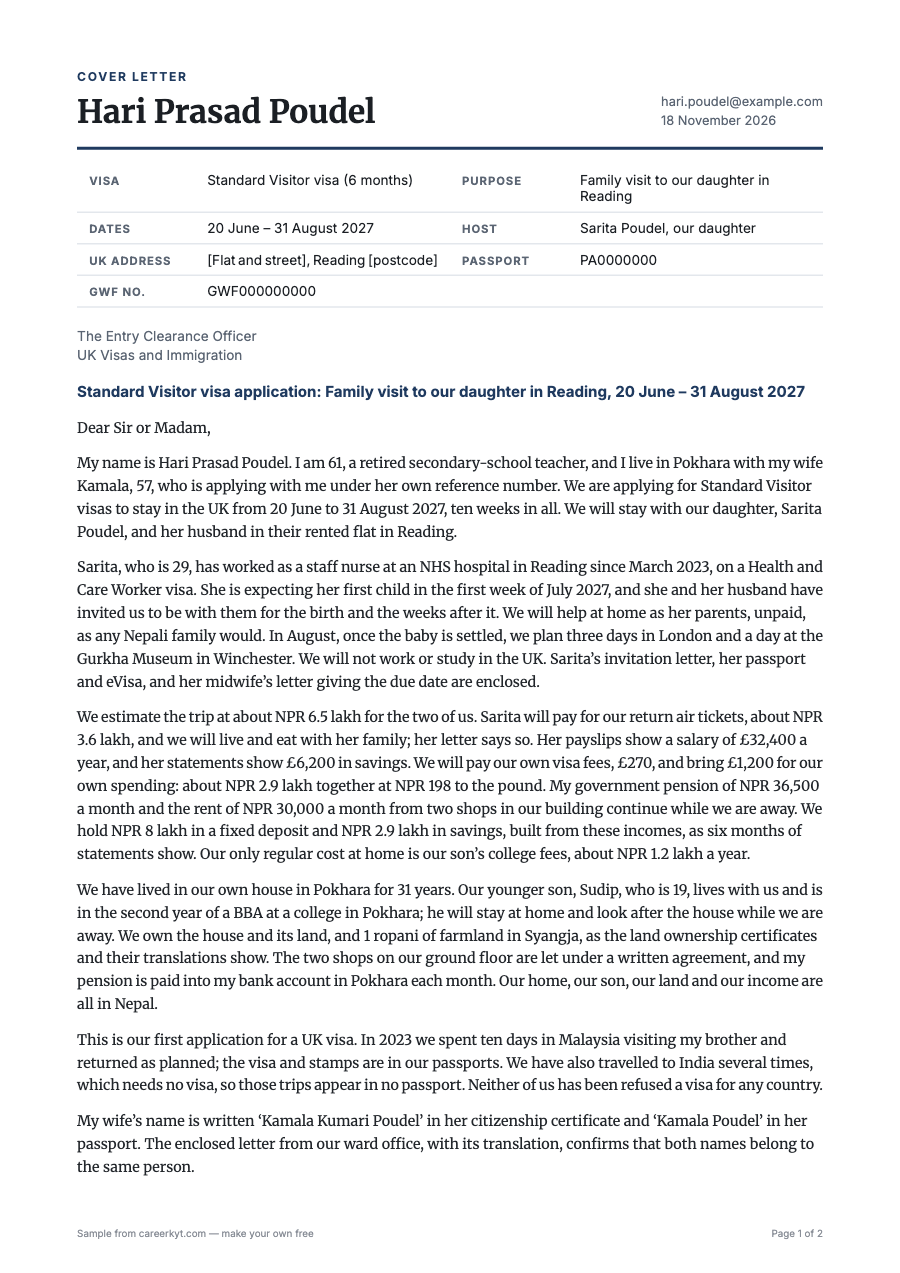
A complete letter for a made-up couple, Hari and Kamala from Pokhara, who are visiting their daughter, a nurse in Reading, for the birth of her first child. Download the PDF or the Word file.
The maker has two more. Sujata works at a bank in Kathmandu and is applying again for a twelve-day holiday, after a refusal over an unexplained deposit. Nirmal runs a felt export company in Lalitpur and is going to a trade fair in Birmingham on a two-year visa. Open “See examples” under any part and switch between them. Read them for the shape, with each claim tied to a document, then write yours about you.
The papers from Nepal behind each part
Money. “There is no set level of funds required,” says the caseworker guidance. Officers compare the likely cost of the trip with your income or savings “minus their financial commitments”, such as rent, loans and the people you support. Bank statements should “detail the origin of the funds held”, and if most of the money arrived recently, officers may make “further checks to establish the origin of this money”. The Home Office sets no number of months for visitors; six months is the usual practice. The rules ignore money the officer cannot verify or that sits in an unregulated institution (Appendix Finance), so a bank or finance company licensed by Nepal Rastra Bank is the safe place for it.
Work and business. The Home Office suggests “a letter from your employer on company headed paper, detailing your role, salary and length of employment”, and from Nepal that letter should also give your approved leave: see the experience letter, salary certificate and employer’s NOC makers, and salary certificate for a visa. If you run a business, send “business registration documents or recent invoices”, with your PAN or VAT certificate and a tax clearance certificate.
Family and property. A relationship certificate links you to the people you name, land ownership certificates (lalpurja) show what the family owns, and old passports show where you have travelled.
Translations. Any document not in English needs a full translation that the Home Office can check, with the translator’s confirmation that it is accurate, the date, the translator’s full name and signature, and their contact details. A notary’s stamp is not one of those things.
Documents not to send. The supporting documents guide lists these as of little use, and the caseworker guidance tells officers not to consider them:
- Hotel bookings, and flight bookings unless you are only passing through the UK. Book after the decision: the guide warns that no document guarantees a visa.
- Travel insurance, personal photographs, business cards, driving licences and evidence of car ownership.
- Bank statements or letters issued more than a year before you apply, credit card statements and photocopies of bank cards.
- Notarial certificates, and educational certificates your visa does not need.
- Your sponsor’s utility bills and council tax bills.
If your son or daughter in the UK invites you
The UK has no official invitation letter or form. If someone in the UK is giving you a room, money or tickets, the supporting documents guide asks for evidence of what they provide and how, that they can support themselves and their own dependants as well, how you are related, and that they are in the UK legally, such as a British passport or a residence document (for most visa holders now an eVisa).
So the host’s letter should give their status in the UK, how they are related to you, your dates, where you will stay and what they will pay for. Their payslips, bank statements and a tenancy agreement or mortgage statement go behind it, with a relationship certificate from Nepal. Leave out their council tax and utility bills: they are on the do-not-send list.
Your letter and theirs must agree. The caseworker guidance names “discrepancies between the statements made by the applicant and the statements made by the sponsor” as a reason to doubt an application, especially on points the sponsor should know. Write both letters from the same dates and figures.
Helping with a new baby is allowed. A family member may look after a child or relative during a visit, “provided the arrangement is temporary and informal and does not amount to employment as a child-minder or carer”. Say plainly that you are coming as family, unpaid, for fixed dates. Where an officer has some doubt but the reason to visit is clear, the guidance allows a single-entry visa instead, for example “to visit an immediate family member who is pregnant or who is seriously ill”.
Fee, appointment and decision time from Nepal
Nepal is on the UK’s visa national list, so Nepali citizens need a visa to visit; the electronic travel authorisation (ETA) is not for them. A Standard Visitor visa costs £135 for up to six months, about NPR 26,700 at Nepal Rastra Bank’s selling rate on 18 November 2026. Long-term visas allow six months a visit and cost £506 for two years, £903 for five and £1,128 for ten. The officer may grant a shorter visa than you ask for, with no refund (fees).
You apply online no earlier than three months before you travel, then attend an appointment at the visa application centre in Kathmandu, run by VFS Global, to give your fingerprints and photo and provide your documents. Check the centre’s address and any paid extras when you book. Each family member needs their own application, fee and appointment, but a family applying together need not send the same document twice.
A decision usually comes within three weeks, and a successful applicant gets an eVisa, a digital record linked to a UKVI account. You do not need a TB test for an ordinary visit: although Nepal is on the TB test list, the Standard Visitor page asks for a certificate only for visits of more than six months.
Why UK visit visas are refused, and applying again
A refusal letter gives its reasons. Most visit refusals carry no right of appeal, and the letter will say whether you can ask for an administrative review. The usual way forward is a new application with a new document for each reason. Tick “refused before” in the maker, and your letter gains a paragraph straight after the introduction that names the earlier application, each reason, and what now answers it. Keep everything else the same: a new story is a reason to doubt the old one. The common reasons:
- Money with no source. A large deposit just before you apply, with no sale deed, matured deposit or income behind it.
- A cost out of line with income. A trip that would take most of your savings, or a host whose payslips cannot cover their own household as well.
- Few ties, family in the UK. The guidance’s own example is “a person with most of their family in the UK and no job or studies in their own country”. Show what you go back to.
- Letters that disagree. Dates, amounts or relationships that differ between your form, your letter and your host’s letter.
- A vague purpose. “Tourism” with no plan, or a business trip that reads like work for a UK company.
- Paper instead of proof. Bookings, insurance and photographs, which officers are told not to consider, in place of the statements and letters that prove something.
- Template text. A letter copied from a sample reads like hundreds of others. Use the examples for the shape and write your own facts.
Common questions
Is a cover letter mandatory for a UK visitor visa?
No. It is not on the Home Office’s list of documents, and no form asks for one. The Home Office does recommend giving “information about your circumstances in your home country and details of the activity” you will do in the UK, and a short letter is the clearest way to do it.
Whom should a UK visa cover letter be addressed to?
To the Entry Clearance Officer, UK Visas and Immigration. The visa application centre in Kathmandu only takes your fingerprints, photo and documents; an officer of UKVI makes the decision. Open with “Dear Sir or Madam” and close with “Yours faithfully”.
How much bank balance do I need for a UK visit visa from Nepal?
There is no fixed amount: the caseworker guidance says “There is no set level of funds required”. Officers compare the likely cost of your trip with your income and savings, minus what you must keep paying at home, and check where the money came from. Show enough for the whole trip, held for some time.
How many months of bank statements are needed for a UK visitor visa?
The Home Office sets no number for visitors. Six months is common practice and usually enough to show where the money came from. Statements issued more than a year before you apply are on its list of documents of little use, and a large recent deposit needs its own paper, such as a sale deed or deposit certificate.
Is an invitation letter required for a UK visitor visa?
No. But if someone in the UK gives you a room, money or tickets, the Home Office asks for evidence of what they provide, that they can afford it, how you are related, and that they are in the UK legally. Their letter, with payslips, statements and proof of status, is the usual way.
What is the UK visit visa fee from Nepal?
£135 for a Standard Visitor visa of up to six months, about NPR 26,700 at Nepal Rastra Bank’s selling rate on 18 November 2026. A two-year long-term visa costs £506, five years £903 and ten years £1,128. Optional services at the visa application centre cost extra.
Do I need hotel and flight bookings for a UK visitor visa?
No. Hotel bookings, flight bookings (unless you are only transiting) and travel insurance are on the Home Office’s list of documents not to use as evidence, and it warns that no document guarantees a visa, so book after the decision. Say in your letter where you plan to stay.
Can my parents look after our new baby on a UK visitor visa?
Yes, as family help. The caseworker guidance allows a family member to look after a child or relative when “the arrangement is temporary and informal and does not amount to employment as a child-minder or carer”. Both letters should say so, with fixed dates and a home in Nepal to return to.
Do I need a TB test for a UK visit visa from Nepal?
Not for an ordinary visit. Nepal is on the TB test list, but the Standard Visitor page asks for a TB certificate only for visits of more than six months, such as longer medical treatment or an academic visit.
How do I write a cover letter after a UK visa refusal?
Read the refusal letter and list each reason. In a paragraph near the start, name the earlier application and answer each reason with a new fact and the document that proves it. Keep everything else the same, and apply again only when you have something new to show.
More free tools
All free tools, by category. Writing something in Nepali? The CV maker, the निवेदन tool and the document tools are free too.
Last updated