
Most SOP advice for the USA mixes up two readers. A US department’s admissions committee reads your statement of purpose and decides whether to admit you. The consular officer in Kathmandu decides your F-1 visa from your DS-160, your I-20 and an interview, and asks for no SOP. Write the statement here part by part, with a word count as you go, then make sure your answers at the interview tell the same story.
The F-1 visa asks for no SOP; the university does
A US student visa is decided at an interview, not from an essay. You apply to a school certified by the Student and Exchange Visitor Program (SEVP). Once it admits you and has seen how you will pay, it issues a Form I-20 with your SEVIS ID. You then pay the SEVIS I-901 fee, fill in the DS-160 online, book an appointment and attend an interview at the US Embassy in Maharajgunj, Kathmandu, with the original I-20 and proof of the fee. None of these steps asks for a statement of purpose.
The statement of purpose belongs to the university application. In graduate admission, the department’s faculty read it beside your transcripts, scores and letters. USEF-Nepal, which runs EducationUSA advising in Nepal, calls the essays “one of the most important parts of your application”.
What the officer decides is set by US law. Under section 214(b) of the Immigration and Nationality Act, a student visa applicant “shall be presumed to be an immigrant” until they satisfy the consular officer otherwise. The embassy in Kathmandu says a student must show three things: “that you intend to study and will not use the visa for any other purpose”, “that you intend to depart the United States after completion of your studies”, and “that you can pay for your studies”. It also tells F-1 applicants to set all their social media accounts to public.
Sources, read 18 November 2026: US Embassy Nepal, Visas; Common Visa Facts and Myths (dated June 2018); DHS, the Form I-20; DHS, the I-901 fee. The forms are the government’s own: the DS-160, the I-901 fee and appointments. Fees and rules change; check the State Department’s student visa page before you apply.
What US universities ask the statement to cover
There is no single format. Each department sets its own prompt and length, and its instructions come before any guide, this one included. Four graduate schools, read 18 November 2026:
- UC Berkeley asks for “your preparation for this field of study, your academic plans or research interests, and your future career goals”, and to “be specific about why UC Berkeley would be a good intellectual fit”. For research: “with whom, the title of the project, what your responsibilities were, and the outcome”. Length: “Approximately 500 to 1,000 well-selected words”. Berkeley Graduate Division
- Cornell asks what you would study “in enough detail to convince the faculty”, the skills you gained from “academic, lab, or research experiences”, and for research degrees “specific faculty members whose research interests align with your own”. “One to two pages in a standard font and size is typical.” Cornell Graduate School
- University of Illinois, computer science: “Generally, the Academic Statement of Purpose is between one to two pages”, on “your goals and background”, “past work history, your interests, and reasons for pursuing a graduate degree”. A separate Personal Statement “must be within 250 words”. Siebel School
- Carnegie Mellon, computer science: “a concise one- or two-page essay that describes your research interests, related experiences and objectives”, with each programme’s own rules on the application. CMU SCS
The six parts, and how long each should be
- What you want to study, 80–130 words: the field named exactly, the moment it started, and why this degree now.
- Your academic preparation, 100–180 words: degree and result, the courses that matter by name, your project or thesis.
- Research and work, 120–220 words: with whom, what, your part and the result, in numbers where you have them.
- Why this programme, 100–180 words: courses, labs or professors by name, what you bring, and what Nepal could not offer.
- Your goals after, 80–150 words: the job, where, and the longer aim, the same plan you will give at the interview.
- Anything to explain, up to 80 words or none: a gap or a weak semester, briefly.
- Together that is about 500–1,000 words, or two pages. If the programme gives a limit, or asks its own questions, follow it. If it asks for a separate personal history or personal statement, write that in its own box. MBA programmes often ask set essay questions; the same facts answer them.
SOP sample for USA — PDF and Word
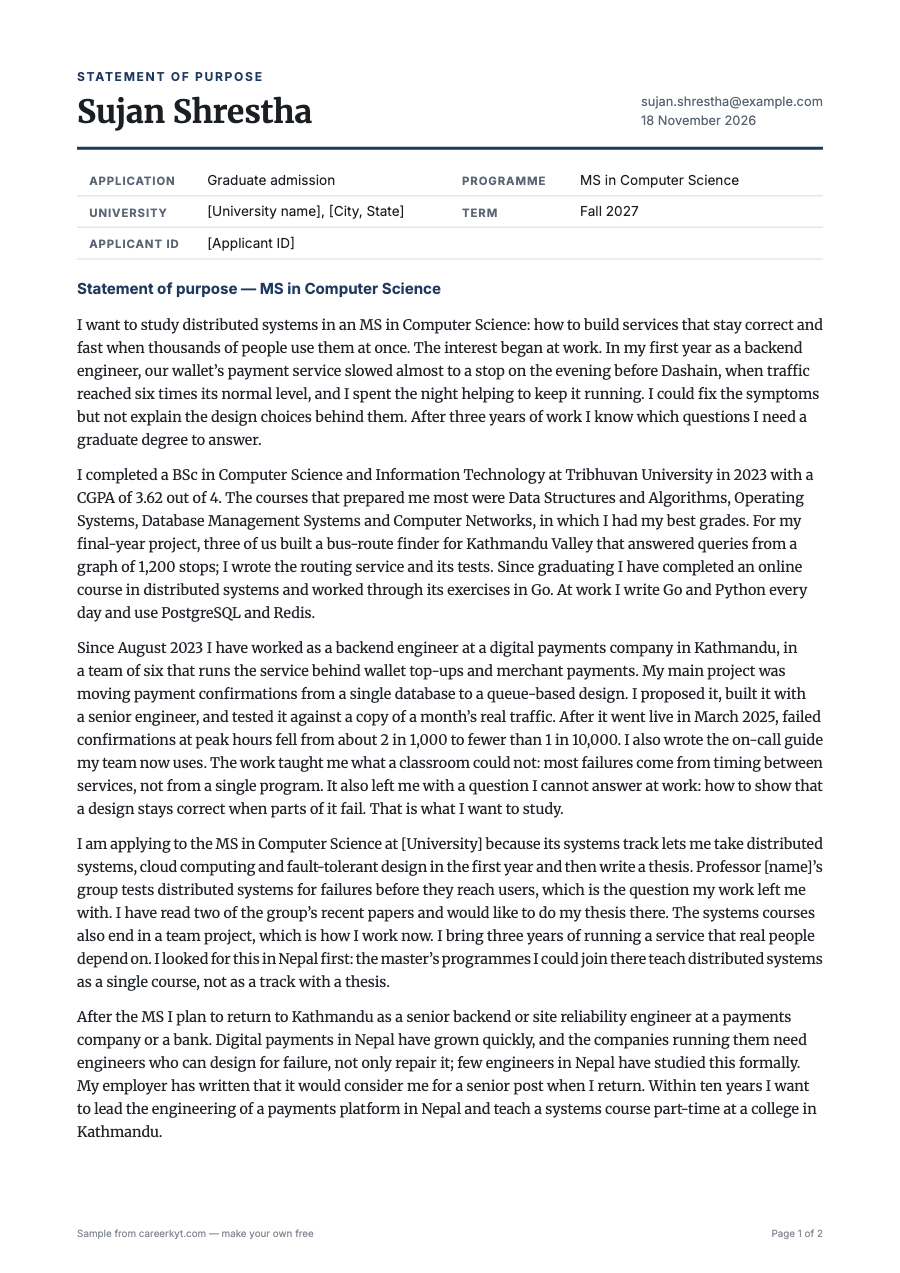
A complete statement of purpose for a made-up Nepali student, Sujan, a backend engineer applying for an MS in Computer Science. Its six parts are 103, 112, 154, 128, 97 and 41 words, 635 in all. Download the PDF or the Word file.
The maker above has two more: Anisha, a credit analyst from Ilam applying for an MBA, and Nirmala, a water-resources engineer applying for a funded PhD. Open “See examples” under any part and switch between them. Read them for the shape: each claim is a fact a document shows, and the university and professors are left as [placeholders] for you to fill. Then write yours about you.
How your SOP and the visa interview must agree
The visa process does not ask for your SOP, but the officer can ask about the same things: why this university, why this programme, who pays and what you will do after. Your DS-160 lists your education and work, and your I-20 shows your programme, its dates, the estimated cost and how it will be paid. Your answers at the window should tell the same story as all three, and as your statement.
- The same plan. If your SOP says you will return to a job in Kathmandu, do not tell the officer you hope to settle abroad, and do not invent ties the SOP never mentions.
- The same facts. Job titles, dates, grades and the programme’s name should match your CV, your DS-160 and your experience letter.
- Why this school, in your words. Name the courses or the professor that made you choose it, not a ranking or an agent’s list. The embassy urges students not to use visa consultancies to choose a university, and points them to USEF-Nepal.
- Who pays, exactly. An SOP usually says nothing about money; the officer will ask. Know the figure on your I-20, who your sponsor is and where their income comes from.
- Work after the degree. The embassy lists Curricular Practical Training, Optional Practical Training and the STEM extension as the off-campus work F-1 students may do after the first academic year. If you plan practical training, say so plainly, and say what comes after it.
- Family in the US. It does not rule you out, the embassy says, but you will need to show that you mean only to study.
- After a refusal. A student refused in Nepal is given a sheet with the reason circled. When you reapply, answer that reason. The embassy says a new university or major “is not likely on its own to be enough”.
The papers from Nepal behind each claim
Every fact in the statement should be one a document shows. For admission that means your transcripts and degree certificates (getting them from TU), a character certificate, an experience letter for any job you describe, training certificates, and recommendation letters from people who saw the work.
For the I-20 and the interview, USEF-Nepal says universities “generally” ask “for a bank statement and sponsor letter”. From Nepal that usually means a sponsor’s affidavit of support, a relationship certificate linking you to your sponsor, a salary certificate or business records, tax clearance, a bank balance certificate, and the student NOC the Ministry of Education issues to anyone going abroad to study. A figure in your SOP or at the interview that no document shows is the weak point.
What weakens a US statement of purpose
- Template text. Admissions readers see the same opening lines in many statements. USEF-Nepal’s advice is “Tell the truth” and to avoid clichés. The examples here show the shape; the words must be yours.
- Writing to the visa officer. “Dear Visa Officer” belongs on no US document. The SOP goes to a department; write it for the professors who will read it.
- Repeating the transcript. Your grades are already in the application. Name two or three courses and say what you did in them.
- A fit paragraph that fits anywhere. If it would work for any university, it says nothing. Name the courses, the lab or the professor.
- Australia’s rules. The four Genuine Student questions and their 150-word limit are Australia’s, for its visa form (SOP for Australia). Some guides for Nepali students mix the two countries up.
- Too long. Keep to the programme’s limit. Where it gives none, two pages is the norm. Cut adjectives first and facts last.
Common questions
Is an SOP required for a US student visa?
No. The F-1 visa process, from the I-20 and the SEVIS fee to the DS-160 and the interview, asks for no statement of purpose. US universities ask for one in graduate applications. At the interview the officer asks about the same things, so read your SOP again before you go.
What is the word limit for an SOP for USA?
There is no single limit; each programme sets its own. UC Berkeley suggests about 500 to 1,000 words, while Cornell, Illinois computer science and Carnegie Mellon computer science give one to two pages. If a programme states a limit in words or characters, that limit counts.
What is the format of an SOP for USA?
An essay of five or six paragraphs, with no headings unless the programme asks set questions. It covers what you want to study, how your studies prepared you, your research or work, why this programme, your goals, and anything that needs explaining. Put your name and the programme at the top.
Is there a sample SOP for USA in PDF?
Yes. A complete SOP for a made-up Nepali student applying for an MS in Computer Science is on this page as a PDF and a Word file, and the maker shows two more, for an MBA and a funded PhD. Use them for the shape only: your statement must describe your own work and match your own documents.
How do I write an SOP for an MS in Computer Science in the USA?
Name the area exactly, such as systems, machine learning or security. Describe one or two projects with your part and the result in numbers, name the courses or the professor’s group that fit, and say what job you want after. Illinois computer science also asks for a separate personal statement of up to 250 words.
Is an MBA SOP for the USA different?
Often the form is. Many MBA programmes ask their own essay questions in place of a general statement of purpose, usually about your goals and why that school. Answer their questions. The content is the same as in the maker here: the work you do, what you lack, and the job you want after.
What does the visa officer ask at the F-1 interview in Kathmandu?
There is no published list. The embassy says a student must show three things: that you mean to study, that you will leave the United States after your studies, and that you can pay. Applicants commonly report questions about the university, the programme, the sponsor and their plans. Answer them as your SOP does.
Should my SOP say I will come back to Nepal?
Say what you plan, plainly, in the goals paragraph: the job, and where. Do not fill the statement with your ties to Nepal. The university is reading for academic fit, and the visa interview is where the officer judges whether you intend to leave after your studies.
Should I take my SOP to the visa interview?
It is not one of the documents the visa process asks for. Take the documents that prove what it says, such as transcripts, test scores and financial papers. Read your SOP before you go, so that your answers match it.
More free tools
All free tools, by category. Writing something in Nepali? The CV maker, the निवेदन tool and the document tools are free too.
Last updated