Quick answer
A VAT bill (कर बीजक) in Nepal carries the bill number, the transaction and issue dates, the seller's PAN/VAT number, name and address, the buyer's name, address and PAN, the payment method, each item with its quantity, rate and amount, the taxable value, 13% VAT, the total, and the total in words — the layout of the Inland Revenue Department's own formats. A PAN bill is the same without the VAT lines. A registered business issues it from its numbered bill book or, if it bills by computer, only through software listed with IRD.
People look up a bill format for two reasons: a shop about to order its bill book, and someone who has to make one bill and wants it right. Both need the same thing — the fields a bill must carry — and the second also needs to know what a bill printed from a website or a spreadsheet is, and is not. This page sets out IRD's own layout, with three filled-in samples.
On this page
- VAT bill format: the fields IRD's format puts on it
- PAN bill format
- How to calculate VAT on a bill in Nepal
- Bill book or billing software: how a registered business may issue bills
- New since Shrawan 2083: hotel, gold, school and hospital bills
- Not registered? A plain bill, estimate or receipt
- Buying something: take the bill
VAT bill format: the fields IRD's format puts on it
The order below is the one the Inland Revenue Department uses in the bill formats it published on 30 Asar 2083. VAT Rules 2053, rule 17, is what makes a bill compulsory for every sale (IRD's notice of 26 Asar 2083).
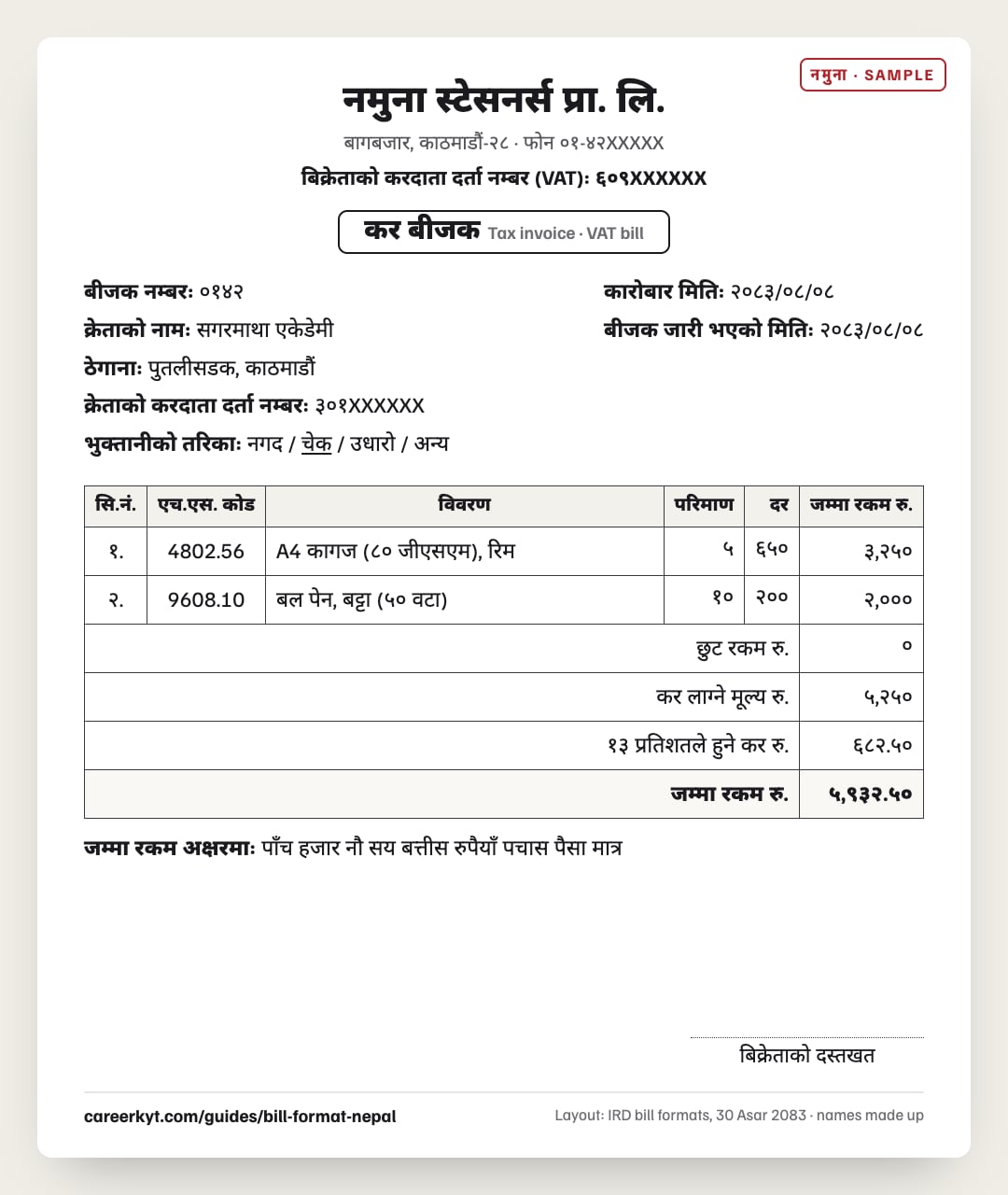
- बीजक नम्बर — the bill number, in an unbroken series
- कारोबार मिति and बीजक जारी भएको मिति — the date of the sale and the date of the bill
- बिक्रेताको करदाता दर्ता नम्बर — the seller's PAN/VAT number, with the seller's name, address and phone
- क्रेताको नाम, ठेगाना and क्रेताको करदाता दर्ता नम्बर — the buyer, with their PAN when they have one
- भुक्तानीको तरिका — नगद, चेक, उधारो or अन्य
- the items: सि.नं., एच.एस. कोड, विवरण, परिमाण, दर, जम्मा रकम
- छुट रकम (discount), कर लाग्ने मूल्य (taxable value), १३ प्रतिशतले हुने कर (VAT) and जम्मा रकम
- जम्मा रकम अक्षरमा — the total in words — and the seller's signature
PAN bill format
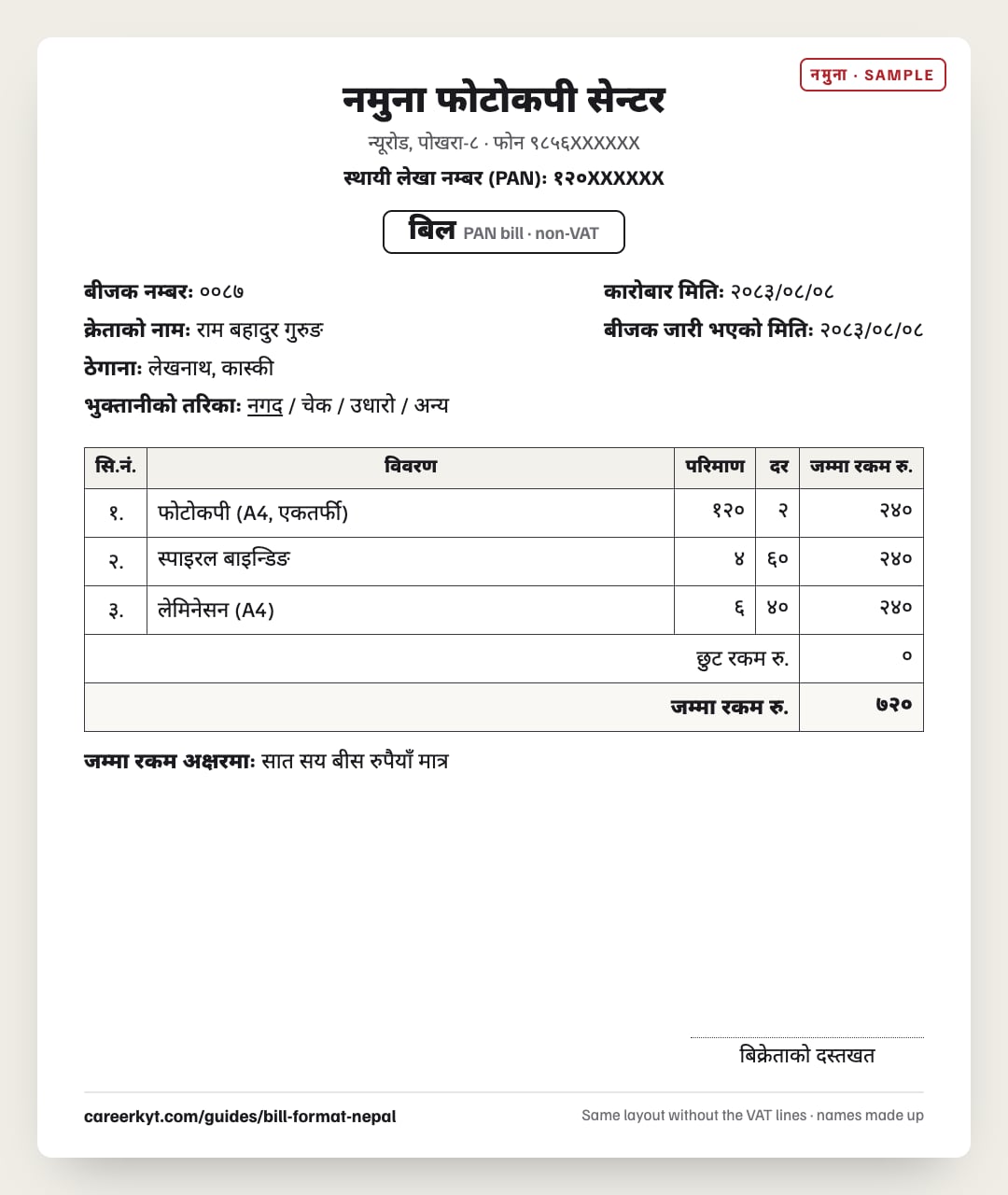
A business registered for income tax (PAN) but not for VAT issues a bill with the same fields and no VAT lines: the PAN at the top, the items, any discount, and the total in figures and words. It is headed बिल, not कर बीजक, and it must not show VAT — a business not registered for VAT cannot charge it.
How to calculate VAT on a bill in Nepal
VAT is 13% of the taxable value — the total after any discount. When a price already includes VAT, divide it by 1.13 to find the value before tax.
| Step | Worked out | Rs |
|---|---|---|
| Items | 5 reams × 650 + 10 boxes × 200 | 5,250.00 |
| Discount | none | 0.00 |
| Taxable value (कर लाग्ने मूल्य) | 5,250 − 0 | 5,250.00 |
| VAT at 13% | 5,250 × 0.13 | 682.50 |
| Total (जम्मा रकम) | 5,250 + 682.50 | 5,932.50 |
| Back from a VAT-inclusive price | 5,932.50 ÷ 1.13 | 5,250.00 |
Bill book or billing software: how a registered business may issue bills
A business issues bills either by hand from its serially numbered bill book, or by computer. Computer billing is only through IRD-listed software. IRD's e-billing notice of 3 Asar 2079 (under the VAT Act 2052, section 14क, and the Income Tax Act 2058, section 81(4)) says that anyone issuing invoices electronically must use only the devices and software listed with the Department, and needs IRD's permission to start.
For some businesses electronic billing is compulsory: turnover above Rs 10 crore a year (except banks and financial institutions that do not bill customers directly); hotels, restaurants and internet providers above Rs 5 crore; department stores, marts and flooring or furnishing shops above Rs 10 crore; and cinemas on the box-office system.
So a bill printed from a free website or a spreadsheet is not a VAT or PAN bill IRD recognises, whatever the site says. Use the samples here as the layout to give your printer for the bill book, or check IRD's list of billing software before buying a program.
New since Shrawan 2083: hotel, gold, school and hospital bills
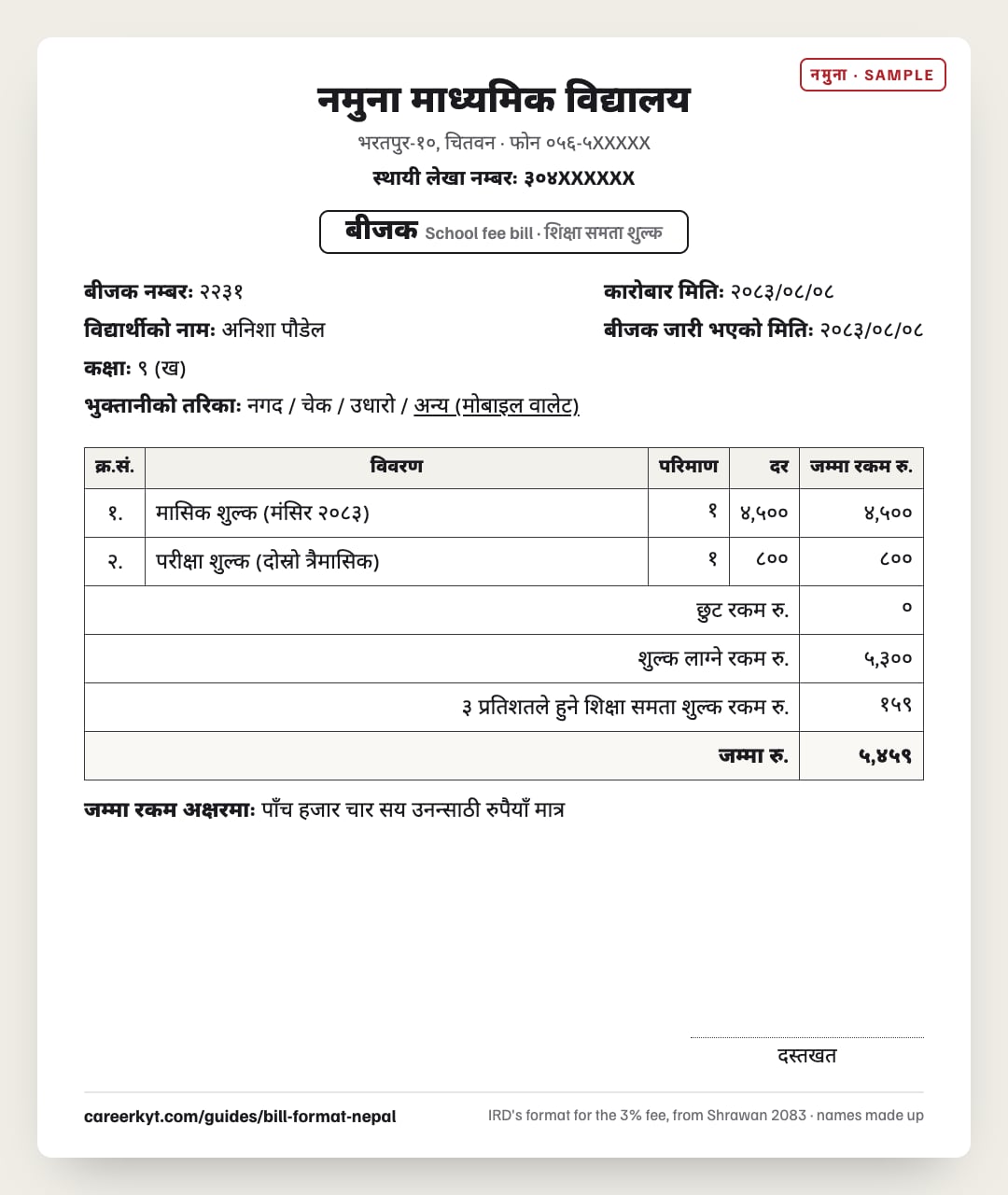
The Finance Act 2083 added four charges, collected from Shrawan 1, 2083, and on 30 Asar 2083 IRD published the bill format for each. Each one adds its own line above the VAT, or in place of it.
| Who | Charge on the bill | Finance Act 2083 |
|---|---|---|
| Hotels of five stars and above, luxury resorts; imported liquor sold in Nepal | 2% विलासिता शुल्क (luxury fee), then 13% VAT | Section 13 |
| Gold, silver and jewellery | 0.5% सिप प्रवर्द्धन शुल्क (skill-development fee), then 13% VAT; the making charge written in the item's description | Section 14 |
| Private schools and colleges | 3% शिक्षा समता शुल्क (education equity fee) on every fee, with the student's name and class on the bill | Section 16 |
| Private hospitals and health services | 3% स्वास्थ्य समता शुल्क (health equity fee) on every service fee | Section 17 |
Not registered? A plain bill, estimate or receipt
Someone not registered for PAN or VAT — a person selling something once, a tutor, a small job — can still give a written bill or receipt for what was paid. Our bill and quotation maker writes a plain bill, an estimate or a quotation with the total in words, and prints a line saying it is not a tax invoice; the receipt maker (भरपाई) records money received. Both are free and run in your browser.
Buying something: take the bill
IRD's notice of 26 Asar 2083 calls taking a bill the buyer's duty, and tax officers check for sellers who do not issue one. A VAT bill you take can also win a prize: IRD's taxpayer incentive draw picks winners from bills scanned in its app — see how the bill lottery works and check the winner list.
Common questions
How do I write a VAT bill in Nepal?
Write the bill number, the sale and issue dates, your VAT number, name and address, the buyer's name, address and PAN, the payment method, each item with quantity, rate and amount, any discount, the taxable value, 13% VAT, the total, and the total in words — then sign it. That is the order of IRD's own formats. Issue it from your numbered bill book or IRD-listed billing software.
How do I calculate VAT on a bill in Nepal?
Take the total after any discount and multiply by 0.13: on Rs 5,250 the VAT is Rs 682.50 and the bill is Rs 5,932.50. If a price already includes VAT, divide by 1.13 to get the value before tax.
What is the difference between a PAN bill and a VAT bill?
A VAT bill (कर बीजक) is issued by a VAT-registered business and charges 13% VAT on a separate line. A PAN bill comes from a business registered only for income tax: the same layout without the VAT lines, and it may not charge VAT.
Can I make a VAT bill in Excel or online?
Not one IRD recognises unless the program is on its list. IRD's e-billing notice says anyone issuing invoices electronically must use only the devices and software listed with the Department, with its permission. Otherwise issue bills from your printed, numbered bill book.
What is the education equity fee on school bills?
From Shrawan 1, 2083, private schools and colleges add a 3% शिक्षा समता शुल्क to every fee they collect from students (Finance Act 2083, section 16), shown on the bill in IRD's format with the student's name and class. Private hospitals add a 3% health equity fee the same way.
Is a bill compulsory for every sale?
Yes, for a registered business: IRD's notice of 26 Asar 2083 cites VAT Rules 2053, rule 17 — a bill must be issued for every supply of goods or services — and warns of action against sellers found not issuing them.
In this topic
Letters and applications
Formats and makers for the letters a job and an office ask for, in Nepali and English.
Applying
- Job application letter format
- जागिरको लागि निवेदन maker
- जागिरको निवेदन कसरी लेख्ने
- निवेदन (application) maker
- निवेदन लेख्ने तरिका
- Application for a character certificate
- Offer letter acceptance email and joining letter
- Recommendation letter
At work
- Leave application format
- बिदाको निवेदन maker
- Resignation letter format
- राजीनामा पत्र maker
- राजीनामा पत्र कसरी लेख्ने
- Appointment letter (नियुक्ति पत्र)
- Job offer letter
- Meeting minute (माइन्युट)
- माइन्युट लेख्ने तरिका
- प्रतिवेदन लेख्ने तरिका (report)
- Quotation (कोटेसन)
- VAT bill and PAN bill format
- Purchase order (खरिद आदेश)
- Work order (कार्यादेश)


